 Globe Quest
 Human Quest · LearningSign in
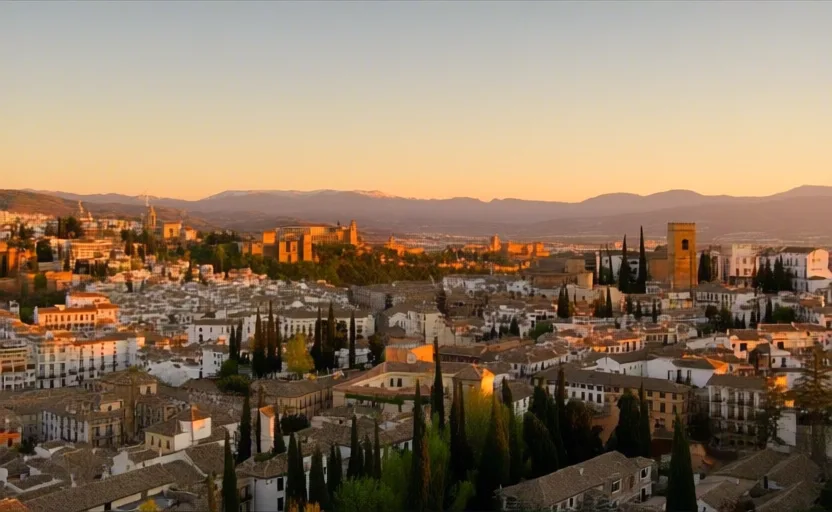 Granada · AI city illustration · Artistic impression
City · Europe
Granada
Also known as Gharnata, غرناطة
Saved in this browser — no account needed. Sign in later and it comes with you.
Where it is
Snow-fed rivers make Granada. The city lies at an average of 738 m, at the foot of the Sierra Nevada and about 50 km from the Mediterranean coast, on a fertile basin called the Vega de Granada. Four rivers meet there: the Darro, Genil, Monachil and Beiro. Their water, running down from the mountains, irrigates the plain and turned a hill town into a capital. The climate is hot-summer Mediterranean, close to cold semi-arid. Summers are hot and dry, winters cool and damp, and frost is common at dawn from November to January.
The land and water around it
The Vega de Granadaplain
A basin of fertile soil within the Baetic mountain ranges, continuing westward through Archidona and Antequera and eastward through Guadix and Baza. Streams from the Sierra Nevada irrigate it, and it is drained by the Genil, which crosses the city from east to west.
The Sierra Nevadamountains
The range above the city supplies the water on which the plain depends. It also hosts a ski station, where the 1996 alpine world championships took place, within reach of a city that is itself at 738 m.
The Sabika and Albayzín hillsvalley
Two adjacent hills divided by the Darro. The Alhambra stands on the Sabika outcrop of the Sierra Nevada, and the Albayzín spreads across the hill north of it. Together they form the medieval part of the city above the modern lower town.
Its history, in short
Iberians founded a hill settlement here around 650 BC, which became the Roman town of Iliberis. Granada in the form we know it appears in the Islamic period, when a mainly Jewish fortress-settlement on the south side of the Darro stood near the larger town of Madīnat Ilbīra. It rose to prominence in the 11th century under the Zirid taifa, and after the Almohad collapse it was the capital of the Nasrid dynasty, whose emirate was the last Muslim-ruled state in the peninsula. The Nasrids survived by paying tribute to Castile and using its quarrels to their own advantage, and they built the Alhambra. Boabdil surrendered on 2 January 1492 to the Catholic Monarchs, who allowed Muslims to keep their faith for a time and then forced Jews to convert or leave. In the 16th century the city was made Christian: a cathedral was built over the main mosque, and the Royal Chapel became the monarchs’ burial place. In the 17th century the population stagnated at about 55,000. French troops occupied the Alhambra in 1810–1812 and tried to blow it up, and in 1830 Washington Irving’s tales of the place drew foreign attention to it.
Timeline
Dates are shown on a timeline rather than as changing shapes on the map. The globe draws modern boundaries only, and tinting a modern outline to stand for a historical one would state something we cannot source.
Classical world
c. 650 BCE
Ilturir
The Iberian Bastetani tribe founds an oppidum known as Ilturir, later Iliberri or Iliberis, where Granada now stands.
Approximate dateWikipedia44 BCE
A Roman colony
Iliberis becomes a Roman colony, and in 27 BCE a municipium named Florentia Iliberritana. Scholars still debate how far today’s Granada continues the Roman town.
Well attestedWikipedia
Post-classical world
11th century
Capital of a Zirid taifa
Under the Zirid taifa the town rises to prominence within Al-Andalus. Its name Ġarnāṭa is attested in Arabic sources since the 10th century, but its meaning is uncertain.
Approximate dateWikipedia1246
The Nasrid emirate
Ibn al-Ahmar, founder of the Nasrid dynasty, agrees to become a vassal of Ferdinand III of Castile. Granada then becomes a tributary state, though the arrangement was repeatedly broken by war.
Well attestedWikipedia
Early modern & oceanic
2 January 1492
The surrender
Emir Muhammad XI, called Boabdil, surrenders the emirate to Ferdinand and Isabella after the Granada War. The treaty lets Muslims keep their faith and customs. The Alhambra Decree on 31 March forces all Jews in Spain to convert or leave.
Well attestedWikipedia13 September 1504
Royal burial place
The Catholic Monarchs choose Granada for their burial by royal decree, which leads to the building of the Royal Chapel.
Well attestedWikipedia
Industrial & imperial
1810–1812
French occupation
Napoleon’s army occupies the Alhambra as a fortified position. As the troops leave they blow up eight towers, and only the cutting of the remaining fuses by a Spanish soldier saves the rest.
Well attestedWikipedia1830
Irving’s Alhambra
Washington Irving lives in Granada and writes Tales of the Alhambra, reviving international interest in southern Spain and its Islamic-era monuments.
Well attestedWikipedia
Places that carry meaning
The Alhambra and Generalife13th–14th centuries
A Nasrid citadel and palace complex, the sole surviving palace-city of the Islamic age, with the Generalife gardens and farms to the east as a rural residence of the emirs. Its irrigation engineering made the palaces and gardens possible.
The AlbayzínMedieval
The residential district on the north hillside, where the city began. It keeps its narrow streets and small squares, and Nasrid and Christian buildings stand side by side.
Cathedral and Royal Chapel16th century
The cathedral was built over the Nasrid Great Mosque, and the Royal Chapel holds the burial place chosen by the Catholic Monarchs in 1504. Both mark the conversion of the city from Muslim to Christian.
Languages here
Places are usually multilingual. This lists what is actually spoken, not one language per border.
SpanishRomance family
The language of the city today.
About 15% of residents were born abroad as of 2025, mainly in Latin America and Morocco. Morocco, Colombia, Venezuela, Argentina and Bolivia are the five largest countries of origin.
ArabicSemitic family
The language of the Nasrid emirate and of the city’s Muslim population until the 16th century.
The city’s historical name, Ġarnāṭa, is Arabic. After the 1492 treaty the Muslim inhabitants were allowed to keep their customs, but in the 16th century the city was progressively remade as a Christian one.
Learn the language here
- 1Understand which languages are spoken hereGranada is multilingual. Start with which languages are used, by whom, and for what — the phrase list only covers one of them.Written by Globe Quest
- 2Learn 11 phrasesCurated everyday phrases for Granada, with audio and a written form.Written by Globe Quest
- 3Say them out loudSpeaking practice with pronunciation feedback, one phrase at a time.Globe Quest material, your own additions
- 4Come back to themSpaced review, so what you learned this week is still there next month.Written by Globe Quest
- 5Practise with people: Arabic practice · DohaAn in-person practice circle. It is a prepared plan and needs a host before it runs.Run by members
Check yourself
What made the Nasrid Emirate of Granada distinctive?
It was the last Muslim-ruled state in the peninsula
The Nasrids ruled from the 13th century until the surrender of 1492, surviving partly as tributaries of Castile.
Why could a large city grow on the Vega de Granada?
Streams from the Sierra Nevada irrigate the plain
The city sits at 738 m and 50 km from the sea. Its wealth came from mountain water feeding an irrigated plain, not from trade by water.
Worth arguing about
- The Alhambra was nearly destroyed in 1812 and rescued partly by tourists’ interest. What does it mean for a monument that its fame depends on outsiders?
- After 1492 the city was remade as Christian over a century. How should a city that changed its religion remember what it replaced?
What we have not established
These are open questions, listed rather than filled in. We would rather show a gap than a plausible guess.
Is Granada a continuation of Roman Iliberis?
Excavations on the Albaicín hill show a significant Roman town, but little is known of the period between the end of Roman rule and the 11th century, so scholars still debate whether the two settlements are one place.
Sources
- Wikipedia · GranadaWikipedia · encyclopedia · checked 2026-11-24
- UNESCO · Alhambra, Generalife and Albayzín, GranadaUNESCO World Heritage Centre · intergovernmental · checked 2026-11-24
Reviewed by Globe Quest editorial on 2026-11-24. Drafted with AI assistance and checked against the sources above before publication.