 Globe Quest
 Human Quest · LearningSign in
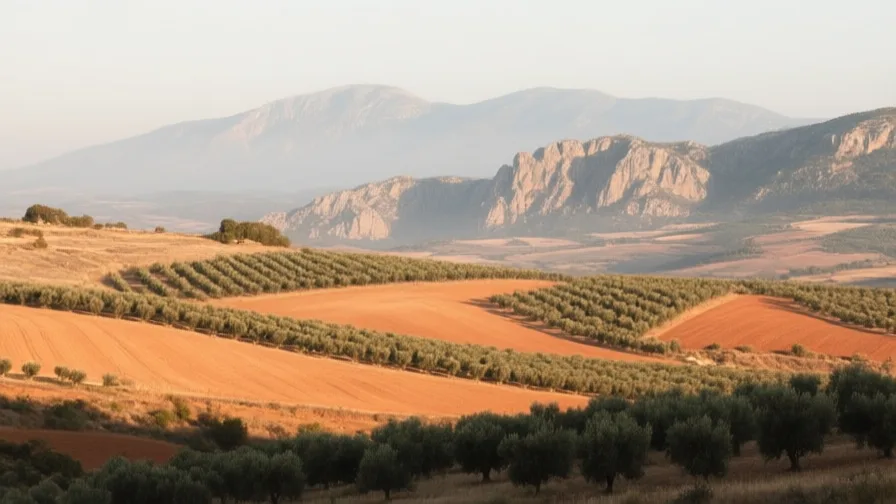 Spain · AI landscape illustration · Artistic impression
Country · Europe
Spain
Saved in this browser — no account needed. Sign in later and it comes with you.
Where it is
Spain fills about 85% of the Iberian Peninsula, in the southwest corner of Europe, with the Atlantic on one side and the Mediterranean on the other and the Pyrenees, 435 km long, as its wall against France. The land is high: the average altitude is about 650 m, and the interior is a mass of plateaus and mountain chains rather than lowland. The climate follows the relief. A dry steppe climate covers much of the interior, a maritime climate with abundant rain runs along the north, and a hot, dry-summer Mediterranean climate dominates elsewhere. The country also holds the Balearic and Canary Islands and two cities on the African coast, Ceuta and Melilla.
The land and water around it
The high interiorplateau
Mainland Spain is dominated by high plateaus and mountain chains, with an average altitude of 650 m. The interior’s dry steppe climate has low and irregular rainfall, hot, cloudless summers and cold winters. The Ebro basin shares the same dry climate.
The Pyrenees and the mountain rangesmountains
The Pyrenees stretch for 435 km between the Mediterranean and the Bay of Biscay and form the border with France and Andorra. Other chains, including the Cantabrian, Iberian, Central and Baetic systems, cross the peninsula. Mulhacén, in the Sierra Nevada, at 3,478 m is its highest point.
The islands and Teidevolcano
The Balearic Islands lie in the Mediterranean and the Canary Islands in the Atlantic. On Tenerife, Mount Teide is an active volcano and the highest point in Spain.
Its history, in short
Greeks, Phoenicians and Carthaginians traded and settled along the coast before Rome expelled Carthage in 206 BC and took two centuries to conquer the whole peninsula. Roman Hispania left the country its name, its language and its roads. Visigothic kingdoms centred on Toledo gave way after 711 to Al-Andalus, ruled from Córdoba, and from the north the Christian kingdoms of Asturias, León, Castile, Navarre and Aragon pushed south in the Reconquista. The marriage of the Castilian and Aragonese monarchs and the conquest of Granada in 1492 brought the long process to its close, and the same year Columbus sailed under Isabella’s patronage, starting an overseas empire. The Habsburgs and then the Bourbons governed it, the latter after the War of the Spanish Succession. The 19th century saw the loss of most American colonies and the war against Napoleonic France. The Civil War of 1936–1939 led to a dictatorship under Franco, which lasted until 1975. Democracy, a decentralised state of autonomous communities and membership of the European Community in 1986 followed. Spain’s centralised and regional identities have never fully been reconciled, as the Catalan referendum of 2017 showed.
Timeline
Dates are shown on a timeline rather than as changing shapes on the map. The globe draws modern boundaries only, and tinting a modern outline to stand for a historical one would state something we cannot source.
Post-classical world
711–718
The Muslim conquest
Forces from across the Strait of Gibraltar conquer nearly all of the peninsula in a few years and bring the Visigothic Kingdom down. Just one pocket of the northern mountains is left outside, and the Kingdom of Asturias-León consolidates there.
Well attestedWikipedia
Early modern & oceanic
1469–1479
Castile and Aragon unite
The marriage of Isabella I of Castile and Ferdinand II of Aragon joins the crowns in 1469. Their dynastic union in 1479 is often seen as the de facto beginning of Spain as a nation state, though the two crowns kept separate institutions for centuries.
Approximate dateWikipedia1492
Granada, Columbus and the expulsion
The Nasrid kingdom of Granada, the last Muslim state in Iberia, falls. Jews are forced to convert or leave, with as many as 200,000 expelled from Castile and Aragon, and Columbus reaches the New World on a voyage funded by Isabella.
Well attestedWikipedia
Industrial & imperial
1808–1814
The Peninsular War
Spain fights Napoleonic France, and in the same years most of its American territories rebel. By the 1820s the Spanish Empire has lost almost all its mainland holdings in the Americas.
1936–1939
The Civil War
A military coup in July 1936 divides the country into a Republican zone and a Nationalist zone. Nazi Germany and Fascist Italy back the Nationalists, while the Soviet Union and Mexico back the Republic. The war ends in a Francoist dictatorship.
Well attestedWikipedia
Contemporary
1975
Franco’s death
Juan Carlos succeeds as king and head of state. The restoration of democracy follows, along with a new constitution in 1978 that recognises the autonomy of regions.
Well attestedWikipedia1986
Joining the European Community
Membership of what is now the European Union is followed by a long boom. Foreign investment triples from 1990 to 2000, and Spain adopts the euro in 2002.
Well attestedWikipediaOctober 2017
The Catalan referendum
The Parliament of Catalonia votes to declare independence after a referendum. The Spanish Senate approves direct rule over Catalonia, and the Spanish prime minister dissolves the Catalan parliament and calls new elections. No country recognises Catalonia as a state.
DisputedWikipediaCatalan pro-independence parties, who say the vote created a republic, and the Spanish government and Senate, which rejected the declaration and imposed direct rule
Places that carry meaning
AtapuercaFrom about 1.3 million years ago
The cave site where flint tools and early human fossils show that hominids lived in Western Europe over a million years ago, among the earliest evidence on the continent.
Altamirac. 15,000 BCE
A cave in northern Spain whose paintings are the clearest sign of prehistoric settlement in the country.
GranadaUntil 1492
Capital of the last Muslim-ruled state in the peninsula, whose surrender in 1492 closed the Reconquista.
Languages here
Places are usually multilingual. This lists what is actually spoken, not one language per border.
SpanishRomance family
The official language of the whole state, in the constitution called castellano.
Spanish has been the effective official language across the country since 1931, and only Mandarin has more native speakers worldwide. Speakers’ rights apply across the entire territory.
Catalan or ValencianRomance family
Co-official in Catalonia, the Balearic Islands and the Valencian Community.
The same language carries the name Catalan in Catalonia and the Balearics and Valencian in the Valencian Community. It is the first language of about one Spaniard in ten, and is also spoken, though not official, in a strip of eastern Aragon and in the Carche area of Murcia.
GalicianRomance family
Co-official, and the majority language of Galicia.
Galician is the first language of nearly 4% of the population and is also heard in neighbouring parts of Asturias and Castile and León. Along with Catalan, it is the main language of its regional government and local administrations.
Basque
Co-official in the Basque Country and parts of northern Navarre.
Basque is a language isolate with no demonstrable relative, and the sole official language in Spain outside both the Romance and Indo-European families. Around 1.4% of the population speak it first. Aranese, a register of Occitan, is co-official in Catalonia’s Val d’Aran.
Protected and immigrant languages
Legally protected but not co-official, plus the tongues of recent arrivals.
Aragonese, Asturian and Leonese are protected: they may be taught as optional subjects but are not official. Immigration has added Arabic, Romanian, English, Chinese and Ukrainian, and roughly one resident in five was born abroad, mostly outside the EU and above all in Latin America.
Learn the language here
Check yourself
How does the Spanish Constitution treat regional languages?
They are co-official with Spanish in their own autonomous communities
Spanish is official everywhere, and other languages may be co-official only inside their communities, which creates an asymmetry between speakers’ rights.
Which events does the year 1492 bring together?
The fall of Granada, the expulsion of the Jews and Columbus’s voyage
The end of Muslim rule in the peninsula, the forced conversion or expulsion of Jews and the first voyage funded by Isabella all fall in a single year.
Worth arguing about
- A single year ended Muslim rule, expelled the Jews and opened the Atlantic world. Which of the three changed the country most?
- Spain gives regional languages and governments real power, yet the 2017 Catalan crisis showed the limits. Where should a country draw the line on autonomy?
What we have not established
These are open questions, listed rather than filled in. We would rather show a gap than a plausible guess.
How tall is Mount Teide, and how many Spanish residents were born abroad?
The text gives Teide as 3,715 m in one place and 3,718 m in another, and the share of residents born abroad as 19.3% in one section and 20.3% in another, both for January 2026, so exact figures remain unsettled.
Sources
- Wikipedia · SpainWikipedia · encyclopedia · checked 2026-11-24
- Wikipedia · History of SpainWikipedia · encyclopedia · checked 2026-11-24
- Wikipedia · Geography of SpainWikipedia · encyclopedia · checked 2026-11-24
- Wikipedia · Languages of SpainWikipedia · encyclopedia · checked 2026-11-24
Reviewed by Globe Quest editorial on 2026-11-24. Drafted with AI assistance and checked against the sources above before publication.