 Globe Quest
 Human Quest · LearningSign in
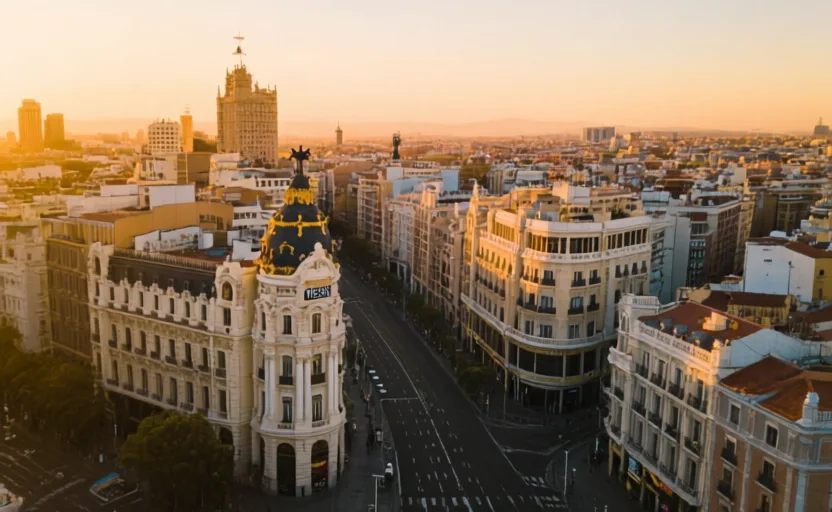 Madrid · AI city illustration · Artistic impression
City · Europe
Madrid
Saved in this browser — no account needed. Sign in later and it comes with you.
Where it is
Spain’s capital is an inland city, and that is the point of it. It lies near the middle of the Iberian Peninsula at about 660 m above sea level, on a modest river, the Manzanares, which is a small river for a city of this size. Madrid is not a port, and its growth came from a decision rather than from trade. It began as a walled outpost in the 9th century, became a court town in the 16th, and has been the centre from which a mountainous, plateau-heavy country is governed ever since.
The land and water around it
The Manzanaresriver
The river beside which the first fortified outpost was built, on its left bank. It is small by capital-city standards, and the city’s size owes nothing to it. The Madrid of the 9th century was placed here for defence, not for water-borne trade.
The high interiorplateau
Madrid sits at about 660 m in the centre of a peninsula whose mainland is a mass of high plateaus and mountain chains. From that central position the court governed a realm that stretched far beyond the peninsula.
Its history, in short
Madrid’s documented story starts in the second half of the 9th century, when the Emirate of Córdoba built a walled military outpost on the left bank of the Manzanares. Christian forces took it in 1083 or 1085, and over the following centuries it grew into a middling town of the Crown of Castile. Everything changed in 1561, when Philip II settled the court there. It held perhaps 20,000 people then and approached 100,000 by the century’s end. When the court spent five years at Valladolid, from 1601, the city is said to have lost half its people; it came back after the king accepted money from the town to help pay for the return. The 17th century brought the writers and painters of the Golden Age, among them Cervantes, Lope de Vega and Velázquez. Charles III’s reign in the 18th century left the Prado and the Puerta de Alcalá. On 2 May 1808 the people of Madrid rose against French troops, an uprising Goya later painted. A capital made by royal decision then became a financial and administrative centre as well, one of the largest metropolitan areas in the European Union.
Timeline
Dates are shown on a timeline rather than as changing shapes on the map. The globe draws modern boundaries only, and tinting a modern outline to stand for a historical one would state something we cannot source.
Post-classical world
Second half of the 9th century
A walled outpost on the Manzanares
The Emirate of Córdoba builds a fortified military settlement on the left bank of the river. This is the earliest documented core of the city.
Approximate dateWikipedia1083 or 1085
Taken by Christian forces
The town passes into the hands of the Crown of Castile. Accounts differ on whether this happened in 1083 or in 1085.
Approximate dateWikipedia
Early modern & oceanic
1561
The court settles in Madrid
Philip II moves the court to Madrid. No formal decree makes Madrid the capital, but the seat of the court becomes the capital in practice, and the population rises towards 100,000 by 1600.
Well attestedWikipedia1601–1606
The capital leaves, then returns
The court moves to Valladolid, and the city loses perhaps half its population, with an estimated 50,000 to 60,000 people leaving. Madrid slides into a deep cultural and economic crisis, and the court comes back after the town offers additional ducats.
Well attestedWikipedia1739
Building the new Royal Palace
Philip V begins constructing a new palace, which is completed under Charles III. His reign is also credited with the Prado and the Puerta de Alcalá.
Well attestedWikipediaMarch 1766
The Esquilache riots
A subsistence crisis, rising oil prices linked to new street lighting and a ban on the long cape and wide-brimmed hat set off mass riots against the king’s Sicilian minister.
Well attestedWikipedia
Industrial & imperial
2 May 1808
Dos de Mayo
Napoleon’s troops have entered the city. When French soldiers try to remove members of the royal family from the palace, a crowd attacks them. Hundreds of Spaniards and French soldiers are killed, and the artillery barracks at Monteleón is defended until its commanders die.
Well attestedWikipedia
Places that carry meaning
Paseo del Prado and Buen Retiro16th–18th centuries
A tree-lined avenue, a royal park (the Buen Retiro gardens, founded in 1631) and a botanical garden, joined into a 200-hectare landscape that also holds museums and research institutions. It was inscribed as a World Heritage Site for the way it used green space and public science as city-making, an idea later copied in Spanish America.
The Royal PalaceFrom 1739
Begun under Philip V and finished by Charles III, it is the grandest product of the period when the city was rebuilt as a royal capital.
The Golden Triangle of ArtPaseo del Prado
Three major museums along the Paseo del Prado: the Prado, the Reina Sofía for modern art, and the Thyssen-Bornemisza, which complements the other two. They sit along the same avenue, one of the best-known art districts in Europe.
Languages here
Places are usually multilingual. This lists what is actually spoken, not one language per border.
SpanishRomance family
The everyday language of the city and the country’s official language.
The Madrid variety belongs to Peninsular Spanish and sits between the northern and southern dialects. The city is also a centre of linguistic prescriptivism, being the seat of the Royal Spanish Academy, whose rulings set the standard for written Spanish. Many of the country’s largest groups of newcomers come from Latin America, so for them there is no language switch.
Catalan, Galician and Basque
Co-official languages in other regions, and first languages of Spaniards living in the capital.
These are regional languages with co-official status in their own communities. Nationally, Catalan or Valencian is the first language of 10.5 per cent of people, Galician of 3.8 and Basque of 1.4. Basque is the only official language of Spain that is not Romance. Shares of these speakers inside Madrid are not given.
Arabic, Romanian, English, Chinese and Ukrainian
The main languages brought by recent immigrants to Spain, a national picture rather than a count for Madrid.
Across Spain, newcomers have added speakers of Arabic, Romanian, English, Chinese and Ukrainian to the population. Spanish itself is used by about 99 per cent of people nationally, as a first or second language.
Learn the language here
- 1Understand which languages are spoken hereMadrid is multilingual. Start with which languages are used, by whom, and for what — the phrase list only covers one of them.Written by Globe Quest
- 2Learn 12 phrasesCurated everyday phrases for Madrid, with audio and a written form.Written by Globe Quest
- 3Say them out loudSpeaking practice with pronunciation feedback, one phrase at a time.Globe Quest material, your own additions
- 4Come back to themSpaced review, so what you learned this week is still there next month.Written by Globe Quest
Check yourself
What turned Madrid from a middling town into a capital?
Philip II settled the royal court there in 1561
Madrid had no obvious commercial advantage. The decision to station the court there in 1561 produced a capital where none had been, and the five years at Valladolid showed how dependent the city was on it.
What happened in Madrid on 2 May 1808?
A crowd rose against French troops removing royal family members
The uprising against the French occupation, remembered as Dos de Mayo, left a lasting mark on how French rule was seen in Spain.
Worth arguing about
- Madrid is a capital that was chosen rather than a city that grew into the role. What does a capital with no obvious geographic reason to exist owe the country that made it?
- The 1601 move to Valladolid halved the city almost overnight. How much of a capital’s economy is really the court?
What we have not established
These are open questions, listed rather than filled in. We would rather show a gap than a plausible guess.
Where does the name Madrid come from?
Several theories exist, but none fully explains how the sound of the name changed over time, so the origin remains unknown.
Sources
- Wikipedia · MadridWikipedia · encyclopedia · checked 2026-11-24
- Wikipedia · History of MadridWikipedia · encyclopedia · checked 2026-11-24
- UNESCO · Paseo del Prado and Buen Retiro, a landscape of Arts and SciencesUNESCO World Heritage Centre · intergovernmental · checked 2026-11-24
- Wikipedia · SpainWikipedia · encyclopedia · checked 2026-11-24
- Wikipedia · Languages of SpainWikipedia · encyclopedia · checked 2026-11-24
Reviewed by Globe Quest editorial on 2026-11-24. Drafted with AI assistance and checked against the sources above before publication.