 Globe Quest
 Human Quest · LearningSign in
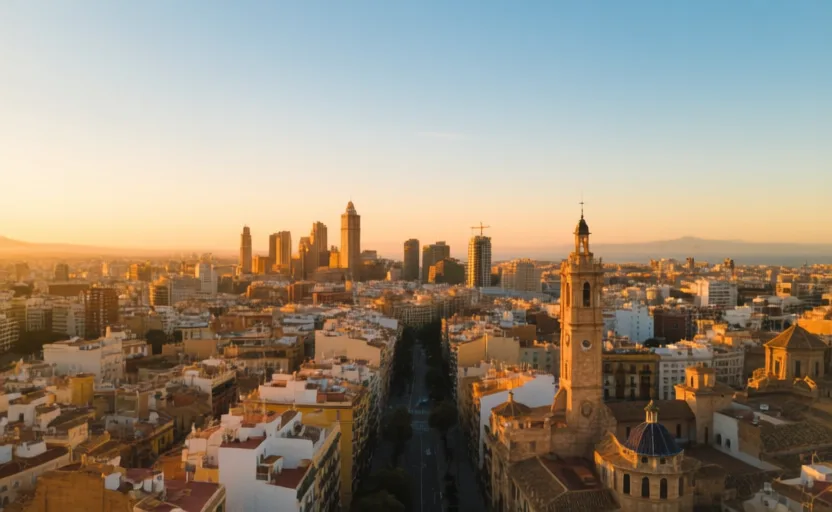 Valencia · AI city illustration · Artistic impression
City · Europe
Valencia
Also known as València, Balansiya
Saved in this browser — no account needed. Sign in later and it comes with you.
Where it is
Where the Turia once spread across its lower floodplain, a bed of fertile alluvial silt has been laid down along the western Mediterranean, facing the Gulf of Valencia. The city stands on that silt. When the Romans founded it, it lay several kilometres from the sea on the plain, and 12 kilometres to the south the Albufera lagoon, once salt water and now fresh, still feeds rice paddies. The climate sits on the border between semi-arid and Mediterranean: mild winters, hot dry summers, about 2,733 hours of sunshine a year, and the heaviest rain in autumn, when cut-off lows can bring torrential downpours. Floods in October 1957 and October 2024 show how far that varies.
The land and water around it
The Turia floodplainriver
The river laid the silts that make the land so fertile, and the Romans first settled on an island in its channel. In the Islamic period the city was called Madinat at-Turab, read either as the city of earth or the city of sands, because of the river’s deposits.
The Albuferalagoon
A coastal lagoon about 12 kilometres south of the centre, cut off from the sea over time, which turned it from salt water to fresh and has slowly shrunk it. It is used for rice growing, hunting and fishing, and covers 21,120 hectares as a natural park. The city council bought it from the Crown in 1911 for 1,072,980 pesetas.
The Gulf of Valencia coastcoast
Facing the western Mediterranean, the coast gave the city its trade with Italian ports and its exposure to Barbary raiders. It also moderates the winters, which are among the mildest in Europe, helped by a warm downslope wind called the ponentà.
Its history, in short
Roman veterans founded Valentia in 138 BC on a river island near the sea, and Pompey razed it in 75 BC. The Church held the city when imperial authority collapsed, and the Visigoths made it a bishop’s seat. It surrendered to Muslim forces about 714 and, as Balansiya, prospered as a trading centre from the 10th century, with new irrigation systems and crops. El Cid took the city in 1094, but the Almoravids retook it in 1102, and in 1238 James I of Aragon conquered it, forcing 50,000 Muslims to leave. The 15th century was a golden age: Genoese traders had introduced mulberry growing and silk techniques, a municipal bank opened in 1407, and by 1500 Valencia was the biggest city in the Crown of Aragon and one of the largest in Europe, as well as a major slave-trading centre. The 1391 pogrom had already destroyed the Jewish quarter. Trade then moved to the Atlantic, pirates raided the coast, and the expulsion of the Moriscos in 1609 deepened the crisis. In the 18th century it became a major silk-manufacturing centre. During the Civil War it was the seat of the government from 1936 to 1937. Today about one in four residents was born abroad.
Timeline
Dates are shown on a timeline rather than as changing shapes on the map. The globe draws modern boundaries only, and tinting a modern outline to stand for a historical one would state something we cannot source.
Classical world
138 BCE
A colony of veterans
The consul Decimus Junius Brutus Callaicus settles about 2,000 soldiers who had served under him at Valentia Edetanorum. Pompey razes the town in 75 BCE and it is rebuilt around fifty years later.
Approximate dateWikipedia
Post-classical world
c. 714
Islamic rule begins
The city surrenders without resistance to the arriving Berbers and Arabs. As Balansiya it grows into a trading centre from the tenth century, and its surroundings gain new irrigation systems and crops.
17 June 1094
El Cid enters
After a siege the city surrenders to the Castilian El Cid, who forms his own principality there. The Almoravids take it back in 1102.
28 September 1238
Conquest by James I
James I of Aragon takes the city after a siege, and 50,000 Muslim residents are forced to leave. Valencia becomes the capital of the Kingdom of Valencia.
Well attestedWikipedia1391
Pogrom in the Jewish quarter
A wave of anti-Jewish violence that began in Seville reaches Valencia. Thousands of Jews are killed, survivors are forced to convert and the quarter is destroyed.
Well attestedWikipedia
Early modern & oceanic
From 1483
The Silk Exchange
The city council begins the Lonja de la Seda under the architects Pere Compte and Joan Ivarra. It houses a trading hall and the Taula de Canvis, the municipal bank set up in 1407.
Well attestedUNESCO World Heritage Centre1609
Expulsion of the Moriscos
Spain expels the descendants of the Muslims who had converted to Christianity. Economic activity in the city suffers a crisis in the aftermath.
Well attestedWikipedia
Industrial & imperial
1936–1937
Seat of the government
During the Spanish Civil War, Valencia serves as the provisional seat of the Spanish government.
Well attestedWikipedia
Places that carry meaning
La Lonja de la SedaBuilt from 1483
A late Gothic merchants’ exchange, inscribed by UNESCO as a well-preserved secular building. Its hall roofs spiral columns almost 16 metres high, and an inscription warns merchants against usury.
The Jewish quarter1239–1391
Jews were assigned a quarter in 1239, walled in 1390 and given a cemetery just beyond one of its three gates. Jews were about 7% of the population when James I took the city. The pogrom of 1391 destroyed the quarter.
The Port of ValenciaMedieval to present
The harbour that tied the city to Italy and the Mediterranean in the fifteenth century now handles more container traffic than almost any other port in Europe or the Mediterranean.
The City of Arts and SciencesModern
A complex designed by Santiago Calatrava and Félix Candela, in a city whose landmarks otherwise date largely from the Late Middle Ages.
Languages here
Places are usually multilingual. This lists what is actually spoken, not one language per border.
Spanish
The predominant language of daily life in the city, and co-official.
In a 2019 survey commissioned by the local government, 76% of residents said they use only Spanish in daily life. About 26.5% of residents are immigrants, with the largest groups born in Colombia, Venezuela, Argentina, Ecuador and Ukraine.
Valencian
The co-official local language, and the language of the city’s name, València.
Only 1.3% of the 2019 respondents use Valencian alone, and 17.6% use both languages. Under a 1983 regional law the city counts as Valencian-speaking territory for schooling, and since 1993 street signs have been in Valencian only. The local variety is called apitxat, and the Acadèmia Valenciana de la Llengua approved the spelling València.
Learn the language here
- 1Understand which languages are spoken hereValencia is multilingual. Start with which languages are used, by whom, and for what — the phrase list only covers one of them.Written by Globe Quest
- 2Learn 11 phrasesCurated everyday phrases for Valencia, with audio and a written form.Written by Globe Quest
- 3Say them out loudSpeaking practice with pronunciation feedback, one phrase at a time.Globe Quest material, your own additions
- 4Come back to themSpaced review, so what you learned this week is still there next month.Written by Globe Quest
Check yourself
What trade was the Lonja de la Seda built for?
Silk
The Lonja was begun in 1483 for the silk trade, which is why it is called the Silk Exchange. Genoese merchants had helped establish mulberry cultivation and silk techniques around the city.
In a 2019 survey, what share of Valencia’s residents said they used only Spanish in daily life?
76%
Spanish dominates in the city proper, even though Valencian is co-official and the city counts as Valencian-speaking territory for schooling. Another 17.6% use both languages, and 1.3% only Valencian.
Worth arguing about
- Valencia’s golden age came from silk, a municipal bank and a trade in people. How should a city present a period of wealth that rested partly on a slave market?
- The city is officially Valencian-speaking for schooling and street signs, yet most residents say they use only Spanish. What should a language policy aim at when daily habits point the other way?
What we have not established
These are open questions, listed rather than filled in. We would rather show a gap than a plausible guess.
How many people live in Valencia?
The city proper has about 841,000 residents, the urban area between 1.56 and 1.6 million, and the metropolitan area anywhere from 1.77 million (2010) to 2.5 million (2017), depending on who draws the boundary and when.
What did the Islamic city call itself, and did Balansiya mean the city or its region?
The city is cited as Madinat at-Turab, “city of earth” or “of sand”, in one reading and “City of Joy” in another, and it is unclear whether Balansiya named the city or the wider taifa around it.
Sources
- Wikipedia · ValenciaWikipedia · encyclopedia · checked 2026-11-24
- Wikipedia · History of ValenciaWikipedia · encyclopedia · checked 2026-11-24
- UNESCO · La Lonja de la Seda de ValenciaUNESCO World Heritage Centre · intergovernmental · checked 2026-11-24
Reviewed by Globe Quest editorial on 2026-11-24. Drafted with AI assistance and checked against the sources above before publication.