 Globe Quest
 Human Quest · LearningSign in
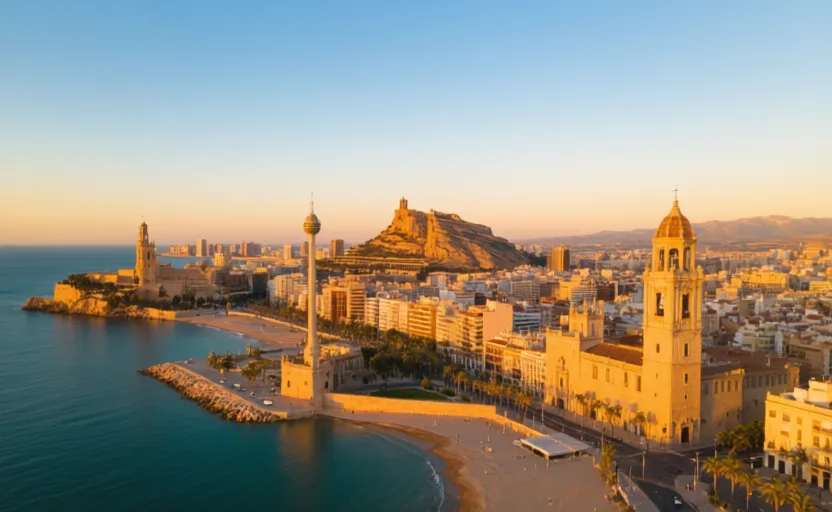 Alicante · AI city illustration · Artistic impression
City · Europe
Alicante
Saved in this browser — no account needed. Sign in later and it comes with you.
Where it is
One of the driest cities in Europe, and one of the sunniest, Alicante has a hot semi-arid climate and only 284.5 mm of rain a year, which falls mostly in September and October and sometimes in torrents. No permanent stream crosses it, only dry beds that fill in storms. The city lies on mostly flat ground on the southeast coast of the peninsula, sheltered by Cape Santa Pola to the southwest and Cape Huerta to the northeast, with a rocky massif, Mount Benacantil, rising straight from the shore. The sea there barely rises and falls, a stability that Spain uses as its national height datum.
The land and water around it
Mount Benacantilmountains
A rocky massif that overlooks the sea from 160 m, crowned by Santa Bárbara Castle, whose older parts date from the 9th century. The first human settlements were on its slopes, and a Late Roman settlement there kept the name that became Laqant and then Alicante.
The bay and its capesbay
Cape Santa Pola to the southwest and Cape Huerta to the northeast shield a harbour long used as a strategic base. The small island of Tabarca, 8 nautical miles south, belongs to the municipality. The foot of the city hall’s main staircase is the zero point for measuring height above sea level across Spain.
The dry plain and its ramblasclimate
Dry channels, called ramblas, run across the flat ground and fill only in heavy storms. On 30 September 1997, 270.2 mm of rain fell in six hours, the worst flood in the city’s modern history. A marsh in the northeast, l’Albufereta, was drained in 1928.
Its history, in short
People have lived around Alicante for more than 7,000 years, first on the slopes of Mount Benacantil. Phoenician and Greek traders reached this coast, and in the 230s BC the Carthaginian general Hamilcar Barca built a fortified settlement called Akra Leuké, presumed to be on the site of the modern city. Under Augustus the nearby Roman town of Lucentum became a municipality, only to decline and be abandoned as Ilici (Elche), better connected, took its trade. The Arabic name Laqant gave the modern name. Castile took the town in 1247 and Aragon in 1296, and in the 15th century it became a Mediterranean trading station for rice, wine, oil, oranges and wool. The expulsion of the Moriscos from 1609 emptied the region of skilled farmers, and after 1700 the city declined slowly. A late 19th-century recovery followed port growth. In the Civil War it was the last Republican city to fall, in April 1939. Tourism has reshaped it since the late 1950s, and by the 1980s most commercial shipping had gone to Valencia’s harbour.
Timeline
Dates are shown on a timeline rather than as changing shapes on the map. The globe draws modern boundaries only, and tinting a modern outline to stand for a historical one would state something we cannot source.
Classical world
Mid-230s BCE
Akra Leuké
Hamilcar Barca founds a fortified settlement whose name means “white citadel” or “white promontory”. It is generally presumed to lie under modern Alicante.
Post-classical world
Early 8th century
Laqant under Islamic rule
Visigothic resistance to the Arab conquest is slight. The name Laqant appears in the pact of Theodemir of 713 and is the ancestor of the modern name.
1247 and 1296
Castile, then Aragon
Alfonso X of Castile conquers the town in 1247. James II of Aragon recovers it for the Crown of Aragon in 1296, and it becomes a Royal Village with a seat in the Valencian Parliament.
Well attestedWikipedia
Early modern & oceanic
1609–1614
The Morisco expulsion
Philip III expels thousands of Moriscos from Valencia. The loss of skilled artisans and farm labourers costs the region dearly and pushes the feudal nobility towards bankruptcy.
Well attestedWikipedia
Industrial & imperial
25 May 1938
The market bombing
Italian aircraft bomb the Mercado, and more than 300 civilians die. It is the worst of the air raids on the city during the Civil War.
Well attestedWikipediaMarch–April 1939
The last Republican port
On the night of 28 March the British ship SS Stanbrook takes aboard thousands of Republican refugees under bombing. Franco’s troops occupy Alicante on 1 April 1939, the last city loyal to the Republic to fall.
Well attestedWikipedia
Contemporary
1954 onward
Arrivals from Algeria
Pied-noirs, settlers of European origin in French Algeria, move to Alicante from 1954 and in greater numbers after Algerian independence in 1962. Estimates range from 3,000 to 30,000. The city had long-standing links to Oran, whose population included many people of Alicantine descent.
DisputedWikipediaSources differ on the number, with some estimates ten times lower than others
30 September 1997
The great flood
A downpour of 270.2 mm in six hours causes the worst flooding in the city’s modern history.
Well attestedWikipedia
Places that carry meaning
Santa Bárbara CastleFrom the 9th century
A fortified complex on Mount Benacantil, 160 m above the sea, and the landmark that dominates the city. It expresses the idea of Alicante as a strategic military site on the Mediterranean.
Lucentum at Tossal de Manises1st century BCE to 3rd century CE
The Roman municipality refounded under Augustus, with a forum built between 30 and 20 BCE. It declined from Vespasian’s reign and lost its status in the 3rd century. Historians have placed its ruins at the Tossal de Manises since the 1990s.
Palmeral of Elche10th–11th centuries
An artificial oasis of 67 orchards and about 45,000 date palms on 144 hectares, brought to Europe during Islamic rule and watered by canals. It lies just south of the city, in Elche, which now forms a conurbation of nearly a million people with Alicante.
Languages here
Places are usually multilingual. This lists what is actually spoken, not one language per border.
SpanishRomance family
The everyday language and the language of administration.
The city’s name is Alicante in Spanish. Foreign-born residents were 96,826 people, about 27% of the population, most arrived in the previous 20 years.
ValencianRomance family
The regional language, in which the city is Alacant.
The official name of the city is bilingual, Alacant / Alicante. The Arabic form Laqant is the ancestor of both names, and it reached Arabic from a Latin and Greek root meaning white or bright.
Learn the language here
- 1Understand which languages are spoken hereAlicante is multilingual. Start with which languages are used, by whom, and for what — the phrase list only covers one of them.Written by Globe Quest
- 2Learn 11 phrasesCurated everyday phrases for Alicante, with audio and a written form.Written by Globe Quest
- 3Say them out loudSpeaking practice with pronunciation feedback, one phrase at a time.Globe Quest material, your own additions
- 4Come back to themSpaced review, so what you learned this week is still there next month.Written by Globe Quest
Check yourself
What is special about the city hall staircase in Alicante?
Its foot is Spain’s zero point for height above sea level
The Mediterranean has very small tides at Alicante, so the foot of the main staircase of the town hall was chosen as the reference level for measuring altitude throughout Spain.
Why did Roman Lucentum decline?
Elche, with better water and land communications, took its trade
Ilici, today’s Elche, stood on the Via Augusta and had better communications, and over the 2nd and 3rd centuries it drew trade from Lucentum until the town lost its municipal status.
Worth arguing about
- A city that cannot rely on rivers for water depends on rare, violent storms. How does a place plan for both drought and flood?
- Alicante had close ties with Oran, and thousands of people moved between them after 1954. How should cities remember migrations that run in both directions across a sea?
What we have not established
These are open questions, listed rather than filled in. We would rather show a gap than a plausible guess.
How many pied-noirs settled in Alicante from 1954?
Some estimates give as many as 30,000, while other sources put the number ten times lower, and no reliable count is available.
Sources
- Wikipedia · AlicanteWikipedia · encyclopedia · checked 2026-11-24
- Wikipedia · History of AlicanteWikipedia · encyclopedia · checked 2026-11-24
- UNESCO · Palmeral of ElcheUNESCO World Heritage Centre · intergovernmental · checked 2026-11-24
Reviewed by Globe Quest editorial on 2026-11-24. Drafted with AI assistance and checked against the sources above before publication.