 Globe Quest
 Human Quest · LearningSign in
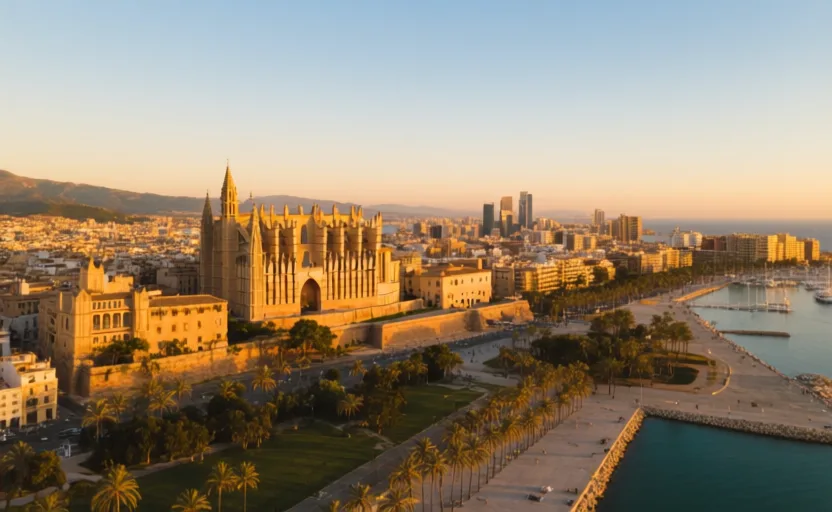 Palma de Mallorca · AI city illustration · Artistic impression
City · Europe
Palma de Mallorca
Saved in this browser — no account needed. Sign in later and it comes with you.
Where it is
A flat city on a southern bay, with mountains at its back, Palma holds almost half the population of the island of Mallorca. Its centre lies north of the Bay of Palma at only 13 m above sea level. A fertile plain called Es Pla runs eastward, and its northern and western edges touch the Serra de Tramuntana, the island’s main mountain chain. The climate is hot semi-arid, bordering on Mediterranean, with about 2,800 hours of sun a year and an average sea temperature of 19.5 °C. Freezes are almost unknown, and the weather has not passed 40 °C in any summer since records began in 1978.
The land and water around it
The Bay of Palmabay
The city’s harbour looks onto this broad bay on the south coast. The Romans used it as the departure point for Carthage and for the Iberian ports of Saguntum, Gades and Carthago Nova, and the port has been the city’s main reason to exist ever since.
Es Plaplain
The flat and fertile plain that stretches east of the city. Together with the mountains to the north, it leaves the capital as a low city open to the sea and the plain.
The Serra de Tramuntanamountains
The island’s principal range, a World Heritage cultural landscape of terraces, cobbled roads and water channels. Arabic water-harvesting technology, including underground qanats, was combined with Christian estate-building after the 13th-century conquest to farm steep slopes with scarce water.
Its history, in short
The Romans founded Palma on the south of the island by 123 BC, on the ruins of a Talaiotic settlement, and used it as the port for voyages to Africa and the Spanish coast, while a second city, Pollentia, served the northwest Mediterranean. Vandal raids and a Byzantine interlude followed, and from 902 to 1229 the city, called Medina Mayurqa, was under Islamic rule and capital of the island. In the late 11th and 12th centuries it was briefly independent as the capital of a Balearic taifa, and from 1157 the last Almoravid rulers, the Banu Ganiya, held the islands and traded with Genoa and Pisa. James I of Aragon took the city on 31 December 1229 after a three-month siege and renamed it Ciutat de Mallorca. It became joint capital of the Kingdom of Majorca with Perpignan. Factional strife and piracy marked the 17th century, when the Inquisition persecuted the city’s Jews, known as xuetes. Mass tourism from the 1950s is what shaped the present city. Visitors to the island grew from 500,000 in 1960 to more than 31 million passengers through the airport in 2023, and workers came from mainland Spain.
Timeline
Dates are shown on a timeline rather than as changing shapes on the map. The globe draws modern boundaries only, and tinting a modern outline to stand for a historical one would state something we cannot source.
Classical world
By 123 BCE
A Roman city
After the conquest of Mallorca, the Romans found two cities: Palma in the south and Pollentia in the northeast. Little survives of Roman Palma today, though excavations in the centre still turn up finds.
Approximate dateWikipedia
Post-classical world
708
A Muslim fleet arrives
A fleet under Abd Allah ibn Musa stops at the island. The period between the fall of Rome and the Muslim conquest is poorly documented, but Byzantine mosaics survive in the oldest part of the cathedral.
Approximate dateWikipedia902–1229
Medina Mayurqa
The city is under Islamic control and remains the capital of the island. Its Arabic name means “City of Majorca”.
Well attestedWikipedia1087–1115
The Balearic taifa
After the Banu Hud take Dénia, the islands break free of mainland rule and enjoy brief independence, with Medina Mayurqa as capital. A decline in piracy, under pressure from Christian naval powers, brings economic stress.
Approximate dateWikipedia1157
The Banu Ganiya
The Almoravids, displaced from al-Andalus by the Almohads, are left with only the Balearic Islands. Refugees arrive, and the rulers grant Genoa and Pisa their first trading concessions.
Well attestedWikipedia31 December 1229
Conquest by James I of Aragon
After three months of siege the city falls and is renamed Ciutat de Mallorca. It is given a municipality covering the whole island and remains the capital of the Kingdom of Majorca.
Well attestedWikipedia
Contemporary
1960
The tourist boom
Mallorca receives 500,000 visitors in 1960 and more than 6.7 million in 1997. The change brings many workers from the mainland and, according to the account of the city’s history, alters its traditions, language and economy.
Well attestedWikipedia2023
Passengers at Son Sant Joan
The airport near Palma handles 31,105,987 arriving passengers, in a municipality of about 438,000 residents.
Well attestedWikipedia
Places that carry meaning
The cathedralEarly medieval origins
Mosaics in its oldest parts show that the site was a paleo-Christian temple in the early Middle Ages and that the Byzantines were present, in a period the written record barely covers.
Bellver CastleKingdom of Majorca
One of the monuments commissioned by James II of Majorca, who championed building in the city after his father’s death split the realm.
Cultural Landscape of the Serra de TramuntanaMedieval to modern
Terraces supported by dry-stone walls, a network of qanats, canals and basins, and farm units of feudal origin. It was inscribed for showing how Muslim and Christian knowledge combined on difficult terrain.
Languages here
Places are usually multilingual. This lists what is actually spoken, not one language per border.
CatalanRomance family
The local language, in its Majorcan variety.
The bay is the Badia de Palma in the local language, and the 17th-century quarrel between the Canamunts and Canavalls factions is named in Majorcan Catalan. Mass tourism and immigration from the mainland have changed the language’s place in the city.
SpanishRomance family
The national language, widely used alongside Catalan.
Foreign-born residents were 128,005 people, 29.2% of the population in 2024, and workers from mainland Spain arrived in large numbers after the 1950s.
Learn the language here
- 1Understand which languages are spoken herePalma de Mallorca is multilingual. Start with which languages are used, by whom, and for what — the phrase list only covers one of them.Written by Globe Quest
- 2Learn 11 phrasesCurated everyday phrases for Palma de Mallorca, with audio and a written form.Written by Globe Quest
- 3Say them out loudSpeaking practice with pronunciation feedback, one phrase at a time.Globe Quest material, your own additions
- 4Come back to themSpaced review, so what you learned this week is still there next month.Written by Globe Quest
Check yourself
What was Palma called under Islamic rule?
Medina Mayurqa
Medina Mayurqa, “City of Majorca” in Arabic, was the island’s capital from 902 to 1229, and the Catalan conquerors then renamed it Ciutat de Mallorca.
What does the Serra de Tramuntana landscape show?
Muslim water technology combined with Christian estate farming
Qanats, canals and terraces from Arabic water management were joined to the land system introduced after the 13th-century conquest, making steep slopes farmable.
Worth arguing about
- Visitors to Mallorca grew from half a million in 1960 to tens of millions. Who is the island’s capital for: its residents or its travellers?
- Almost 30% of Palma’s residents were born abroad, and many others came from the mainland. How does a minority language like Catalan hold its place in such a city?
What we have not established
These are open questions, listed rather than filled in. We would rather show a gap than a plausible guess.
What survives of Roman Palma?
The city has no significant Roman remains today, and the period between Rome’s fall and the Muslim conquest is poorly documented, so the early city is known mainly through occasional finds.
Sources
- Wikipedia · Palma de MallorcaWikipedia · encyclopedia · checked 2026-11-24
- UNESCO · Cultural Landscape of the Serra de TramuntanaUNESCO World Heritage Centre · intergovernmental · checked 2026-11-24
Reviewed by Globe Quest editorial on 2026-11-24. Drafted with AI assistance and checked against the sources above before publication.