 Globe Quest
 Human Quest · LearningSign in
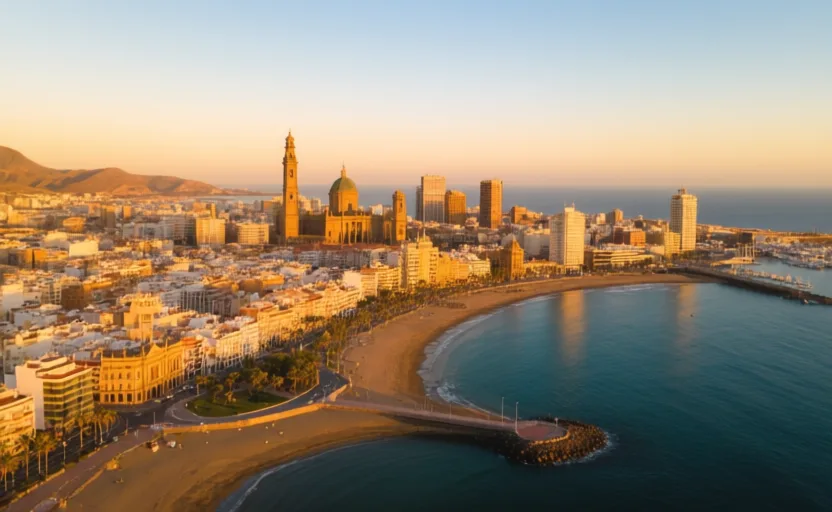 Las Palmas de Gran Canaria · AI city illustration · Artistic impression
City · Europe
Las Palmas de Gran Canaria
Saved in this browser — no account needed. Sign in later and it comes with you.
Where it is
About 150 kilometres off the African coast, Las Palmas fills the north-eastern corner of Gran Canaria, the largest city of the Canary Islands. The old town grew beside the mouth of a ravine, the Guiniguada, and the modern city spreads along a narrow isthmus that joins the peninsula of La Isleta to the main island. Despite its latitude the climate is classed as desert: only about 151 millimetres of rain fall in a year, over some 22 days, and sunshine exceeds 2,800 hours. The cool Canary Current keeps the average annual temperature near 21 degrees, with little seasonal swing.
The land and water around it
La Isleta and the isthmus of Guanartemepeninsula
A peninsula tied to the main island by a sandy isthmus, once a spit of dunes. The isthmus gives the city a beach on each side.
Las Canteras reefreef
A natural barrier of coral sandstone, locally called the bar, runs along the 3,100-metre Las Canteras beach and shelters the water inside it from most Atlantic waves and currents.
The mountains of the interiormountains
Behind the coast rises the central massif of the island, sheltered by the Tejeda caldera and cut by cliffs and ravines. Its caves and terraces hold the main archaeological record of the island's pre-Spanish culture.
Its history, in short
The city began as a military camp. Juan Rejón, leading a Castilian army, set up the Real de Las Palmas at the mouth of the Guiniguada ravine on 24 June 1478, in what is now the Vegueta district, and a war of conquest followed. It lasted five years, cost many lives especially among the island's native people, and ended in 1483 when Pedro de Vera brought the island into the Crown of Castile. In 1485 the diocese moved here from Lanzarote, and the city gained a bishopric, a royal court and the residence of the captains general, which made it the effective capital of the archipelago in the 16th and 17th centuries. Columbus put in for repairs in 1492. Francis Drake tried to plunder it in 1595, and a Dutch raid in 1599 destroyed part of the town before being repelled. The deep-water Puerto de la Luz, begun in 1883, turned a regional capital into a port of the Atlantic routes, and its traffic rose when the Suez Canal closed from 1967 to 1975. In 1927 the Canary Islands were split into two provinces and Las Palmas became capital of the new province of Las Palmas.
Timeline
Dates are shown on a timeline rather than as changing shapes on the map. The globe draws modern boundaries only, and tinting a modern outline to stand for a historical one would state something we cannot source.
Early modern & oceanic
24 June 1478
Real de Las Palmas founded
Juan Rejón camps at the mouth of the Guiniguada ravine with about 30 soldiers and starts the Castilian conquest of the island.
Well attestedWikipedia1483
End of the conquest
Pedro de Vera subdues the native communities of Gáldar in the north-west, and the island is incorporated into the Crown of Castile.
Well attestedWikipedia20 November 1485
The diocese moves from Lanzarote
The bishopric of the Canaries is transferred to Las Palmas, which then acquires a royal court and the first Inquisition tribunal of the islands.
Well attestedWikipedia1492
Columbus repairs the Pinta
On his first voyage to the Americas Columbus anchors in the port to fix a rudder, and stops again on the way back.
Well attestedWikipedia1595 and 1599
Drake and the Dutch raid
Francis Drake tries to plunder the town in 1595. A Dutch force under Pieter van der Does destroys part of it in 1599 but is driven out.
Well attestedWikipedia
Industrial & imperial
1883
Puerto de la Luz begins
Construction of the new seaport starts and drives the city's modern growth.
Well attestedWikipedia1927
Capital of the province of Las Palmas
The Province of the Canary Islands is divided in two. Las Palmas de Gran Canaria heads the province covering Gran Canaria, Lanzarote and Fuerteventura.
Well attestedWikipedia
Places that carry meaning
VeguetaFrom 1478
The district where the Real de Las Palmas was first set up, now the historic quarter. The Casa de Colón, a museum named for Columbus, and the Museo Canario stand here.
Museo CanarioFounded 1879
A museum of the archaeology of the islands, with a collection shown in 16 halls and a library of over 60,000 volumes, many on Canarian subjects.
Risco Caído and the Sacred MountainsPre-Hispanic, to the 15th century
A World Heritage landscape in the island's mountains, with cave dwellings, rock art, farming terraces and water-management works left by an island culture that developed in isolation after Berber arrivals from North Africa. Libyco-Berber inscriptions mark the westernmost reach of Amazigh culture.
Languages here
Places are usually multilingual. This lists what is actually spoken, not one language per border.
SpanishRomance family
The language of daily life, government and school.
Spanish is official across Spain, and the Canarian variety is one of the dialects that shaped Spanish in the Americas. In Las Palmas it is also the common tongue between newer communities: the foreign-born population was 15.7 per cent in 2024, with large African and Latin American groups, a fast-growing Venezuelan one, and smaller long-established Sindhi, Korean and Chinese communities.
Libyco-BerberAfroasiatic family
Known today only from inscriptions left by the island’s first inhabitants.
Inscriptions in the Gran Canaria mountains are the clearest evidence that the pre-Hispanic culture came from the Amazigh world of North Africa. No community speaks the language today.
Arabic, Romanian, English, Chinese and Ukrainian
The main languages brought by recent immigrants to Spain, a national picture rather than a count for Las Palmas.
Across Spain, newcomers have added speakers of Arabic, Romanian, English, Chinese and Ukrainian to the population. Spanish itself is used by about 99 per cent of people nationally, as a first or second language.
Learn the language here
- 1Understand which languages are spoken hereLas Palmas de Gran Canaria is multilingual. Start with which languages are used, by whom, and for what — the phrase list only covers one of them.Written by Globe Quest
- 2Learn 12 phrasesCurated everyday phrases for Las Palmas de Gran Canaria, with audio and a written form.Written by Globe Quest
- 3Say them out loudSpeaking practice with pronunciation feedback, one phrase at a time.Globe Quest material, your own additions
- 4Come back to themSpaced review, so what you learned this week is still there next month.Written by Globe Quest
Check yourself
How did Las Palmas begin?
As a Castilian military camp set up in 1478 at the mouth of a ravine
Juan Rejón founded the Real de Las Palmas at the Guiniguada ravine as the base of the conquest of Gran Canaria, which ended in 1483.
Why does Las Palmas have a desert climate yet mild temperatures all year?
Very little rain falls, and the cool Canary Current moderates the heat
Only about 151 millimetres of rain fall in a year, but the cool ocean current keeps temperatures within a narrow range and the city has never recorded snow.
Worth arguing about
- The island's first culture came from North Africa, while the city was founded by a European army from a camp. Whose history should a museum in Las Palmas tell first?
- A port that grew when the Suez Canal closed shows how a city can depend on events far away. What does that dependence mean for a place on an island?
What we have not established
These are open questions, listed rather than filled in. We would rather show a gap than a plausible guess.
How many people spoke the island's original language, and what did it sound like?
Only inscriptions survive, and the island's culture ended with the conquest, so the number of speakers and the language itself can only be inferred.
Sources
- Wikipedia · Las PalmasWikipedia · encyclopedia · checked 2026-11-24
- Wikipedia · SpainWikipedia · encyclopedia · checked 2026-11-24
- UNESCO · Risco Caido and the Sacred Mountains of Gran Canaria Cultural LandscapeUNESCO World Heritage Centre · intergovernmental · checked 2026-11-24
- Wikipedia · Languages of SpainWikipedia · encyclopedia · checked 2026-11-24
Reviewed by Globe Quest editorial on 2026-11-24. Drafted with AI assistance and checked against the sources above before publication.