 Globe Quest
 Human Quest · LearningSign in
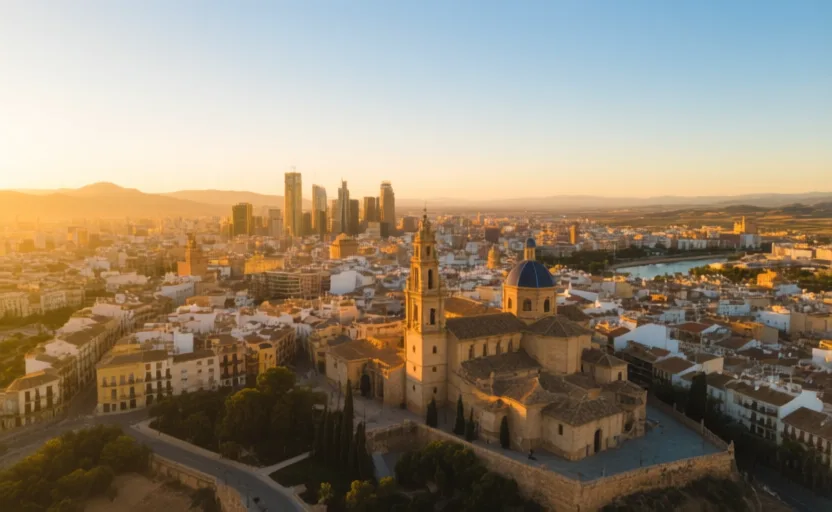 Murcia · AI city illustration · Artistic impression
City · Europe
Murcia
Saved in this browser — no account needed. Sign in later and it comes with you.
Where it is
Murcia stands only 43 metres above sea level in the middle of a low, fertile plain that the Segura river crosses from west to east, with the Guadalentín joining from the right. The plain, the huerta, is a patchwork of irrigated orchard and vegetable ground, ringed by hills to the north and by the Cordillera Sur to the south. The setting is hot and dry: a semi-arid climate with more than 320 sunny days a year, winters that seldom see snow, and summers in which 40 degrees is reached almost every year. Rain comes rarely but can be torrential, and the river has repeatedly flooded the city.
The land and water around it
The Segura river and its huertariver
A modest river whose flow is mostly small but which has flooded the city many times. Irrigation channels dug from it, begun by the Umayyad planners, turned the plain into the orchard that earns the city the name “Europe’s orchard”.
The Cordillera Surmountains
A chain of ranges, including Carrascoy and El Puerto, that splits the municipality in two: the irrigated orchard to the north and a drier semi-steppe field to the south. A regional park of pine woods lies just south of the city.
The Monteagudo hillhill
A steep hill that rises abruptly near the middle of the plain, one of the few strong features on otherwise flat ground.
Its history, in short
The present city was founded in 825 by the Umayyad emir of Córdoba, Abd ar-Rahman II, as Madinat Mursiyah. Its planners used the course of the Segura to lay out a network of irrigation channels that made the surrounding land productive. After the caliphate fell, Murcia became the capital of its own kingdoms, famous for ceramics, silk and paper, and the birthplace of the mystic Ibn Arabi. Castile took it in 1243 by the treaty of Alcaraz, after which Christian settlers outnumbered the Muslims, who were confined to a suburb. A revolt in 1264 was put down by James I of Aragon, and for a time the city was Aragonese before passing to Castile in 1304. Silk made the 18th century a golden age, and most of the churches and monuments seen today date from then. Floods, plague and earthquake punctuated the story: the river flooded in 1651, 1879, 1946 and 1948, and a levee, now a walkway, finally held it back. Murcia became capital of a provincial region in 1833, and of its own autonomous community in 1982.
Timeline
Dates are shown on a timeline rather than as changing shapes on the map. The globe draws modern boundaries only, and tinting a modern outline to stand for a historical one would state something we cannot source.
Post-classical world
825
Madinat Mursiyah founded
Abd ar-Rahman II, emir of Córdoba, founds the city and has its irrigation network laid out along the Segura.
Well attestedWikipedia1172
Almohad conquest
The north African Almohads take the city, the last Muslim empire to rule southern Spain. A small Muslim emirate of Murcia follows from 1223 to 1243.
Well attestedWikipedia1243
Treaty of Alcaraz
Ferdinand III of Castile makes Murcia a protectorate, gaining access to the Mediterranean. Christian immigrants arrive in large numbers.
Well attestedWikipedia1264–1266
Muslim revolt and Aragonese conquest
A popular Muslim revolt breaks out in 1264 and is suppressed by James I of Aragon, who conquers the city in 1266 and brings Aragonese and Catalan settlers.
Well attestedWikipedia1304
Final incorporation into Castile
The Treaty of Torrellas places Murcia permanently in Castile after the Aragonese conquest of 1296.
Well attestedWikipedia
Early modern & oceanic
1651
The flood of San Calixto
The Segura floods the city and kills more than 1,000 people, after a plague in 1648 that was reported to be about 50 per cent fatal.
Approximate dateWikipedia1706
Flooding the orchard to defend the city
In the War of the Spanish Succession Bishop Belluga orders the huerta flooded on purpose to stop the advance of the Archduke’s army. The Bourbon victory at the Huerto de las Bombas follows.
Well attestedWikipedia
Industrial & imperial
1829
Earthquake
A major earthquake strikes. Contemporary accounts estimate about 6,000 deaths across the province, followed by plague and cholera.
Approximate dateWikipedia
Places that carry meaning
Murcia Cathedral and its bell towerTower begun 1521
The cathedral’s tower, begun in 1521 by Italian architects, is the city’s main symbol and a signature work of the Renaissance. The Junterón Chapel inside is another.
Contraste and the silk buildingsEarly 17th and late 18th century
The Contraste, or silk exchange, was built in the early 1600s, and a Royal Silk Spinning Factory followed in 1770, evidence of the silk economy that carried the city.
Puente ViejoBuilt 1718–1742
The oldest bridge in the city, built after a flood in 1701 destroyed the earlier one that carried the royal road to Cartagena.
Languages here
Places are usually multilingual. This lists what is actually spoken, not one language per border.
SpanishRomance family
The everyday and official language.
Foreign-born residents were 16.3 per cent of the population in 2024, with the largest groups from the Americas and Africa. The city has one of the largest Romani populations in Spain.
ArabicSemitic family
The language of the medieval city that gave it its name.
Mursiya, the Arabic form of the name, became Murcia. After the Christian conquest of 1243 Christian settlers became the majority, and Muslims were confined to the suburb of Arrixaca.
Learn the language here
- 1Understand which languages are spoken hereMurcia is multilingual. Start with which languages are used, by whom, and for what — the phrase list only covers one of them.Written by Globe Quest
- 2Learn 12 phrasesCurated everyday phrases for Murcia, with audio and a written form.Written by Globe Quest
- 3Say them out loudSpeaking practice with pronunciation feedback, one phrase at a time.Globe Quest material, your own additions
- 4Come back to themSpaced review, so what you learned this week is still there next month.Written by Globe Quest
- 5Practise with people: Arabic practice · DohaAn in-person practice circle. It is a prepared plan and needs a host before it runs.Run by members
Check yourself
How did the Umayyad planners make the land around Murcia productive?
By building irrigation channels using the course of the river
Their network of channels from the Segura created the huerta, the irrigated plain that still defines the city’s landscape and its agriculture.
What did Bishop Belluga do in 1706 to defend Murcia?
He ordered the huerta flooded on purpose
In the War of the Spanish Succession, deliberate flooding of the orchard slowed the advance of the enemy, and the militias he organised won the battle of Huerto de las Bombas.
Worth arguing about
- The same river fed a prosperous orchard and flooded the city again and again. Is a water system that gives and takes the same one?
- Murcia’s population changed hands twice in the 13th century, with Muslims confined to one suburb and Christians arriving from across the peninsula. What does a city keep when its people are replaced?
What we have not established
These are open questions, listed rather than filled in. We would rather show a gap than a plausible guess.
How many people live in Murcia?
Figures for 2024 differ in the same article, at about 479,000 and about 472,000, and the metropolitan figure for 2020 of about 673,000 depends on which neighbouring municipalities are counted.
Sources
- Wikipedia · MurciaWikipedia · encyclopedia · checked 2026-11-24
- Wikipedia · History of MurciaWikipedia · encyclopedia · checked 2026-11-24
Reviewed by Globe Quest editorial on 2026-11-24. Drafted with AI assistance and checked against the sources above before publication.