 Globe Quest
 Human Quest · LearningSign in
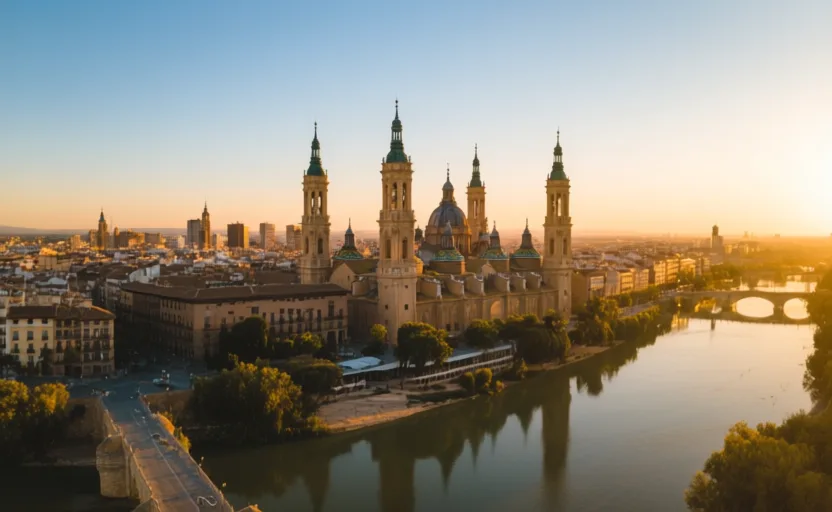 Zaragoza · AI city illustration · Artistic impression
City · Europe
Zaragoza
Saved in this browser — no account needed. Sign in later and it comes with you.
Where it is
Zaragoza occupies the middle of the Ebro basin in north-eastern Spain, about 200 metres above the sea, on a river that enters the municipality at 205 metres and leaves it at 180. Two tributaries join nearby: the small Huerva, now largely buried under the streets, and the Gállego, which arrives from the Pyrenees. Mountains ring the basin and keep out moist air, so the climate is semi-arid, with about 328 millimetres of rain a year and a cold northwesterly wind, the Cierzo, in winter. The city lies roughly at the centre of a hexagon marked by Bilbao, Madrid, Valencia, Barcelona, Bordeaux and Toulouse.
The land and water around it
The Ebro basinvalley
A wide, dry depression enclosed by mountains. The river banks are flat, but the land beside them rises into escarpments and flat-topped hills called muelas, and the surrounding heights reach 600 to 750 metres.
The Ebro and its tributariesriver
The Roman town was laid out on the right bank, with its north-eastern corner at the mouth of the Huerva. The Gállego, longer and carrying more water, comes in from the Pyrenees on the opposite side.
Gypsum groundplain
Near the river meanders the gypsum-rich soil dissolves and subsides, leaving sinkholes that can fill with irrigation water. South of the city a seasonal salt lagoon, la Sulfúrica, forms in the moorland.
Its history, in short
A small Iberian settlement called Salduie stood here before Augustus founded a colony for army veterans between 25 and 11 BCE and named it Caesaraugusta; the later names Saraqusta and Zaragoza descend from it. The Umayyads governed al-Andalus's northern frontier, the Upper March, from here, and when the caliphate of Córdoba broke up in 1018 it turned into an independent taifa, which flourished culturally under the Banu Hud before falling to the Almoravids in 1110. Alfonso I of Aragon took it in 1118 and made it the capital of his kingdom. A Jewish community with seven synagogues and a reputation for medical and grammatical scholarship lived there until the expulsion order of 1492. The plague of 1564 killed about 10,000 of an estimated 25,000 to 30,000 people. In the Peninsular War the city endured two sieges, in 1808 and again at the turn of the year, and surrendered only after some 50,000 defenders had died. The railway arrived in 1861. Its modern economy rests on car manufacturing nearby, a logistics zone and a cargo airport, and it hosted a world's fair on water in 2008.
Timeline
Dates are shown on a timeline rather than as changing shapes on the map. The globe draws modern boundaries only, and tinting a modern outline to stand for a historical one would state something we cannot source.
Classical world
between 25 and 11 BCE
Caesaraugusta founded
Augustus settles veterans of the Cantabrian wars on the site of the Iberian village of Salduie. The colony gets a forum, baths and a theatre.
Approximate dateWikipedia
Post-classical world
8th century
Capital of the Upper March
After the Umayyad conquest of the peninsula the city becomes the seat of the northern frontier province of al-Andalus.
Approximate dateWikipedia1018
The taifa of Zaragoza
As the caliphate of Córdoba collapses, the city becomes an independent kingdom, ruled first by the Tujibids and from 1039 by the Banu Hud.
Well attestedWikipedia18 December 1118
Conquest by Alfonso I of Aragon
The king takes the city from the Almoravids and makes it the capital of the Kingdom of Aragon.
Well attestedWikipedia
Early modern & oceanic
29 April 1492
Expulsion announced to the Jewish community
The Crown's decision is read to the kingdom's procurators in Zaragoza two days before the formal edict for Castile. The city's rabbi is ordered to leave the Jewish quarter within a day.
Well attestedWikipedia1564
Plague
An outbreak of bubonic plague reportedly kills about 10,000 people in a city of 25,000 to 30,000.
Approximate dateWikipedia
Industrial & imperial
1808–1809
The two sieges
Napoleonic armies besiege the city from June to August 1808 and again from December 1808 to February 1809. It surrenders after roughly 50,000 defenders have died.
Well attestedWikipedia16 September 1861
The railway arrives
The Barcelona line opens, followed in 1863 by the line to Madrid.
Well attestedWikipedia
Places that carry meaning
Basílica del PilarChristian tradition from the 1st century
The basilica of Our Lady of the Pillar commemorates a legend in which Mary appeared to the apostle James on a pillar. The Fiestas del Pilar, centred on 12 October, grew around it.
Aljafería PalacePart of the Mudéjar ensemble
A palace that is now one of the buildings grouped as the Mudéjar architecture of Aragon, a World Heritage listing shared with La Seo cathedral and other buildings.
Roman remains1st century BCE onward
Many ruins of Caesaraugusta can still be seen in the modern city, from its forum and baths to its theatre.
Languages here
Places are usually multilingual. This lists what is actually spoken, not one language per border.
SpanishRomance family
The everyday and official language of the city.
Immigrants made up 19.4 per cent of the population in 2025, with Colombia, Romania, Nicaragua, Ecuador and Morocco the largest countries of birth, so Spanish is also the common language between communities.
AragoneseRomance family
A declining local Romance language, now spoken by a small group.
Long restricted mostly to the north of Aragon, it has recently drawn new interest, and up to 7,000 people are reported to speak it in Zaragoza itself.
Learn the language here
- 1Understand which languages are spoken hereZaragoza is multilingual. Start with which languages are used, by whom, and for what — the phrase list only covers one of them.Written by Globe Quest
- 2Learn 12 phrasesCurated everyday phrases for Zaragoza, with audio and a written form.Written by Globe Quest
- 3Say them out loudSpeaking practice with pronunciation feedback, one phrase at a time.Globe Quest material, your own additions
- 4Come back to themSpaced review, so what you learned this week is still there next month.Written by Globe Quest
Check yourself
What happened to Zaragoza on 18 December 1118?
It became the capital of the Kingdom of Aragon after Alfonso I took it from the Almoravids
The Christian conquest ended centuries of Muslim rule and made the city the political and spiritual centre of the kingdom.
Why is Zaragoza's climate semi-arid even though it lies on a major river?
It stands in a basin whose surrounding mountains block moist air
The Ebro basin is enclosed by mountains, so the city receives only about 328 millimetres of rain a year and a cold dry wind, the Cierzo, in winter.
Worth arguing about
- Zaragoza has been a frontier capital for Romans, Muslim rulers and Aragonese kings. What does a city gain and lose from sitting on a border that keeps moving?
- A city that passes through two sieges, a plague and an expulsion keeps old buildings but loses much of its population and community life. What counts as continuity?
What we have not established
These are open questions, listed rather than filled in. We would rather show a gap than a plausible guess.
How large is Zaragoza's population?
Published figures for 2025 differ by several thousand depending on the register used, and the metropolitan figure of around 760,000 depends on where the boundary is drawn.
Sources
- Wikipedia · ZaragozaWikipedia · encyclopedia · checked 2026-11-24
Reviewed by Globe Quest editorial on 2026-11-24. Drafted with AI assistance and checked against the sources above before publication.