 Globe Quest
 Human Quest · LearningSign in
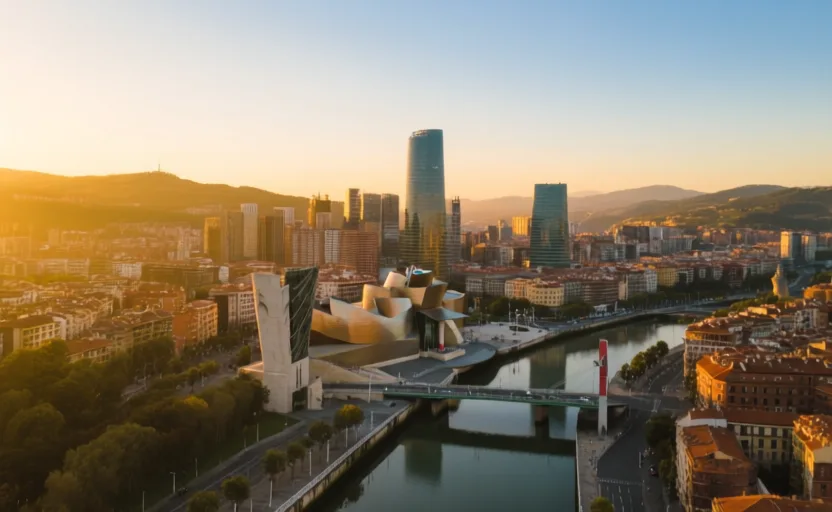 Bilbao · AI city illustration · Artistic impression
City · Europe
Bilbao
Saved in this browser — no account needed. Sign in later and it comes with you.
Where it is
Green ridges close in on Bilbao from every side, and the river is the only way out. The city lies about 16 km from the Bay of Biscay along the Nervión estuary, with an average altitude of just 19 m, ringed by small mountain ranges averaging 400 m. Of the municipality’s 40 square kilometres, more than half is hillside rather than street. Rain falls in every season, the Atlantic keeps summers mild by Iberian standards, and sunshine is low. This is the wet, cool end of Spain, and it set the city’s trade and industry.
The land and water around it
The Nervión–Ibaizabal estuaryestuary
The Nervión and Ibaizabal meet at Basauri and run 15 km to the sea as one estuary with a low average flow. It has been dredged, lined with docks and straightened by the Deusto canal, and decades of toxic dumping once left it almost without life. In August 1983 it overflowed by up to five metres.
The mountain ringmountains
Bilbao sits on the Basque threshold, between the Cantabrian Mountains and the Pyrenees. The land is folded limestone, sandstone and marl, and the hills around it, including Artxanda, Pagasarri and Malmasín, are part of the municipality. They hold the city to the river valley, which is why neighbouring districts were annexed rather than built on high ground.
The Biscay rainclimate
An oceanic climate: rain throughout the year, with November the wettest month and only about 50 mm in July. Sleet falls around 10 days a year and snow is rare. On 26 August 1983, 225.6 mm of rain fell in a single day, causing the worst flooding in the record.
Its history, in short
Bilbao was founded by charter in 1300 by Diego López V de Haro, Lord of Biscay, on the right bank of the Nervión, with the fuero of Logroño to attract trade. A second charter in 1310 made it a compulsory stop for goods travelling from Castile to the sea, and it grew as a port exporting wool and iron from Biscay. In 1511 the Consulate of the Sea was created and took charge of the estuary, and in 1602 Bilbao replaced Bermeo as capital of Biscay. The 19th century made it the centre of Spain’s second-most industrialised region, behind Barcelona’s. In the First Carlist War the Carlists made it their main target, and in 1937 Nationalist forces besieged it for weeks while German planes bombed it. Postwar iron production drew migrants from Castile-León and Galicia, until a devastating industrial crisis in the 1980s. The 1983 flood, when the estuary overflowed by up to five metres, added to the damage. Renewal began with the Guggenheim Museum and has been followed by a new airport terminal, a metro and a tram line. Today it is a service city.
Timeline
Dates are shown on a timeline rather than as changing shapes on the map. The globe draws modern boundaries only, and tinting a modern outline to stand for a historical one would state something we cannot source.
Post-classical world
15 June 1300
The charter
Diego López V de Haro founds the town by charter on the right bank of the Nervión. Ferdinand IV of Castile confirms it in January 1301.
Well attestedWikipedia
Early modern & oceanic
1511
Consulate of the Sea
Queen Joanna orders the creation of the Consulate, which takes jurisdiction over the estuary and improves its infrastructure. The port becomes one of the kingdom’s most important.
Well attestedWikipedia1596
First book in Basque
A first printing press reached the town in 1577. In 1596 it produces Doctrina Christiana en Romance y Bascuence, the first book published in the Basque language.
Well attestedWikipedia1602
Capital of Biscay
Bilbao takes the title of provincial capital from Bermeo.
Well attestedWikipedia
Industrial & imperial
1861
The Abando extension
Engineer Amado Lázaro projects a planned extension with wide avenues and regular buildings, inspired by the hygiene ideas of the time.
Well attestedWikipedia1887–1893
The Vizcaya Bridge
A hanging transporter bridge, with a gondola slung beneath a high crossbeam, connects Getxo and Portugalete over the estuary mouth without blocking shipping. It was built on private initiative.
May–June 1937
The siege
Nationalist troops besiege the city, which holds until 19 June. Bridges across the estuary are ordered destroyed before it falls. Bombing had begun in August 1936.
Well attestedWikipedia
Contemporary
26 August 1983
The flood
Continuous rain makes the estuary overflow during the Aste Nagusia festivities. Two people die, and damage costs around €360 million.
Well attestedWikipedia
Places that carry meaning
The Seven Streets13th–15th centuries
The old town began with three walled streets, and four more in the 15th century formed the Zazpikaleak. St James’ Cathedral on a pilgrim route and the Church of San Antón stand in this old quarter, now largely pedestrian.
Vizcaya Bridge1887–1893
Inscribed on the World Heritage list as the first bridge with a hanging transporter. Four lattice steel towers rise 51 m, and a crossbeam 160 m long carries a gondola for passengers and vehicles 45 m above high tide.
Guggenheim Museum Bilbao1990s onward
The museum started the regeneration that continued with the metro, tram and the Abandoibarra and Zorrozaurre projects. The city received the Lee Kuan Yew World City Prize in 2010.
Languages here
Places are usually multilingual. This lists what is actually spoken, not one language per border.
SpanishRomance family
The most spoken language in the city.
Spanish is the main language in daily life. Foreign-born residents are 16.3% of the population, with Colombians and Moroccans the largest groups, so many newcomers also speak Spanish.
BasqueLanguage isolate family
The second most spoken language in the city.
At least 51% of residents can speak some Basque, and 29% describe themselves as fluent. The first book printed in it came from Bilbao in 1596. Its speakers call a person from the city a bilbotar.
Learn the language here
- 1Understand which languages are spoken hereBilbao is multilingual. Start with which languages are used, by whom, and for what — the phrase list only covers one of them.Written by Globe Quest
- 2Learn 11 phrasesCurated everyday phrases for Bilbao, with audio and a written form.Written by Globe Quest
- 3Say them out loudSpeaking practice with pronunciation feedback, one phrase at a time.Globe Quest material, your own additions
- 4Come back to themSpaced review, so what you learned this week is still there next month.Written by Globe Quest
Check yourself
What made Bilbao a commercial hub after 1310?
A charter requiring Castilian goods heading to the sea to stop there
The 1310 charter extended the town’s commercial privileges and made it a compulsory stop for trade from Castile to the sea, giving the estuary port its start.
Why is the Vizcaya Bridge notable?
It is the first bridge with a hanging transporter
A gondola suspended from a high crossbeam carries traffic across without blocking ships on the estuary, a design first used here.
Worth arguing about
- A city that lived off iron and ships turned to a museum to reinvent itself. What does that model owe to its particular history, and could it work elsewhere?
- Basque is spoken by fewer than a third of Bilbao’s residents fluently, yet it is a symbol of the city. What is a minority language for?
Sources
- Wikipedia · BilbaoWikipedia · encyclopedia · checked 2026-11-24
- UNESCO · Vizcaya BridgeUNESCO World Heritage Centre · intergovernmental · checked 2026-11-24
Reviewed by Globe Quest editorial on 2026-11-24. Drafted with AI assistance and checked against the sources above before publication.