 Globe Quest
 Human Quest · LearningSign in
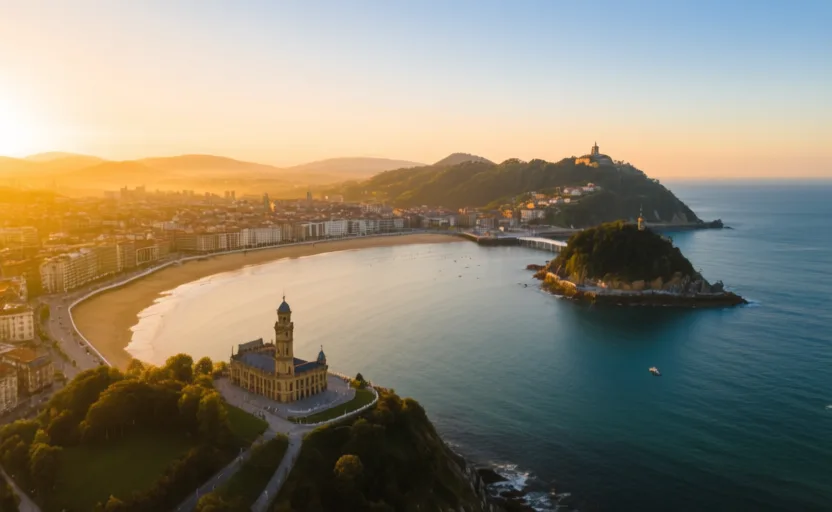 San Sebastián · AI city illustration · Artistic impression
City · Europe
San Sebastián
Saved in this browser — no account needed. Sign in later and it comes with you.
Where it is
Squeezed between the sea and green hills, San Sebastián lies on the south-eastern shore of the Bay of Biscay, about 20 kilometres from the French border. The Urumea river reaches the sea here, and most of the modern centre stands on its former wetlands, after the river was diverted into a canal in the first half of the 20th century. The old town sits at the foot of the hill of Urgull; Ulia, Igeldo and Adarra rise around it. The climate is oceanic, with about 1,650 millimetres of rain a year spread through the seasons, cloud for much of the year, and temperatures between roughly 9 and 21 degrees on average.
The land and water around it
La Concha and the Bay of Biscay coastbay
The city has three beaches: Concha and Ondarreta on the sheltered bay and Zurriola, an open beach on the other side of the river mouth. The hills of Urgull and Igeldo frame the bay.
The Urumea riverriver
Much of the modern city rests on reclaimed wetlands. Amara Berri, Riberas de Loiola and the centre itself occupy the old riverbed, left dry once the Urumea was forced into a straight canal.
Urgull, Ulia, Igeldo and Adarramountains
Hills close around the city. Urgull rises directly over the old town and is where the English cemetery lies; Ulia runs east towards Pasaia and Adarra stands to the south.
Its history, in short
The first known written mention is from 1014, when a monastery of Saint Sebastian, then inside the territory of Hernani, was donated to the Abbey of Leire. A royal charter followed in 1181 from the king of Pamplona, and in 1200 Castile took the town, cutting Navarre off from its sea access. Gascon-speaking settlers from Bayonne populated the old nucleus and shaped its identity; later regional decisions pushed them out of public office. Fire destroyed the town in 1489, and it was rebuilt in stone. Its position near the frontier made it a fortress: it was taken by French troops under the Duke of Berwick, who held it until 1721, and after later destruction the old town was rebuilt in an austere neoclassical grid. The defensive walls came down in 1863 and the city expanded onto the flat land beyond. It was European Capital of Culture in 2016, shared with Wrocław, and its economy now leans on commerce, services and long standing as a tourist destination.
Timeline
Dates are shown on a timeline rather than as changing shapes on the map. The globe draws modern boundaries only, and tinting a modern outline to stand for a historical one would state something we cannot source.
Post-classical world
1014
The monastery of Saint Sebastian
The earliest written record of the place: a monastery with apple orchards for cider, within the boundaries of Hernani, is reported donated to the Abbey of Leire.
Well attestedWikipedia1181
Royal charter
King Sancho VI of Pamplona grants the town its fuero, with jurisdiction between the Oria and Bidasoa rivers.
Well attestedWikipedia1200
Conquered by Castile
Alfonso VIII of Castile takes the town and confirms its charter, leaving the Kingdom of Navarre without its main direct outlet to the sea.
Well attestedWikipedia
Early modern & oceanic
Industrial & imperial
1863
The walls come down
The defensive walls are demolished and the city begins to expand beyond its former military limits.
Well attestedWikipedia
Contemporary
2016
European Capital of Culture
San Sebastián shares the title with Wrocław, Poland, under the motto “Waves of people’s energy”.
Well attestedWikipedia
Places that carry meaning
Parte ViejaRebuilt in the early 19th century
The old town at the foot of Urgull, rebuilt on a slightly altered plan after destructive events, in a systematic neoclassical style. Plaza de la Constitución was built in 1817.
Urgull and the English Cemetery1835–1836
The hill beside the old town holds the graves of some of the British Auxiliary Legion who defended the town against Carlist besiegers.
Ametzagañac. 24,000 to 22,000 BCE
An open-air Upper Palaeolithic site between South Intxaurrondo and Astigarraga, the first evidence of people on the city's ground: hunters of a much colder climate who used flaked stone to cut hides.
Languages here
Places are usually multilingual. This lists what is actually spoken, not one language per border.
BasqueLanguage isolate family
The city's original language and the source of its name, Donostia.
Residents are called donostiarra, in Basque, even when speaking Spanish. The Basque name and the Spanish name both mean Saint Sebastian. Basque Week each September features bertsolaris, traditional improvising poets.
SpanishRomance family
A co-official language and the common language between newcomers.
The city's official name is bilingual. The foreign-born made up 14.5 per cent of residents in 2024, mostly from Latin America and Morocco.
GasconRomance family
The language of medieval settlers from Bayonne, now gone from the city.
Gascon-speaking colonists populated the old nucleus from the early 13th century, and centuries later regional diets progressively excluded their descendants from influential posts.
Learn the language here
- 1Understand which languages are spoken hereSan Sebastián is multilingual. Start with which languages are used, by whom, and for what — the phrase list only covers one of them.Written by Globe Quest
- 2Learn 12 phrasesCurated everyday phrases for San Sebastián, with audio and a written form.Written by Globe Quest
- 3Say them out loudSpeaking practice with pronunciation feedback, one phrase at a time.Globe Quest material, your own additions
- 4Come back to themSpaced review, so what you learned this week is still there next month.Written by Globe Quest
Check yourself
What do the names Donostia and San Sebastián have in common?
Both mean Saint Sebastian
The Basque element dona or done means saint, and the rest of Donostia is a shortened form of Sebastian, so the two names carry the same meaning.
What lies beneath much of the modern city centre?
The former bed and wetlands of the Urumea river
The river was diverted into a canal in the first half of the 20th century, and the centre and several districts were built on the old riverbed.
Worth arguing about
- A town founded on a frontier changed hands between Navarre and Castile and was fortified for centuries. How does a border shape a town’s habits long after the walls are gone?
- The city names itself in two languages and treats both as its own. Is a bilingual name a compromise or a description?
What we have not established
These are open questions, listed rather than filled in. We would rather show a gap than a plausible guess.
How did the Basque name Donostia develop?
Two competing hypotheses trace different sound changes from the Latin form of the saint's name, and the evidence does not decide between them.
Sources
- Wikipedia · San SebastiánWikipedia · encyclopedia · checked 2026-11-24
Reviewed by Globe Quest editorial on 2026-11-24. Drafted with AI assistance and checked against the sources above before publication.