 Globe Quest
 Human Quest · LearningSign in
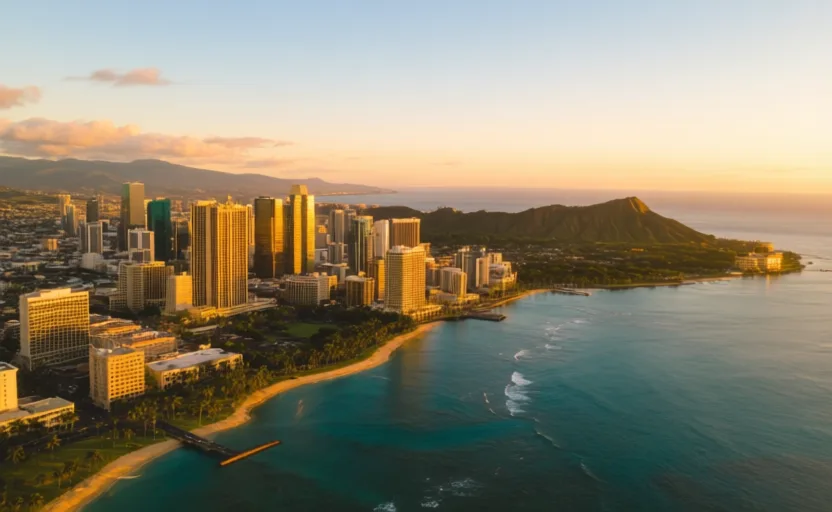 Honolulu · AI city illustration · Artistic impression
City · North America
Honolulu
Saved in this browser — no account needed. Sign in later and it comes with you.
Where it is
Few large cities are as cut off as this one. Honolulu lies on the south-east coast of the island of Oʻahu, in the middle of the Pacific, more than 2,000 nautical miles from the nearest point on the American mainland and a little further from San Francisco, the nearest major city. Its urban core is a coastal strip of about 177 square kilometres including its water, and part of an old volcanic field lies inside the city limits. Rain-shadow dryness gives it a semi-arid climate even though it is in the tropics: roughly 16 inches of rain a year, mostly from October to early April.
The land and water around it
Honolulu Harborharbour
The name itself means a sheltered harbour or calm port. A protected anchorage on a mid-ocean island was worth more than any amount of farmland, and it is why the settlement, the royal court and later the shipping trade collected here.
The Honolulu Volcanicsvolcano
The island is volcanic, and a volcanic field known as the Honolulu Volcanics lies partly inside the city limits. The city is built on the island’s south-east coast, with the ocean on one side and the volcanic island on the other.
A tropical city in a rain shadowclimate
Every month averages at least 18 °C, yet the rainfall is too low for the city to count as tropical in the standard climate classification. Winters bring the heavier rain; summers bring light showers. Hurricanes are rare, and the last to pass near the city was Iniki in 1992.
Its history, in short
The harbour is the reason for the city. Oral histories and artefacts place a settlement here by the 11th century, in the district then called Kou. After Kamehameha I took Oʻahu he moved his court to the coast in the early 1800s, and since 1794 foreign ships had begun to use the harbour as a stopping place between North America and Asia. In 1845 Kamehameha III made it the permanent capital of the Hawaiian Kingdom, and he and his successors built a modern government town: a palace, a cathedral, a court and law building. Missionary descendants set up the large commercial houses downtown. The monarchy was overthrown in 1893 and the islands annexed by the United States in 1898; Honolulu stayed the capital, the largest city, and the main port and airport. A fire in 1900 and the attack on Pearl Harbor in 1941 are the two shocks the sources single out, and after statehood in 1959 air travel and tourism drove a second boom. Today the city is also shaped by drought, sea-level rise and an older, shrinking population.
Timeline
Dates are shown on a timeline rather than as changing shapes on the map. The globe draws modern boundaries only, and tinting a modern outline to stand for a historical one would state something we cannot source.
Post-classical world
11th century
The first settlement
Oral histories and artefacts indicate that Polynesian settlers lived on the site of today’s Honolulu by about the 11th century.
Approximate dateWikipedia
Early modern & oceanic
1794
The first foreign ship enters
Captain William Brown of Britain sails into the harbour. More ships follow, and the port becomes a meeting point for merchant vessels crossing between North America and Asia.
Well attestedWikipedia
Industrial & imperial
1804–1810
Kamehameha I moves his court
After winning Oʻahu at the Battle of Nuʻuanu, Kamehameha I brings his court from the island of Hawaiʻi to Waikiki, then to what is now downtown. The dates given for the later moves differ by a year, and the capital goes back to Kailua-Kona in 1812.
Approximate dateWikipedia1845
Permanent capital of the kingdom
Kamehameha III moves the seat of government from Lahaina on Maui. Over the following decades the kings build the Iolani Palace, Aliiōlani Hale and St. Andrew’s Cathedral.
Well attestedWikipedia1893
Overthrow of the monarchy
The Hawaiian monarchy is overthrown. The city remains the seat of government under the changed order.
Well attestedWikipedia1898
Annexation by the United States
The islands are annexed and organised as a U.S. territory, with Honolulu as its capital.
Well attestedWikipedia7 December 1941
Pearl Harbor
Japan’s attack on the naval base next to the city brings the United States into the Second World War. The harbour is still a major U.S. Navy base and home of the Pacific Fleet.
Well attestedWikipedia
Contemporary
1959
Statehood and the tourism boom
Hawaii becomes a U.S. state with Honolulu as its capital. Jet travel and the hotels of Waikiki turn tourism into the city’s main industry.
Well attestedWikipedia
Places that carry meaning
Iolani Palace and the Capitol District19th century
The eastern part of downtown holds the palace built under the Hawaiian kings, Aliiōlani Hale, the statue of Kamehameha I and the state’s government buildings. Royal and present-day government stand within a few blocks of each other.
Pearl Harbor and the USS Arizona Memorial1941 onward
The naval base west of the city is the site of the 1941 attack and a working base today. The memorial marks the event and draws visitors from around the world.
Chinatown and the Arts District19th century onward
A historic district on the edge of downtown that includes the former Hotel Street vice district and a twelve-block arts quarter bounded by Bethel and Smith Streets, Nimitz Highway and Beretania Street.
Bishop MuseumModern
The state’s largest natural-history collection and the largest collection of Hawaiian and Pacific cultural objects in the world, according to its description.
Languages here
Places are usually multilingual. This lists what is actually spoken, not one language per border.
EnglishGermanic family
The everyday language of government, school and business.
English is by far the most common language in the United States, though Congress has never named an official one. About 77% of Americans speak only English at home, and 14% speak Spanish.
HawaiianAustronesian family
The language of the place name and of the former kingdom.
Honolulu is a Hawaiian word for a sheltered harbour, and the old district name Kou is Hawaiian too. The word is related to a similar place name at the tip of New Zealand’s North Island, a reminder that Hawaiian is one of a wide family of Polynesian languages.
TagalogAustronesian family
The language of the city’s second-largest Asian-American group.
Residents of Filipino descent make up about 13% of the city, after Japanese Americans at 20%. Tagalog is among the languages that more than a million people across the United States speak at home, together with Chinese and Korean, the languages of the city’s next two Asian groups.
Learn the language here
- 1Understand which languages are spoken hereHonolulu is multilingual. Start with which languages are used, by whom, and for what — the phrase list only covers one of them.Written by Globe Quest
- 2Learn 13 phrasesCurated everyday phrases for Honolulu, with audio and a written form.Written by Globe Quest
- 3Say them out loudSpeaking practice with pronunciation feedback, one phrase at a time.Globe Quest material, your own additions
- 4Come back to themSpaced review, so what you learned this week is still there next month.Written by Globe Quest
Check yourself
What does the name Honolulu mean in Hawaiian?
Sheltered harbour or calm port
The name describes the natural harbour on Oʻahu’s south coast, which is the reason the settlement and later the capital grew where they did.
From where did Kamehameha III move the kingdom’s permanent capital to Honolulu in 1845?
Lahaina on Maui
Lahaina had been the seat of the kingdom. Honolulu’s harbour and commerce won out, and the kings who followed built their palace and law courts there.
Worth arguing about
- A city of about 350,000 people is among the most isolated major cities in the world. What does remoteness do to prices, food supply and the sense of being a place with its own politics?
- Honolulu was a kingdom’s capital, then a territorial capital and now a state capital, all in two centuries. Which of those layers should a visitor see first, and who gets to decide?
What we have not established
These are open questions, listed rather than filled in. We would rather show a gap than a plausible guess.
Which languages do Honolulu residents speak at home?
Nationally English and Spanish dominate, with Chinese, Tagalog and Korean among the larger others. The ancestry of Honolulu’s residents is well recorded, but a city-level count of home languages is not, so shares for Hawaiian and the Asian languages stay unknown.
When exactly did Kamehameha I settle his court in downtown Honolulu?
Accounts give 1809 and 1810 for the move to the present downtown. We kept the span and did not choose a single year.
Sources
- Wikipedia · HonoluluWikipedia · encyclopedia · checked 2026-11-24
- Wikipedia · Languages of the United StatesWikipedia · encyclopedia · checked 2026-11-24
Reviewed by Globe Quest editorial on 2026-11-24. Drafted with AI assistance and checked against the sources above before publication.