 Globe Quest
 Human Quest · LearningSign in
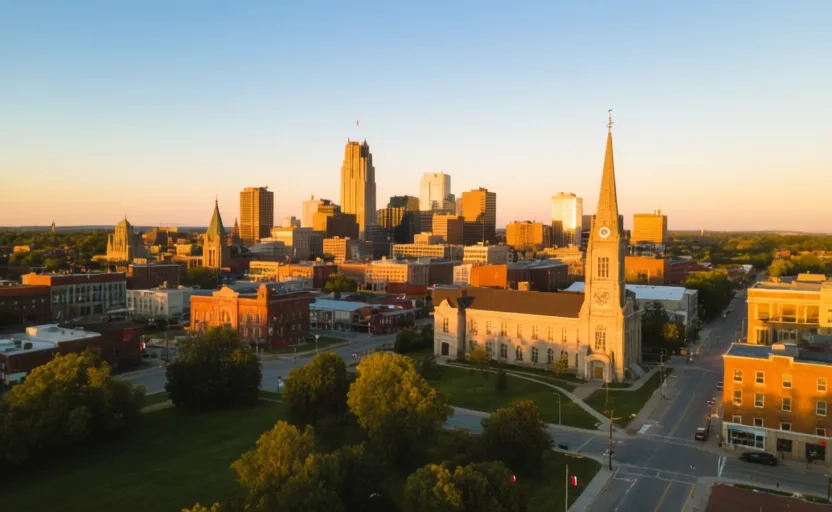 Kitchener · AI city illustration · Artistic impression
City · North America
Kitchener
Saved in this browser — no account needed. Sign in later and it comes with you.
Where it is
Kitchener stands inland, about 100 kilometres west of Toronto, in the Grand River valley of the Saint Lawrence Lowlands. The ground is high for southern Ontario, generally above 300 metres, and it is built on glacial deposits: the Waterloo Moraine, a ridge that threads through the region and holds artesian wells which supply most of the city’s drinking water, and the kame hill at Baden just to the west. Being inland and elevated gives it a harsher frost season than the lakeshore cities, about 147 frost-free days a year and roughly 160 centimetres of snow, with warm humid summers.
The land and water around it
The Waterloo Moraineplateau
A glacial ridge winding through the region, full of artesian wells. The city takes most of its drinking water from them, and the first settlement here was called Sandhills after the moraine’s high ground.
The Grand River valleyvalley
No other city in the Grand River watershed or on the Haldimand Tract is larger. The valley’s land was granted to the Six Nations and then sold on in large blocks to settlers.
Baden Hillhill
A glacial kame remnant just west of the city, in Wilmot Township, and the highest ground for many miles around.
Its history, in short
The city sits on the Haldimand Tract, the Grand River lands bought from the Mississaugas in 1784 and granted to the Six Nations. Between 1796 and 1798 the Six Nations sold a large part of it to Colonel Richard Beasley, and Mennonite farming families from Pennsylvania, seeking land where they could practise their faith without persecution, began arriving in the early nineteenth century. Benjamin Eby, a Mennonite preacher from Lancaster County, bought a large block in 1806, and his settlement, Ebytown, was renamed Berlin in 1833. It won the county seat in 1853 when a merchant donated land for a courthouse, and the Grand Trunk Railway arrived in 1856. German-speaking immigrants, mostly Lutheran and Catholic, dominated the town after 1850, bringing their gymnastics societies and band music; it became a city in 1912. Four years later a referendum renamed Berlin as Kitchener. Manufacturing still shaped it into the twenty-first century, when a downtown redevelopment push and new technology, health and digital-media firms began to widen the economy.
Timeline
Dates are shown on a timeline rather than as changing shapes on the map. The globe draws modern boundaries only, and tinting a modern outline to stand for a historical one would state something we cannot source.
Early modern & oceanic
1784
The Haldimand Tract
The British buy the Grand River valley from the Mississaugas to grant it to the Six Nations in return for their allegiance in the American Revolution.
Well attestedWikipedia
Industrial & imperial
1806
Benjamin Eby arrives
A Mennonite preacher from Lancaster County buys a large tract and founds Ebytown on the south-east side of what became Queen Street.
Well attestedWikipedia1833
The name Berlin
The settlement takes the name that it would keep for more than eighty years.
Well attestedWikipedia1853
County seat
Waterloo becomes a separate county and Berlin wins the seat over the larger Galt after a local merchant, Joseph Gaukel, donates land for the courthouse.
Well attestedWikipediaJuly 1856
The Grand Trunk Railway
The line from Sarnia to Toronto passes through Berlin and boosts its industries. The 1869 population is about 3,000.
Well attestedWikipedia9 June 1912
City status
Berlin is designated a city, its town hall at King and Frederick streets serving as city hall until a classical-revival building replaced it in 1924.
Well attestedWikipedia1916
Berlin becomes Kitchener
A referendum changes the name of the city.
Well attestedWikipedia
Contemporary
1969
Oktoberfest begins
The nine-day celebration is modelled on the Bavarian original and now run jointly with neighbouring Waterloo.
Well attestedWikipedia
Places that carry meaning
Frederick and Gaukel Streets19th century
Named for Frederick Gaukel, a German hotel keeper who arrived in 1819 and built what became the Walper House, one of the first Germans from Europe to settle here.
House of Industry and Refuge1869–1951
A very large county poorhouse with an attached farm on Frederick Street, built to keep people from begging or being jailed. It housed some 3,200 people before closing in 1951, and was later demolished.
Westmount20th century
A suburb on forested hills north of the Schneider farm, modelled on the Montreal suburb of the same name and borrowing street names such as Belmont Avenue from it.
Languages here
Places are usually multilingual. This lists what is actually spoken, not one language per border.
EnglishGermanic family
The common language of the city.
English, Irish and Scottish ancestries together form a large share of the population, and English is the language that links the city’s many origins.
GermanGermanic family
The historic language of the settlement and the source of its identity.
Pennsylvania Dutch pioneers arrived from the 1800s, and German-speaking immigrants directly from Europe followed from 1819 and in large numbers after 1850. Berlin was the most German of the Waterloo Region towns. Today 17.7 per cent of residents claim German ancestry, the largest single group.
South Asian and other immigrant languages
Spoken by newer communities, about 32 per cent of the city identifying as visible minorities.
In 2021 about 9.9 per cent of residents were South Asian, 6.9 per cent Black and 3.7 per cent Southeast Asian, with Arab, Latin American, Chinese and Filipino communities also present, and Polish, Dutch and Portuguese ancestries older. These counts record ancestry, not the languages spoken at home.
Learn the language here
- 1Understand which languages are spoken hereKitchener is multilingual. Start with which languages are used, by whom, and for what — the phrase list only covers one of them.Written by Globe Quest
- 2Learn 13 phrasesCurated everyday phrases for Kitchener, with audio and a written form.Written by Globe Quest
- 3Say them out loudSpeaking practice with pronunciation feedback, one phrase at a time.Globe Quest material, your own additions
- 4Come back to themSpaced review, so what you learned this week is still there next month.Written by Globe Quest
Check yourself
What was Kitchener called before 1916?
Berlin
The settlement began as Ebytown, was named Berlin in 1833 and kept that name until a 1916 referendum renamed it Kitchener.
Where does Kitchener get most of its drinking water?
Artesian wells in the Waterloo Moraine
The glacial Waterloo Moraine holds many artesian wells, and the city draws most of its drinking water from them rather than from a lake or reservoir.
Worth arguing about
- Berlin was renamed by referendum in 1916. How should a city with a strong German heritage weigh its roots against a moment of national pressure?
- Kitchener and Waterloo are twin cities with separate governments. Is it better for a region to share one council or to stay two?
What we have not established
These are open questions, listed rather than filled in. We would rather show a gap than a plausible guess.
Why did voters choose the name Kitchener in 1916?
The referendum is dated, but the arguments and the margin of the vote are still to be researched, so no account of the debate is given here.
Sources
- Wikipedia · Kitchener, OntarioWikipedia · encyclopedia · checked 2026-11-24
Reviewed by Globe Quest editorial on 2026-11-24. Drafted with AI assistance and checked against the sources above before publication.