 Globe Quest
 Human Quest · LearningSign in
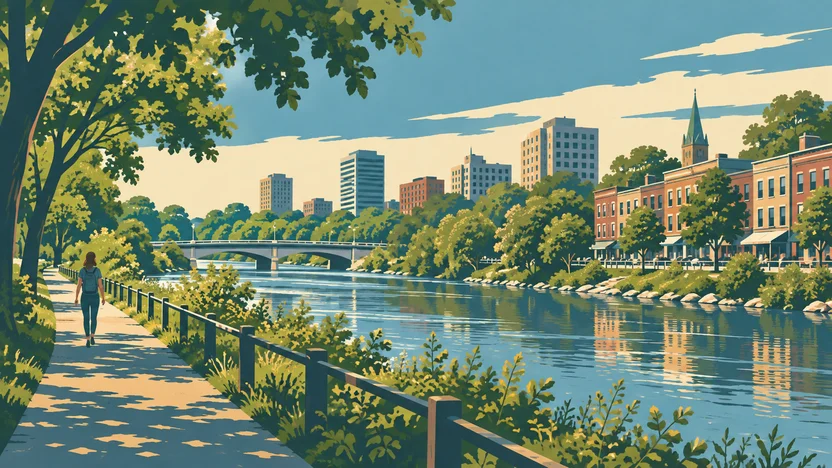 London ON · AI city illustration · Artistic impression
City · North America
London ON
Saved in this browser — no account needed. Sign in later and it comes with you.
Where it is
London, Ontario is a river city in the farmland of the Southwestern Ontario peninsula, roughly 200 kilometres from both Toronto and Detroit and 230 from Buffalo. Its centre is the point where two branches of the Thames meet, a place called the Forks. The land was shaped as the last ice age ended, which left marshes such as Sifton Bog and some of the most productive farmland in the province. Lake Huron lies about 60 kilometres to the northwest, and breezes off it and Lake Erie converge over the area, so the climate is humid continental with cloudy winters, snowfall of nearly two metres a year, and frequent thunderstorms.
The land and water around it
The Forks of the Thamesriver
The meeting of the river’s branches at the centre of the city. Anishinaabe speakers called it Eshkani-ziibi, “Antler River”, and a community at the fork is recorded around 1690. The city built on the same spot.
Fanshawe Lakelake
A reservoir on the North Thames, made by the dam built in 1953 after catastrophic floods in 1883 and 1937. The lake exists because the city kept flooding.
Sifton Bogmarsh
A marshland left behind by the retreating glaciers, within a landscape that otherwise produced some of Ontario’s best farmland. It sits at the edge of a city whose growth has been argued over for the forest and farms it replaces.
Its history, in short
People have used this ground for about 11,000 years. Shortly before European contact it held Attawandaron, Odawa and Ojibwe villages, among them a Neutral Iroquoian town of perhaps 2,000 people at what is now the Lawson Site. The Iroquois drove those groups out by about 1654, and were themselves pushed out roughly fifty years later by the Ojibwa. In 1793 Lieutenant-Governor John Graves Simcoe chose the forks of the river as a site for the capital of Upper Canada and gave it the names London and Thames, but the capital went to York instead and the settlement became an administrative seat for the west. The village was founded in 1826, a garrison came in 1838, and the railway reached it in 1853; a politician later named those three events as the keys to its growth. London became a city in 1855. The river was also its worst enemy, with a steamer disaster in 1881 and floods in 1883 and 1937, until the Fanshawe Dam went up in 1953. Annexations in 1961 and 1993 more than doubled its area twice, spreading the city into the farmland around it.
Timeline
Dates are shown on a timeline rather than as changing shapes on the map. The globe draws modern boundaries only, and tinting a modern outline to stand for a historical one would state something we cannot source.
First cities & states
about 11,000 years ago
Paleo-Indian presence
Archaeological sites across southwestern Ontario, named for the Parkhill Complex, show people living in the area.
Approximate dateWikipedia
Early modern & oceanic
c. 1654
Iroquois drive out the Neutral and others
The Beaver Wars empty the region of its earlier villages. About fifty years later the Iroquois are in turn forced out by the Ojibwa.
Approximate dateWikipedia1793
Simcoe chooses the site
John Graves Simcoe selects the forks as the seat of Upper Canada’s future capital and names the river and place for their English counterparts. He had first wanted to call it Georgiana. The capital was never moved here.
Well attestedWikipedia
Industrial & imperial
1826
The village is founded
The courts and administration of the district arrive, and a tavern, the first building in London, is put up by Peter MacGregor, who was also the first jailer.
Well attestedWikipedia1853
The railway arrives
A rail connection follows the 1838 military garrison. Together with the court, they were later credited with making London’s growth.
Well attestedWikipedia24 May 1881
The Victoria Day disaster
The stern-wheeler ferry SS Victoria capsizes in the shallow river and about 200 passengers drown, in a city so small that almost everyone knew someone affected.
Well attestedWikipedia
Contemporary
1953
Fanshawe Dam
Built by the Upper Thames River Conservation Authority with federal, provincial and municipal funds to control the floods of 1883 and 1937.
Well attestedWikipedia1 January 1993
The Westminster annexation
London takes in almost all of Westminster Township, to the south, including Lambeth. The city nearly doubles in area again, following the 1961 annexation that added 60,000 people.
Well attestedWikipedia
Places that carry meaning
Lawson Siteabout 500 years ago
An excavation and partial reconstruction of a Neutral Iroquoian village in the northwest of the city, estimated to have held around 2,000 people.
Victoria Parkpresent day
The downtown park that serves as the main stage for community events, drawing an estimated million visitors a year.
London City Hall1898
The site of a collapse in January 1898 when the floor of the assembly hall gave way and 23 people were killed. A coroner’s inquest found the wooden beam under it was unsound.
Languages here
Places are usually multilingual. This lists what is actually spoken, not one language per border.
EnglishGermanic family
The mother tongue of about seven in ten residents and the language almost everyone knows.
English is the mother tongue of 71.1 per cent in 2021, and 98 per cent report knowing it. About 7.2 per cent report knowing French.
ArabicSemitic family
The largest mother tongue after English.
Arabic is the first language of 3.7 per cent, and about 5 per cent of residents are of Arab background, which makes it a visible part of the city’s public life.
Other immigrant languages
Spanish, Mandarin, Portuguese, Polish, Korean, Punjabi, Malayalam and Urdu.
Spanish is the mother tongue of 2.7 per cent, Mandarin of 1.6, and Portuguese 1.3. French and Polish are 1.1 per cent each, and Korean, Punjabi and Malayalam 0.8 each.
AnishinaabemowinAlgonquian family
The language of the Ojibwe and Odawa communities that held the forks.
The Anishinaabe name Eshkani-ziibi for the river is still on record. Indigenous people are 2.6 per cent of today’s population, most of them First Nations.
Learn the language here
- 1Understand which languages are spoken hereLondon ON is multilingual. Start with which languages are used, by whom, and for what — the phrase list only covers one of them.Written by Globe Quest
- 2Learn 13 phrasesCurated everyday phrases for London ON, with audio and a written form.Written by Globe Quest
- 3Say them out loudSpeaking practice with pronunciation feedback, one phrase at a time.Globe Quest material, your own additions
- 4Come back to themSpaced review, so what you learned this week is still there next month.Written by Globe Quest
- 5Practise with people: Arabic practice · DohaAn in-person practice circle. It is a prepared plan and needs a host before it runs.Run by members
Check yourself
Why was the Fanshawe Dam built?
To control the floods that struck the Thames in 1883 and 1937
The Thames flooded badly in 1883 and in 1937, when more than a thousand houses were destroyed. The 1953 dam on the North Thames created Fanshawe Lake and protects the lands downstream.
What did Simcoe plan for the site in 1793?
The capital of Upper Canada
He proposed it as the capital and named the river Thames and the place London, but the capital stayed at York. Instead London became the administrative seat for the area west of York.
Worth arguing about
- The city’s name copied England’s, and so did the river’s. What does it mean for a place to be named for a capital it never became?
- Growth into the surrounding farmland and rare Carolinian forest is contested. How should a city weigh housing against the land it was founded in?
Sources
- Wikipedia · London, OntarioWikipedia · encyclopedia · checked 2026-11-24
Reviewed by Globe Quest editorial on 2026-11-24. Drafted with AI assistance and checked against the sources above before publication.