 Globe Quest
 Human Quest · LearningSign in
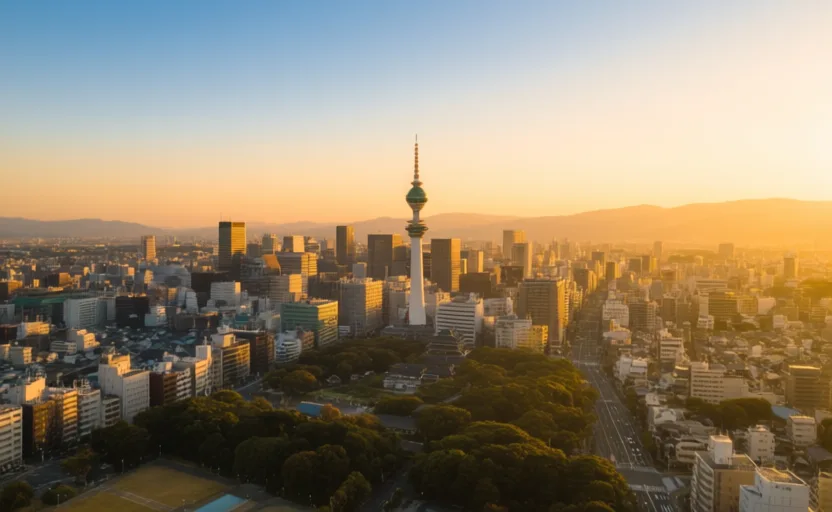 Nagoya · AI city illustration · Artistic impression
City · East Asia
Nagoya
Saved in this browser — no account needed. Sign in later and it comes with you.
Where it is
Midway between Tokyo and Osaka, Nagoya occupies the Nōbi Plain at the head of Ise Bay on the Pacific side of central Honshu. The plain is one of the most fertile in the country, and the city was placed on low plateaus to keep out floodwater. The Kiso River runs along its western edge, and the Shōnai and Tempaku rivers cross it toward the bay. Because the rivers could carry goods to and from the hinterland, and the region lay on the road and later the rail line between the old and new capitals, the location gave the city an economic and political position at the centre of the country. The climate is humid subtropical.
The land and water around it
The Nōbi Plainplain
The second-largest plain on Honshu, at 1,800 square kilometres, and among the most fertile in the country. The city and its port both lie on it.
Ise Baybay
The bay to the south holds the port of Nagoya, the largest seaport in Japan.
The Hori Canalriver
A canal built in 1610, the year of the city’s founding, which feeds into the Shōnai River system. Its rivers and canals allowed trade with the hinterland.
Its history, in short
This was the home ground of the three men who unified Japan: Oda Nobunaga, Toyotomi Hideyoshi and Tokugawa Ieyasu all rose from the area, and Nobunaga won the Battle of Okehazama just outside the future city in 1560. The city itself was a Tokugawa project. In 1610 Ieyasu shifted the seat of Owari Province to Nagoya from Kiyosu, some 7 kilometres off, and the whole castle town of some 60,000 people moved with it. The nearby Atsuta Shrine, home of the sword that is one of the Imperial Regalia, became a waystation on the Tōkaidō between Kyoto and Edo. The Owari branch of the Tokugawa family ruled from the castle and patronised crafts and theatre. Modern Nagoya grew out of its pottery, textile and clockwork-doll workshops into an industrial hub. Aircraft makers such as Mitsubishi, founded in 1920, made it a major target of American bombing, and the castle burned in 1945. The city was rebuilt and is now centred on the automotive industry.
Timeline
Dates are shown on a timeline rather than as changing shapes on the map. The globe draws modern boundaries only, and tinting a modern outline to stand for a historical one would state something we cannot source.
Classical world
113 CE (traditional)
Atsuta Shrine and the sword
Tradition says the prince Yamato Takeru died in 113 and that his widow honoured his memory, with the sword Kusanagi, in a shrine. The shrine now holds the sword among the Imperial Regalia.
Oral historyWikipediaTraditional Japanese sources, as recorded in the account of Atsuta Shrine.
Early modern & oceanic
May–June 1560
Battle of Okehazama
Oda Nobunaga defeats Imagawa Yoshimoto just outside the future city and becomes a leading warlord of the Sengoku period.
Well attestedWikipedia1610
Capital of Owari moved
Tokugawa Ieyasu moves the provincial capital from Kiyosu to a better-placed site. The castle town’s 60,000 people move with their buildings and materials.
Well attestedWikipedia
Industrial & imperial
1 October 1889
Proclaimed a city
The first census of that year counts 157,496 people. The population passes one million by 1934.
Well attestedWikipedia1920
Mitsubishi Aircraft Company
Space, central location and good connections draw the aviation industry. By the Pacific War roughly a quarter of the city’s workers are in aircraft production.
Well attestedWikipedia
Contemporary
1942–1945
Air raids
Raids start on 18 April 1942. Large incendiary attacks in 1945 burn nearly a quarter of the city, and the castle is mostly destroyed on 14 May.
Well attestedWikipedia1959
Typhoon and rebuilt castle
The Ise-wan Typhoon floods and severely damages the city, and the main keep of the castle is reconstructed in the same year.
Well attestedWikipedia2005
Expo 2005
The city hosts the world fair, and later the 2010 conference that produced the Nagoya Protocol.
Well attestedWikipedia
Places that carry meaning
Nagoya Castle1610 onward
Built partly from materials from Kiyosu Castle. The Nagoya Noh Theatre in its grounds continues the drama patronage of the Owari lords.
Atsuta ShrineAncient
A legendary shrine that keeps the sword Kusanagi. It became the waystation called Miya on the Tōkaidō road, and a town grew up to serve travellers.
Arimatsu and Narumi17th century onward
Tie-dye districts whose craft traces to dyers from Bungo Province in Kyushu, brought in by the Owari lords during the castle’s construction.
Languages here
Places are usually multilingual. This lists what is actually spoken, not one language per border.
Japanese (Nagoya or Owari dialect)Japonic family
The local speech of the western half of Aichi.
It sits near both standard Japanese and Kansai speech, with differences in pronunciation and vocabulary, which fits a city between the two centres.
Standard JapaneseJaponic family
The shared national language of schools, media and offices.
Standard Japanese is based on the Tokyo dialect and works as the common register for regional speakers, including those who use Nagoya’s own forms.
Ryukyuan and Ainu languages
Minority languages of other parts of Japan, both classed as endangered.
Ryukyuan languages are spoken in Okinawa and parts of Kagoshima, and Ainu in Hokkaido. They are part of Japan’s linguistic picture but not of Nagoya’s everyday speech.
Learn the language here
- 1Understand which languages are spoken hereNagoya is multilingual. Start with which languages are used, by whom, and for what — the phrase list only covers one of them.Written by Globe Quest
- 2Learn 11 phrasesCurated everyday phrases for Nagoya, with audio and a written form.Written by Globe Quest
- 3Say them out loudSpeaking practice with pronunciation feedback, one phrase at a time.Globe Quest material, your own additions
- 4Come back to themSpaced review, so what you learned this week is still there next month.Written by Globe Quest
Check yourself
What happened in 1610?
Tokugawa Ieyasu shifted the seat of Owari Province from Kiyosu to Nagoya
The shift was so complete that the whole castle town from Kiyosu relocated, a founding that explains why Nagoya is a planned Tokugawa city.
Which industries made Nagoya a target for bombing in the Second World War?
Aircraft and war industries
The Nagoya area had one of the largest concentrations of aircraft production in Japan, including the makers of the Zero fighter.
Worth arguing about
- Nagoya is Japan’s fourth-largest city but is often described as the one between the other two. What does being in the middle do to a city’s identity?
- A city founded by moving a whole town with its buildings: is that a founding or a relocation, and how does it shape civic memory?
Sources
- Wikipedia · NagoyaWikipedia · encyclopedia · checked 2026-11-24
- Wikipedia · Geography of JapanWikipedia · encyclopedia · checked 2026-11-24
- Wikipedia · Languages of JapanWikipedia · encyclopedia · checked 2026-11-24
Reviewed by Globe Quest editorial on 2026-11-24. Drafted with AI assistance and checked against the sources above before publication.