 Globe Quest
 Human Quest · LearningSign in
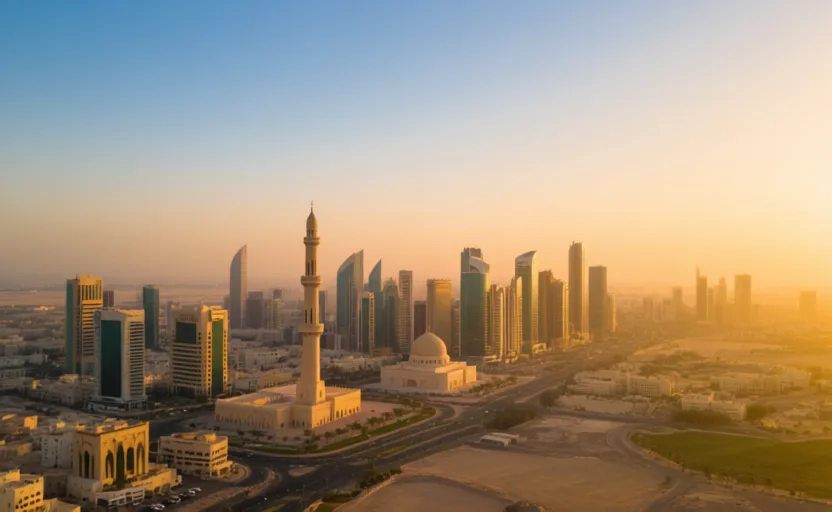 Ras Al Khaimah · AI city illustration · Artistic impression
City · Middle East
Ras Al Khaimah
Saved in this browser — no account needed. Sign in later and it comes with you.
Where it is
The name means “headland of the tent”, and the city lies on the Gulf coast in the far north of the UAE, at the entrance to the Persian Gulf. A creek splits it in two: the old town on the west side, and the newer Al Nakheel district to the east. Behind it the land climbs quickly into the Hajar Mountains, where snow was recorded on the Jebel Jais cluster in 2004, a first for the UAE. Palm plantations at Rams and the Shimal coast to the north add farmland to the strip between mountains and sea. The climate is hot and humid, and the airport has recorded the highest wet-bulb temperature of any reliable weather station.
The land and water around it
The creekestuary
A creek divides the old town from Al Nakheel and defines the city’s two halves. The town on its banks is the successor to the older Islamic-era port of Julfar.
Hajar Mountains and Jebel Jaismountains
The range rises just inland of the coast. Snow fell on the Jebel Jais cluster in 2004, the first time it was recorded in the UAE, and only a few times since. Dhayah Fort, on a hilltop, was where the last of the Al Qasimi held out in 1819.
The Shimal plainplain
North of the city, the plain around Shimal holds the emirate’s largest pre-Islamic landscape of tombs and settlements. Settlements of the Wadi Suq period lay in dispersed palm gardens along this northern coast, and Ras Al Khaimah later eclipsed Julfar as its principal port.
Its history, in short
People have lived on this coast for around 7,000 years, living from fishing and hunting, with herders inland. In the Islamic period the main port was Julfar, a short way north. It was abandoned in the early seventeenth century as Ras Al Khaimah rose to take its place, and the navigator Ibn Majid is counted among the town’s famous sons. The Portuguese held the coast from 1507. In the eighteenth century the Qawasim, the Al Qasimi family, built a maritime power here and in Sharjah that clashed often with British-flagged shipping. Britain attacked the town in 1809 and again in 1819, and in January 1820 the general treaty ended piracy and slavery and began British protection of the Trucial States. Ras Al Khaimah became fully independent from Sharjah in 1869, was folded back into it from 1900 to 1921, and was the last emirate to join the UAE, in February 1972. Today it is an industrial port, home to a ceramics maker, a drug manufacturer and a free zone.
Timeline
Dates are shown on a timeline rather than as changing shapes on the map. The globe draws modern boundaries only, and tinting a modern outline to stand for a historical one would state something we cannot source.
First cities & states
5th or 6th millennium BCE
A shell midden at Jazirat al-Hamra
Fish bones and shells, with fragments of Ubaid pottery from Mesopotamia, show that people fished this coast and traded across the Gulf some 7,000 years ago.
Approximate dateWikipedia2600–2000 BCE
The Umm an-Nar tombs at Shimal
Two circular tombs at Shimal are the largest funerary structures yet found in south-east Arabia.
Approximate dateWikipediac. 1000 BCE
The falaj
Underground channels carry water from mountain aquifers to the lowland farms. The system is one of the oldest of its kind and makes larger farming communities possible.
Approximate dateWikipedia
Early modern & oceanic
1507
Portuguese control
The city falls under the Portuguese Empire.
Well attestedWikipedia
Industrial & imperial
1809
The first British campaign
After attacks on Omani-flagged ships, Britain sails against Ras Al Khaimah and largely destroys the Qasimi fleet.
Well attestedWikipediaDecember 1819–January 1820
Siege and treaty
British forces storm Ras Al Khaimah, then take Dhayah Fort after about 800 people shelter there for three days. In January the General Maritime Treaty follows, signed by Sultan bin Saqr Al Qasimi of Sharjah, who is reinstated at Ras Al Khaimah.
Well attestedWikipedia1869
Independent of Sharjah
Ras Al Khaimah becomes a separate sheikhdom. It is re-incorporated into Sharjah between September 1900 and 7 July 1921, and its last governor then becomes its independent ruler.
Well attestedWikipedia
Places that carry meaning
JulfarIslamic period to the early 17th century
The port and trading town just north of the modern city, which Ras Al Khaimah replaced. The two are often confused but were different settlements, and Julfar itself grew on an earlier site, Kush.
ShimalUmm an-Nar and later
A dense archaeological landscape about eight kilometres north-east of the city, with many tombs. It is the emirate’s largest pre-Islamic site.
Dhayah FortEarly 19th century
A hilltop fort north of the city, where the people of Rams took refuge in December 1819. British guns breached its walls and the last of the Al Qasimi surrendered on 22 December.
KhattNeolithic onward
A village known for its hot springs, which is the oldest permanently inhabited area of the emirate.
Languages here
Places are usually multilingual. This lists what is actually spoken, not one language per border.
ArabicSemitic family
The official and national language.
Emiratis speak a Gulf dialect. The city’s name itself, “headland of the tent”, recalls the tents and palm-frond houses once common in the area.
EnglishGermanic family
The most commonly spoken language in the UAE overall, and the language of business.
It is the common tongue among residents who come from many countries, most of them from South Asia.
Learn the language here
- 1Understand which languages are spoken hereRas Al Khaimah is multilingual. Start with which languages are used, by whom, and for what — the phrase list only covers one of them.Written by Globe Quest
- 2Learn 11 phrasesCurated everyday phrases for Ras Al Khaimah, with audio and a written form.Written by Globe Quest
- 3Say them out loudSpeaking practice with pronunciation feedback, one phrase at a time.Globe Quest material, your own additions
- 4Come back to themSpaced review, so what you learned this week is still there next month.Written by Globe Quest
- 5Practise with people: Arabic practice · DohaAn in-person practice circle. It is a prepared plan and needs a host before it runs.Run by members
Check yourself
When did Ras Al Khaimah join the UAE?
In February 1972, the last of the emirates
Six emirates formed the union in December 1971. Ras Al Khaimah joined on 10 February 1972, after Iran took control of Abu Musa and the Tunbs.
What was the relationship between Julfar and Ras Al Khaimah?
They were two different settlements, and Ras Al Khaimah rose as Julfar was abandoned
Julfar was an Islamic-era port, abandoned in the early 17th century. The two are often mixed up, though they had separate histories.
Worth arguing about
- Ras Al Khaimah has 7,000 years of settlement behind it but the youngest place in the federation’s story. What does a place gain and lose by joining a union late?
- The British campaigns of 1809 and 1819 are described in British and Gulf accounts in different terms, as suppressing piracy or as breaking a maritime rival. Which description do you find more convincing, and why?
What we have not established
These are open questions, listed rather than filled in. We would rather show a gap than a plausible guess.
How many people live in Ras Al Khaimah city?
One estimate gives about 116,000 in 2021, another about 192,000 in 2025. The two differ in date and probably in the boundary used.
Who holds Abu Musa and the Tunbs?
Iran controls these islands and the UAE claims them. The Tunbs were once administered by the Al Qasimi, and the dispute remains unresolved, so this entry records both claims and takes no side.
Sources
- Wikipedia · Ras Al KhaimahWikipedia · encyclopedia · checked 2026-11-24
- Wikipedia · History of Ras Al KhaimahWikipedia · encyclopedia · checked 2026-11-24
- Wikipedia · United Arab EmiratesWikipedia · encyclopedia · checked 2026-11-24
Reviewed by Globe Quest editorial on 2026-11-24. Drafted with AI assistance and checked against the sources above before publication.