 Globe Quest
 Human Quest · LearningSign in
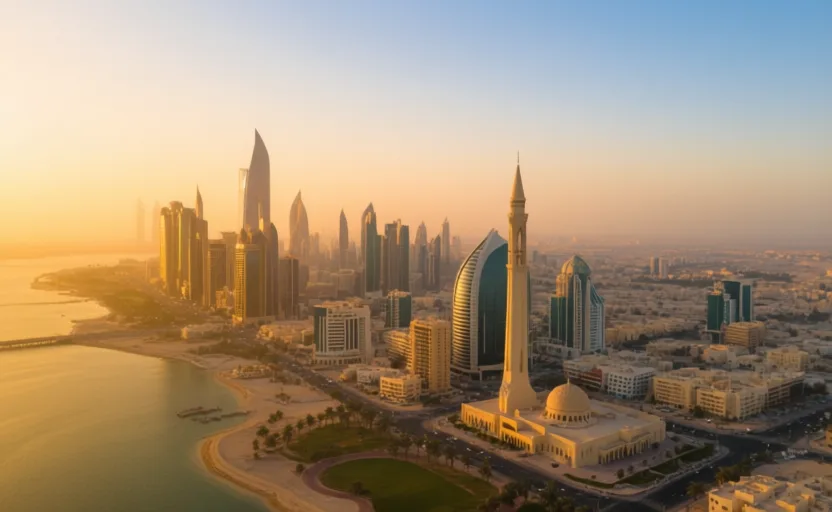 Fujairah · AI city illustration · Artistic impression
City · Middle East
Fujairah
Saved in this browser — no account needed. Sign in later and it comes with you.
Where it is
Fujairah faces the other way from the rest of the UAE. Its city is the only emirate capital on the east coast, and the emirate is the only one whose coastline lies wholly on the Gulf of Oman, with no shore on the Persian Gulf. The Hajar Mountains come down almost to the water, and one pass, Wadi Ham, leads through them to the interior and the Gulf side. Summers reach about 41 °C and the humidity can be high. Rain averages about 120 millimetres a year, mostly between December and March, but heavy storms can flood the plain.
The land and water around it
The Gulf of Oman coastcoast
A shore facing the Gulf of Oman, an arm of the Indian Ocean, which makes Fujairah the UAE’s one emirate with no Persian Gulf shore. It is the capital’s window onto open ocean rather than the enclosed Gulf.
The Hajar foothillsmountains
The city stands in the foothills of the Hajar Mountains, which shelter it from the interior and shape its rainfall.
Wadi Hamvalley
The dry valley that runs through the mountains to the interior and to the Persian Gulf coast, and the main trade route to Fujairah. The Al Bithnah Fort guards it.
Its history, in short
Fujairah’s importance has always been the mountain pass behind it. The Sharqiyin, who dominate the emirate, guard the entrance of Wadi Ham, the route to the interior and the Persian Gulf coast. For centuries this east coast, the Shamaliyah, was subject to Muscat, until in 1850 it passed to the Al Qasimi of Sharjah by agreement. Governors at Kalba often broke away. In 1901 Sheikh Hamad bin Abdullah Al Sharqi declared Fujairah independent of Sharjah, which Muscat and several Trucial sheikhs accepted but Britain did not. At that point the emirate was about 150 houses and 3,000 date palms, living from pearling and dates. Britain gave recognition only in 1952, because an oil exploration company needed to sign a concession with a recognised ruler, so Fujairah was the last emirate to join the Trucial States. It joined the UAE on 2 December 1971. Today the city is an industrial and commercial hub with a port on the Indian Ocean side of the country.
Timeline
Dates are shown on a timeline rather than as changing shapes on the map. The globe draws modern boundaries only, and tinting a modern outline to stand for a historical one would state something we cannot source.
First cities & states
2000–1300 BCE
Wadi Suq burials
Burials at Bithnah and the Qidfa’ Oasis show people living in the emirate and trading from at least 4,000 years ago.
Approximate dateWikipedia
Post-classical world
1446
Al Badiyah Mosque
A small mosque is built of mud and bricks. It is the oldest mosque still in use in the UAE.
Approximate dateWikipedia
Industrial & imperial
1850
The east coast passes to Sharjah
In a deal between the Al Qasimi ruler Sultan bin Saqr and Muscat’s sultan, the east coast, known as the Shamaliyah and until then under Muscat, is annexed by Sharjah.
Well attestedWikipedia1901
Independence from Sharjah
The Sharqiyin chief, Sheikh Hamad bin Abdullah Al Sharqi, declares Fujairah independent. Muscat and several of the Trucial sheikhs recognise it, but Britain does not.
Well attestedWikipedia
Contemporary
1952
Treaty with Britain
Fujairah becomes the last of the emirates to enter treaty relations with Britain. The reason is practical: an oil company needed a concession signed with a recognised ruler.
Well attestedWikipedia2 December 1971
Joins the UAE
The emirate becomes part of the new federation.
Well attestedWikipediaJuly 2022
Floods
The heaviest rain in nearly three decades floods the emirate, damaging businesses and homes and leading to rescues and temporary shelters.
Well attestedWikipedia
Places that carry meaning
Al Badiyah Mosque1446
The oldest mosque in use in the UAE, of mud and brick, with four domes and no minaret. Similar mosques in Yemen, eastern Oman and Qatar usually have between seven and twelve domes.
Al Bithnah FortLate Islamic period
A Sharqiyin fort that guards the Wadi Ham route through the mountains, one of many late Islamic fortresses in the emirate.
Fujairah MuseumOpened 1991
A museum beside the restored fort, holding pottery, jewellery and spearheads from across the emirate, some of them dating to the sixth millennium BCE. Its best-known object is an ostrich egg from about 2500 BCE.
Bidiyah fort1450–1670 (carbon-dated)
A fortress identified with the Portuguese “Libedia” on a 1646 map, built using a tower of the third millennium BCE.
Languages here
Places are usually multilingual. This lists what is actually spoken, not one language per border.
ArabicSemitic family
The official and national language.
Emiratis, who were 34.2 per cent of the city’s population in 2023, speak a Gulf variety of Arabic as their first language.
EnglishGermanic family
The language most commonly spoken across the country, and of business.
As in the rest of the UAE, the expatriate majority use it as a shared language alongside their own.
Learn the language here
- 1Understand which languages are spoken hereFujairah is multilingual. Start with which languages are used, by whom, and for what — the phrase list only covers one of them.Written by Globe Quest
- 2Learn 12 phrasesCurated everyday phrases for Fujairah, with audio and a written form.Written by Globe Quest
- 3Say them out loudSpeaking practice with pronunciation feedback, one phrase at a time.Globe Quest material, your own additions
- 4Come back to themSpaced review, so what you learned this week is still there next month.Written by Globe Quest
- 5Practise with people: Arabic practice · DohaAn in-person practice circle. It is a prepared plan and needs a host before it runs.Run by members
Check yourself
What is distinctive about Fujairah’s coastline within the UAE?
It lies wholly on the Gulf of Oman, with none on the Persian Gulf
Fujairah looks on the Indian Ocean side, through the Gulf of Oman, and it is the only emirate whose shore is entirely there.
Why did Britain finally recognise Fujairah in 1952?
An oil company needed to sign a concession with a recognised ruler
Britain had withheld recognition for over fifty years. Oil exploration made it practical, and the emirate entered treaty relations as the last of the Trucial States.
Worth arguing about
- For centuries this coast answered to Muscat, then Sharjah, then Britain, each on its own terms. Whose history does an emirate like Fujairah belong to?
- Fujairah’s trade rests on one pass through the mountains. How much of a place’s character comes from the one route that connects it to everything else?
What we have not established
These are open questions, listed rather than filled in. We would rather show a gap than a plausible guess.
When was the fort at Bidiyah built?
Carbon dating puts it between 1450 and 1670, a range that straddles the arrival of the Portuguese on this coast, so whether it was a local or a Portuguese work is not settled.
Sources
- Wikipedia · FujairahWikipedia · encyclopedia · checked 2026-11-24
- Wikipedia · Emirate of FujairahWikipedia · encyclopedia · checked 2026-11-24
- Wikipedia · United Arab EmiratesWikipedia · encyclopedia · checked 2026-11-24
- Wikipedia · Demographics of the United Arab EmiratesWikipedia · encyclopedia · checked 2026-11-24
Reviewed by Globe Quest editorial on 2026-11-24. Drafted with AI assistance and checked against the sources above before publication.