 Globe Quest
 Human Quest · LearningSign in
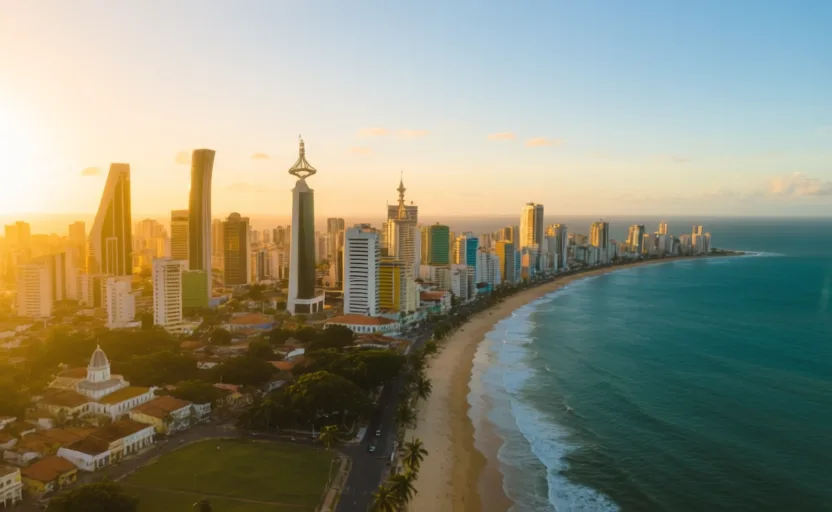 Recife · AI city illustration · Artistic impression
City · Latin America
Recife
Saved in this browser — no account needed. Sign in later and it comes with you.
Where it is
Where the Capibaribe and Beberibe rivers split into a delta before reaching the Atlantic, a low, flat tract of islands and river banks became Recife. The city proper rests on three islands, Recife, Santo Antônio and Boa Vista, joined by more than fifty bridges, which is why people call it the Venice of Brazil. Offshore a long stone reef runs parallel to the beach and encloses the harbour. The climate is tropical monsoon, warm all year with high humidity, a short dry season from October to December, and June the wettest month.
The land and water around it
The reefreef
The word recife means reef. The one that gave the city its name is a consolidated ancient beach, hard as stone, not a coral reef. It runs parallel to the shore and shelters the harbour, but it also makes currents beyond it unpredictable.
The Capibaribe and Beberibe deltadelta
The two rivers meet near the coast and form a tangle of channels and islands. Other rivers, such as the Jiquiá, Tejipió, Jordão and Pina, also cross the city. Sugar cane covered their banks in the sixteenth century.
The coastal sugar plainplain
Warm, wet land around the city carried the cane that made the captaincy wealthy, and the sugar-derived industries of ethanol and sugar remain important in the metropolitan area.
Its history, in short
Recife began between 1535 and 1537 as fishing shacks, inns and warehouses around a harbour, a way station for Portuguese ships. The land belonged to the captaincy of Pernambuco, whose capital was nearby Olinda, and in 1541 the first sugar mill was built on the flood plain of the Beberibe. The sugar boom turned the harbour into a trading hub. In the 1600s the Dutch West India Company took the region and made Recife the capital of New Holland, calling it Mauritsstad. The Portuguese retook it in 1654 after the two battles of Guararapes. In 1710–1711 the merchants of Recife and those of Olinda fought the Mascate War. Today Recife is the largest urban area in the Northeast of Brazil, a commercial centre with ports, an airport, a large medical sector and a digital district in the old port quarter.
Timeline
Dates are shown on a timeline rather than as changing shapes on the map. The globe draws modern boundaries only, and tinting a modern outline to stand for a historical one would state something we cannot source.
Early modern & oceanic
1535–1537
Port of Olinda
Duarte Coelho settles Igarassu and Olinda in 1536, and the royal charter of March 1537 refers to the port at the “reef of the ships”. Fishing huts and warehouses collect around it.
Approximate dateWikipedia1541
First sugar mill
Coelho brings machinery from Portugal, and his brother-in-law builds the first mill, Our Lady of Help, on the floodplain of the Beberibe.
Well attestedWikipedia17th century to 1654
Mauritsstad, capital of New Holland
The Dutch West India Company holds the region and makes Recife its capital. Olinda is looted and burned by the Dutch, and the Portuguese recapture Recife in 1654 after the battles of Guararapes.
1710–1711
The Mascate War
Merchants of Recife and merchants of nearby Olinda fight each other in a dispute that shows the port’s growing weight.
Well attestedWikipedia1782
Cathedral of São Pedro
The cathedral on the Pátio de São Pedro dates from this year, one of the colonial buildings around which the old city is organised.
Well attestedWikipedia
Contemporary
1982
Olinda inscribed
UNESCO lists the historic centre of nearby Olinda, whose existing buildings date largely from the eighteenth century, after the Dutch burned the earlier town.
1995
Surfing banned
After a run of shark attacks along the urban beaches, surfing is outlawed on Pina, Boa Viagem, Piedade and Candeias.
Well attestedWikipedia
Places that carry meaning
Old Recife and the Pátio de São Pedro17th and 18th centuries
The old harbour quarter, with restored colonial houses around a rectangular square and the cathedral of 1782. The Cinco Pontes fort houses the state museum.
OlindaFounded 1535; most buildings 18th century
The hill town six kilometres north that once ruled the captaincy. Its churches and convents, about twenty baroque churches among them, reflect the wealth of the sugar economy.
Porto DigitalRecent
A technology district with more than 90 companies, set in the historic port quarter.
Languages here
Places are usually multilingual. This lists what is actually spoken, not one language per border.
PortugueseRomance family
The language of the city.
Portuguese settled the coast from the 1530s. A Dutch interlude in the seventeenth century left traces in the city’s history, but the Portuguese retook it in 1654 and the language held its place.
Indigenous languages
Spoken by Brazil’s many Indigenous peoples, long before Portuguese.
Brazil today has about 217 Indigenous languages, though none is spoken by more than 40,000 people. This is a national figure and does not describe Recife.
Brazilian Sign Language (Libras)
Made the official language of the deaf community in 2002.
Libras is a full sign language used by deaf people across the country, and Recife is part of that national community.
Learn the language here
- 1Understand which languages are spoken hereRecife is multilingual. Start with which languages are used, by whom, and for what — the phrase list only covers one of them.Written by Globe Quest
- 2Learn 12 phrasesCurated everyday phrases for Recife, with audio and a written form.Written by Globe Quest
- 3Say them out loudSpeaking practice with pronunciation feedback, one phrase at a time.Globe Quest material, your own additions
- 4Come back to themSpaced review, so what you learned this week is still there next month.Written by Globe Quest
Check yourself
What is the reef that gave Recife its name?
A consolidated ancient beach as hard as stone
The reef is not coral but an old beach that has set hard, and it runs parallel to the shore enclosing the harbour.
What was Recife called under Dutch rule?
Mauritsstad
It was the capital of New Holland, founded by the Dutch West India Company, until the Portuguese retook it in 1654.
Worth arguing about
- Recife began as the port of Olinda, and their merchants later fought a war. When does a port deserve to outrank the town that created it?
- Shark attacks since the 1990s have changed how people use the beach. Should a city that sells its coast restrict it, or warn and leave the choice to bathers?
What we have not established
These are open questions, listed rather than filled in. We would rather show a gap than a plausible guess.
How many people live in Recife?
The 2022 census counted about 1.49 million in the city, while the metropolitan area has more than three and a half million. The total depends on whether the urban area or the legal municipality is meant.
Sources
- Wikipedia · RecifeWikipedia · encyclopedia · checked 2026-11-24
- UNESCO · Historic Centre of the Town of OlindaUNESCO World Heritage Centre · intergovernmental · checked 2026-11-24
- Wikipedia · Languages of BrazilWikipedia · encyclopedia · checked 2026-11-24
Reviewed by Globe Quest editorial on 2026-11-24. Drafted with AI assistance and checked against the sources above before publication.