 Globe Quest
 Human Quest · LearningSign in
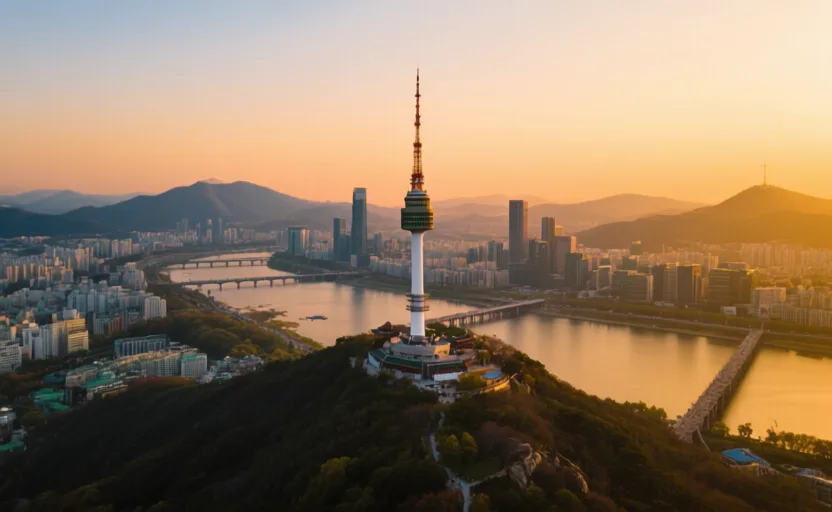 Seoul · AI city illustration · Artistic impression
City · East Asia
Seoul
Also known as Hanseong, Gyeongseong, 서울
Saved in this browser — no account needed. Sign in later and it comes with you.
Where it is
Mountains ring the Korean capital and a broad river cuts through its middle. Seoul proper covers about 605 square kilometres in the northwest of the country, roughly 15 kilometres in radius, with the Han River dividing it into a northern and a southern half. Four hills in the old centre, Bugaksan, Inwangsan, Naksan and Namsan, carry the line of the historic fortress wall, and Bukhansan stands at the northern edge, while the Han plain opens to the west and south. The climate is monsoonal, with hot humid summers, a rainy season in June and July, typhoons between July and September, and very cold winters.
The land and water around it
Han Riverriver
The river splits the capital in two. Baekje’s early capital lay on the south side and the Joseon city on the north. The Han is no longer used for navigation because its estuary lies on the border between the two Koreas, where civilian entry is barred.
The inner mountainsmountains
Bugaksan, Inwangsan, Naksan and Namsan stand in the old centre, and the Seoul Fortress Wall runs over them. Eight mountains in all border the city, along with the more level Han plain and the western districts.
Cheonggyecheonriver
A stream that runs west to east through the valley of the old city before it meets the Han. It was covered in concrete for many years and uncovered again by an urban revival project in 2005.
Its history, in short
People lived along the lower Han for tens of thousands of years, but the city’s documented story starts in 18 BCE, when Baekje founded its capital, Wiryeseong, on the south bank in what is now southeastern Seoul. Silla seized the region in 553, Goryeo built a secondary “southern capital” here in 1104, and in 1394 the founder of Joseon chose Hanyang as his new capital and planned it as an expression of Confucian ideas, within a wall that took shape around 1396. Late in the nineteenth century, after centuries of isolation, the city opened to foreigners and became the first in East Asia to have electricity, trolleys, water, telephone and telegraph systems at once. Japan annexed Korea in 1910, renamed the city Keijō or Gyeongseong, tore down the walls and cut it down to a district of the surrounding province. After 1945 it took its present name and in 1946 became a city under its own charter. Fighting in the Korean War changed its hands four times and left it largely in ruins. Postwar reconstruction, annexations in 1963 and the development of Gangnam from the late 1970s built the modern metropolis, hosted the 1988 Olympic Games, and made it the centre of a metropolitan area that holds more than half the country’s people.
Timeline
Dates are shown on a timeline rather than as changing shapes on the map. The globe draws modern boundaries only, and tinting a modern outline to stand for a historical one would state something we cannot source.
Classical world
18 BCE
Baekje’s capital Wiryeseong
Baekje founds its capital on the Han River. The site is thought to lie within the earthen ramparts of Pungnap and Mongchon in what is now southeastern Seoul, though its exact location is not known.
Post-classical world
553
Silla takes the Han valley
In July or August, Silla takes control of the area from Baekje and makes it a province. The Silla king later visits the area and, in 568, makes Namcheon the seat of a new province.
Approximate dateWikipedia1104
Southern Capital
King Sukjong of Goryeo builds a palace near today’s Gyeongbokgung. The place, called Namgyeong, grows into a full-scale city with political weight.
Well attestedWikipedia1394–1396
Joseon makes Hanyang its capital
Yi Seong-gye chooses Hanyang over Muak in September 1394 and construction begins in October. Gyeongbokgung is finished in 1395 and the fortress wall is partly done by about 1396.
Well attestedWikipedia
Industrial & imperial
1910
Annexation and Keijō
After the annexation treaty Japan renames the city Gyeongseong (Keijō in Japanese), demotes it to an ordinary city within Gyeonggi Province, removes the city walls and builds Western-style buildings.
Well attestedWikipedia
Contemporary
1950–1953
The city changes hands four times
The Korean War leaves the city mostly in ruins. One estimate of the ruin counts 191,000 or more buildings, among them some 55,000 homes and a thousand factories, and refugees from the north swell the population to about 2.5 million, more than half of them homeless.
1988
Summer Olympics
Seoul hosts the Olympic Games on the back of rapid growth since the 1960s. The Olympic Park built for the games in Songpa District is now the city’s largest park.
Well attestedWikipedia2004
Constitutional Court keeps the capital in Seoul
After the government announces a plan to move the capital south, the Constitutional Court rules that Seoul must remain the capital as an unwritten constitutional custom, unless a national referendum decides otherwise. Sejong City, opened in 2012, takes on many ministries instead.
Places that carry meaning
Changdeokgung Palace Complex15th century
A 57.9-hectare palace at the foot of Baegaksan, built as a secondary palace beside Gyeongbokgung. Its buildings follow the slope rather than a rigid grid, and the large rear garden, Biwon, holds over 56,000 trees and plants.
Jongmyo ShrineBuilt late 14th century; rebuilt early 17th century
The shrine where the spirit tablets of Joseon’s kings and queens are kept. The original was destroyed in the Japanese invasion of the 16th century and rebuilt in the early 17th, and ancestral rites with music and dance are still performed there.
Fortress wall and gatesFrom 1396
The Joseon wall once enclosed the whole city. Most of it was removed in the colonial period, but it survives over the northern mountains, and gates including Sungnyemun (Namdaemun) and Heunginjimun (Dongdaemun) still stand in the downtown.
Languages here
Places are usually multilingual. This lists what is actually spoken, not one language per border.
Korean
The language of the city and the basis of the national standard.
The standard Korean of the country is called the Seoul dialect. Seoul’s word for itself comes from the common noun “capital city”, an old native Korean word.
ChineseSino-Tibetan family
The language of the largest group of foreign residents.
In 2016 Seoul had 404,037 foreign residents. Chinese citizens formed the largest group, most of them ethnic Koreans (186,631 in 2011) and some not (29,901). The next largest were United States and Taiwanese citizens.
EnglishGermanic family
Taught throughout school and used with foreign residents.
Almost all South Korean students study English throughout their education.
Learn the language here
- 1Understand which languages are spoken hereSeoul is multilingual. Start with which languages are used, by whom, and for what — the phrase list only covers one of them.Written by Globe Quest
- 2Learn 12 phrasesCurated everyday phrases for Seoul, with audio and a written form.Written by Globe Quest
- 3Say them out loudSpeaking practice with pronunciation feedback, one phrase at a time.Globe Quest material, your own additions
- 4Come back to themSpaced review, so what you learned this week is still there next month.Written by Globe Quest
Check yourself
What does the word “seoul” mean in Korean?
Capital city
Seoul is an old native Korean word for a capital. It was used informally for the Joseon capital Hanseong long before it became the city’s official name in 1946.
What happened to the Joseon fortress wall?
Most of it was removed under Japanese rule, and it survives mainly over the northern mountains
The wall once circled the city but was taken down in the colonial period, apart from sections over the mountains and several of the great gates.
Worth arguing about
- The Constitutional Court said Seoul must remain the capital by custom, yet many ministries have moved to Sejong. What makes a capital a capital?
- The city’s centre was shaped by a fortress, flattened by war and rebuilt at speed. How much of the older city should be reconstructed?
What we have not established
These are open questions, listed rather than filled in. We would rather show a gap than a plausible guess.
Is Seoul’s population falling since 2014, or since the early 1990s?
Accounts date the start of the decline differently. One places the peak above 10 million and the decline from 2014, while another says the number has been dropping since the early 1990s as people move out to satellite cities in Gyeonggi. About 9.6 million lived in the city in 2024.
Sources
- Wikipedia · SeoulWikipedia · encyclopedia · checked 2026-11-24
- Wikipedia · History of SeoulWikipedia · encyclopedia · checked 2026-11-24
- Wikipedia · South KoreaWikipedia · encyclopedia · checked 2026-11-24
- UNESCO · Jongmyo ShrineUNESCO World Heritage Centre · intergovernmental · checked 2026-11-24
- UNESCO · Changdeokgung Palace ComplexUNESCO World Heritage Centre · intergovernmental · checked 2026-11-24
Reviewed by Globe Quest editorial on 2026-11-24. Drafted with AI assistance and checked against the sources above before publication.