 Globe Quest
 Human Quest · LearningSign in
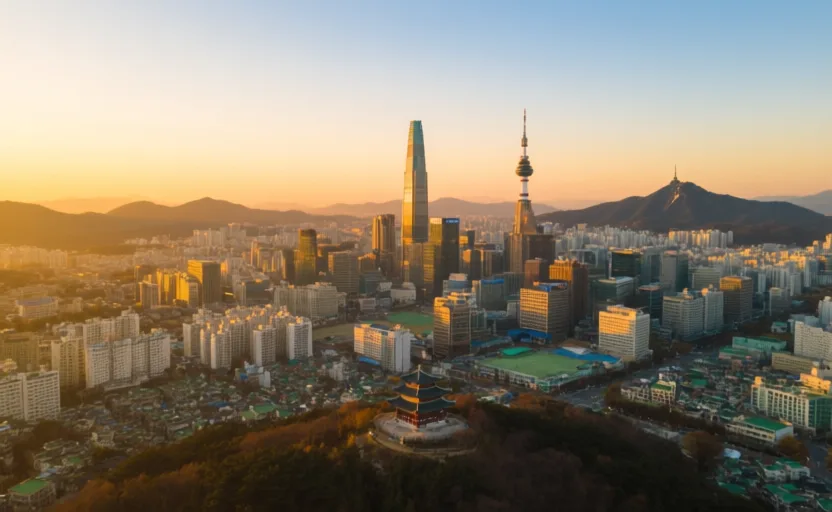 Suwon · AI city illustration · Artistic impression
City · East Asia
Suwon
Saved in this browser — no account needed. Sign in later and it comes with you.
Where it is
About 30 kilometres south of Seoul, Suwon fills a shallow basin on the northern edge of the Gyeonggi plain. Low hills close it in: Gwanggyosan to the north, the Chilbosan ridge to the west, and Paldalsan, a granite hill, in the old centre. Every stream rises on these slopes and runs south, and together they drain to the Yellow Sea at Asan Bay. Natural lakes are rare on the Korean mainland, so the city’s eleven small lakes are all reservoirs. The climate sits on the line between humid continental and humid subtropical, and heavy rain has caused floods, including 145 mm in a single day in 2010.
The land and water around it
Paldalsan and the Suwon basinplain
Jurassic biotite granite centred on Paldalsan underlies much of the city, with older gneiss in the north. The fortress was laid out across this ground, its southern and northern gates linked by the main road, and the wall climbs the hill and drops back to the flat.
The Suwoncheon and its reservoirsriver
The main stream of Suwon flows through the middle of the fortress. It and its neighbours run south and merge before reaching the Yellow Sea, so the whole city drains one way. With so few natural lakes in Korea, the city’s water bodies are built reservoirs, and one of them, Manseokkeo, has been designated a world heritage irrigation site.
The Sihwa tidal coastcoast
The Yellow Sea is only about 18 kilometres from the western ridge. Sihwa Lake, a coastal inlet closed off from the sea, holds the world’s largest tidal power station, a reminder of how near the tidal flats lie to this inland-feeling city.
Its history, in short
The place name means “water source”, and nearly every earlier name for the area carried the same sense. The district began as a small polity of the Mahan confederacy, passed under Goguryeo influence, then Unified Silla, then Goryeo, and took the name Suwon in 1310. For centuries local government sat a few kilometres away at the foot of Hwasan. In 1796 King Jeongjo moved the centre to its present site under Paldalsan and ordered a fortress wall built around it. The wall made Suwon a planned city rather than a market town. In the twentieth century the town became a prize in war: it changed hands four times in the Korean War, and a massacre of about 1,800 people is placed here in June 1950. Gyeonggi Province began moving its headquarters here from Seoul in 1964, and Samsung Electronics, founded in the city in 1969, brought its own headquarters to Suwon in 1973. The city has kept absorbing villages from its neighbours ever since, and new planned towns such as Gwanggyo now stand beyond the old wall.
Timeline
Dates are shown on a timeline rather than as changing shapes on the map. The globe draws modern boundaries only, and tinting a modern outline to stand for a historical one would state something we cannot source.
Post-classical world
1310
The name Suwon is given
After centuries of changing names that nearly all meant “water source”, the district receives the name it still carries.
Well attestedWikipedia1395
Administrative centre of Gyeonggi
Soon after the founding of the Joseon dynasty, Suwon is made an administrative centre of Gyeonggi Province.
Well attestedWikipedia
Early modern & oceanic
1796
Jeongjo moves the town and builds Hwaseong
King Jeongjo relocates central Suwon to the foot of Paldalsan and commands a defensive wall around it. The completion report, the Hwaseong Seongyeok Uigwe, is published in 1801.
Industrial & imperial
1899
A town of about 50,000
An administrative report records 49,708 people in 12,579 households.
Well attestedWikipedia
Contemporary
1950–1953
Four changes of hands
The first aerial combat of the Korean War is fought over Suwon Airfield on 27 June 1950, and the city falls to the North a week later. It changes hands four times in all. A US intelligence officer’s account places a massacre of about 1,800 suspected leftists here in late June 1950.
Approximate dateWikipedia1967
Provincial headquarters completed
Gyeonggi Province’s headquarters, begun in 1964, are finished on 23 June 1967, a date now kept as Suwon Citizen’s Day.
Well attestedWikipedia1973
Samsung Electronics arrives
Samsung Electronics moves its headquarters from Euljiro in Seoul to Suwon in order to build an electronic components plant with Japan’s Sanyo.
Well attestedWikipedia
Places that carry meaning
Hwaseong Fortress1796
A 5.74-kilometre wall of stone and brick enclosing 130 hectares, with four cardinal gates, floodgates, observation towers and bastions. It was designed by the scholar Jeong Yakyong, mixing residential and military functions, and its builders were paid for their labour at a time when corvée was normal.
Suwon Hyanggyo1291; moved c. 1795
A state Confucian school, the largest and oldest in Gyeonggi under the Joseon dynasty. It was built beside Hwasan and shifted to its present site when the fortress went up.
Adams Memorial Hall1923
A building funded partly by a church in the United States, where independence activists such as Park Seon-tae and Lee Deuk-su met weekly during Japanese colonial rule.
Languages here
Places are usually multilingual. This lists what is actually spoken, not one language per border.
Korean
The everyday and official language.
The standard dialect is the speech of Seoul, which lies 30 kilometres to the north. It is written in Hangul, created in 1446, while Hanja survive only in niche uses such as print media and legal papers.
EnglishGermanic family
A taught second language.
Almost all students in South Korea learn English at school. About 2.9 per cent of Suwon’s residents are foreign.
Learn the language here
- 1Understand which languages are spoken hereSuwon is multilingual. Start with which languages are used, by whom, and for what — the phrase list only covers one of them.Written by Globe Quest
- 2Learn 11 phrasesCurated everyday phrases for Suwon, with audio and a written form.Written by Globe Quest
- 3Say them out loudSpeaking practice with pronunciation feedback, one phrase at a time.Globe Quest material, your own additions
- 4Come back to themSpaced review, so what you learned this week is still there next month.Written by Globe Quest
Check yourself
What does the name Suwon literally mean?
Water source
Nearly every earlier name for the area shared this meaning, which fits a basin where the streams rise on the surrounding hills.
Why did King Jeongjo move the centre of Suwon in 1796?
To place the town at the foot of Paldalsan and protect it with a new wall, Hwaseong
The new site at the foot of Paldalsan was walled as a defended political and commercial town, and the fortress still defines the old centre.
Worth arguing about
- A city planned around a wall in 1796 now hosts one of the world’s largest electronics employers. What does its early planning explain about how it has grown?
- Suwon has lost land to, and gained land from, almost every neighbour since 1963. How does a city keep an identity when its borders keep moving?
Sources
- Wikipedia · SuwonWikipedia · encyclopedia · checked 2026-11-24
- Wikipedia · South KoreaWikipedia · encyclopedia · checked 2026-11-24
- UNESCO · Hwaseong FortressUNESCO World Heritage Centre · intergovernmental · checked 2026-11-24
Reviewed by Globe Quest editorial on 2026-11-24. Drafted with AI assistance and checked against the sources above before publication.