 Globe Quest
 Human Quest · LearningSign in
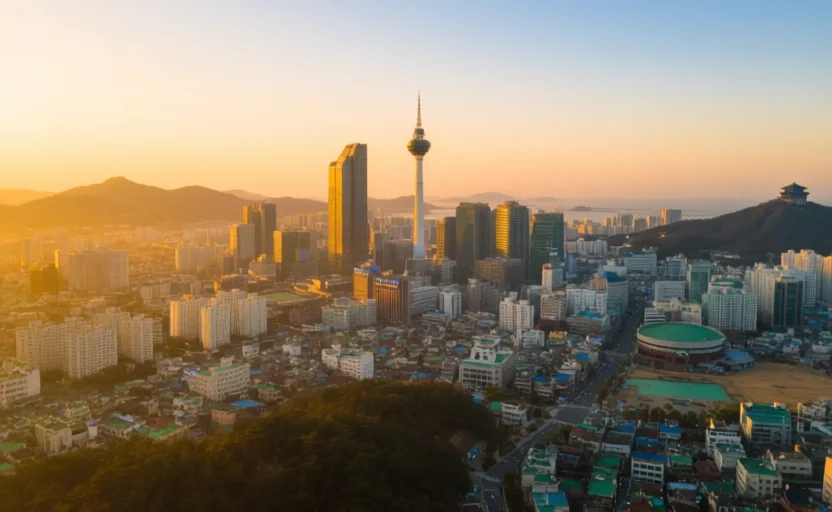 Ulsan · AI city illustration · Artistic impression
City · East Asia
Ulsan
Saved in this browser — no account needed. Sign in later and it comes with you.
Where it is
Ulsan occupies the south-eastern tip of the Korean Peninsula, where the southern end of the Taebaek Mountains runs down to the East Sea. The coast is a mountainous emergent one, simple in outline. The Taehwa River crosses the city to reach the sea and has been the axis of its ecological restoration since the early 2000s. Busan is about 70 kilometres to the south. Winters are cold but dry, summers hot and humid, with most rain between April and September.
The land and water around it
Southern end of the Taebaek Mountainsmountains
The range ends here at the coast, so the city lies where hills meet the East Sea. The coastline is classed as a mountainous emergent coast.
The Taehwa Riverriver
It flows through the middle of the city to the East Sea, and its banks have been a focus of clean-up and restoration since the early twenty-first century.
Bangucheon Streamvalley
A meandering stream about three kilometres long, cut through stratified cliffs. Two rock panels along it carry thousands of years of carvings, so the same valley records people who lived on this coast long before the port.
Its history, in short
People have lived here since the Palaeolithic: stone tools turn up at Mugeo-dong, and a long run of Bronze Age settlements follows. In the Jinhan period the area mined and worked iron. Under Later Silla it served as a port for the economic centre at Gyeongju, probably receiving Persian luxuries such as glass and silver. In 1592 warrior monks and citizen soldiers resisted the Japanese invasion here, and a combined Korean and Chinese siege of the castle failed in January 1598. Shipbuilding was recorded as early as 1642. The modern city is a product of the early 1960s. Until 1962 it was a fishing port and market town; that year the government made it a Special Industrial Zone as part of the first five-year plan, and it became a city the next year. Hyundai Heavy Industries founded its shipyard in 1973, and the city grew into a company town. Ulsan became a metropolitan city in 1997.
Timeline
Dates are shown on a timeline rather than as changing shapes on the map. The globe draws modern boundaries only, and tinting a modern outline to stand for a historical one would state something we cannot source.
First cities & states
c. 5000 BCE to 9th century CE
Carving on the Bangucheon cliffs
Successive generations engrave animals, hunters, whales and inscriptions on the rock, in a tradition that runs from the Neolithic through the Bronze Age to the Silla period.
Approximate dateUNESCO World Heritage Centre
Post-classical world
Later Silla period
Port for Gyeongju
Ulsan serves as an important harbour for the economic hub at Gyeongju and likely receives luxury goods from Persia such as silver and glass.
Approximate dateWikipedia
Early modern & oceanic
1592
Resistance to the Japanese invasion
Warrior monks join citizen soldiers against the invaders at the port town. A Korean and Chinese operation to besiege the castle fails in January 1598.
Well attestedWikipedia1642
Shipbuilding on record
Joseon records show Ulsan was already developed as a shipbuilding site by this year.
Well attestedWikipedia
Contemporary
1962
Special Industrial Zone
Under the country’s first five-year economic plan, Ulsan is opened as a port and designated an industrial district, and the shipbuilding port of Bangeojin is annexed. It becomes a city the next year.
Well attestedWikipedia1973
Hyundai Heavy Industries founded here
The shipyard draws a large influx of workers, effectively turning the city into a company town.
Well attestedWikipedia15 July 1997
Metropolitan city
Ulsan is promoted to metropolitan city status, after legislation was declared at the end of 1996.
Well attestedWikipedia
Places that carry meaning
Petroglyphs along the Bangucheon Stream5000 BCE to 9th century CE
Two panels, at Daegok-ri and Cheonjeon-ri, carry animals detailed enough to identify the species, human figures, hunting scenes, geometric patterns and writing. The images of whales and stages of whaling are rare in rock art anywhere.
The Ulsan Industrial Districtfrom 1962
The district holds the world’s largest car assembly plant, the world’s largest shipyard and a major oil refinery. It is where South Korea’s first hydrogen car charging station opened in 2009.
Languages here
Places are usually multilingual. This lists what is actually spoken, not one language per border.
Korean
The language of daily life and administration.
Korean has a standard dialect based on Seoul speech and four regional dialects, among them Gyeongsang, plus Jeju as a separate language. It is written in Hangul.
EnglishGermanic family
A taught second language.
Almost every student in South Korea studies English through school.
Learn the language here
- 1Understand which languages are spoken hereUlsan is multilingual. Start with which languages are used, by whom, and for what — the phrase list only covers one of them.Written by Globe Quest
- 2Learn 11 phrasesCurated everyday phrases for Ulsan, with audio and a written form.Written by Globe Quest
- 3Say them out loudSpeaking practice with pronunciation feedback, one phrase at a time.Globe Quest material, your own additions
- 4Come back to themSpaced review, so what you learned this week is still there next month.Written by Globe Quest
Check yourself
What changed for Ulsan in 1962?
It was designated a Special Industrial Zone and began its shift from fishing port to industrial city
Before 1962 it was a fishing port and market town. The first five-year plan opened it as a port and industrial district, and Hyundai and SK soon followed.
What makes the Bangucheon petroglyphs unusual in world rock art?
They record whales and stages of whaling
Whaling scenes are seldom depicted in rock art, and these carvings span about 6,000 years of coastal life.
Worth arguing about
- A city shaped within one lifetime around a few conglomerates is sometimes called a company town. What does a place lose, and gain, when one firm decides its direction?
- Ulsan built the country’s first hydrogen stations and now pipes by-product hydrogen into the city. Is an industrial city the right place to test a clean-energy future?
Sources
- Wikipedia · UlsanWikipedia · encyclopedia · checked 2026-11-24
- Wikipedia · South KoreaWikipedia · encyclopedia · checked 2026-11-24
- UNESCO · Petroglyphs along the Bangucheon StreamUNESCO World Heritage Centre · intergovernmental · checked 2026-11-24
Reviewed by Globe Quest editorial on 2026-11-24. Drafted with AI assistance and checked against the sources above before publication.