 Globe Quest
 Human Quest · LearningSign in
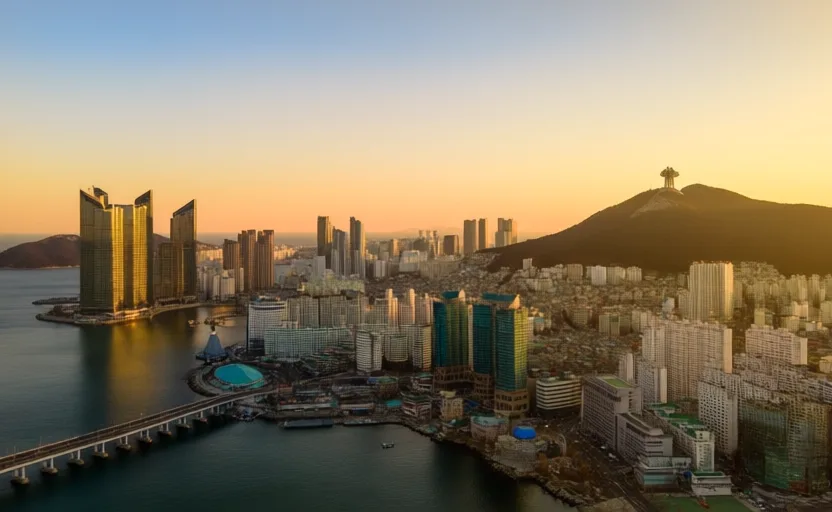 Busan · AI city illustration · Artistic impression
City · East Asia
Busan
Saved in this browser — no account needed. Sign in later and it comes with you.
Where it is
On the southeastern tip of the Korean Peninsula, Busan is a city made by its coastline. The Korea Strait lies to the south and east, low mountains close the north and west, and the heavily built-up districts are packed into narrow valleys between the Nakdong and Suyeong rivers, with mountains separating the districts. Geumjeongsan is the highest peak. The Nakdong, the longest river in South Korea, reaches the sea through a delta on the west side. Tsushima, in Japan, is only about 50 kilometres away, and the city sits roughly 314 kilometres from Seoul. Winters are mild by Korean standards and snow falls on about four days a year, but typhoons are a recurring danger.
The land and water around it
Nakdong River deltadelta
The delta lies on the west side of the city, where the longest river in South Korea reaches the Korea Strait.
Geumjeongsan and the valleysmountains
Low mountains to the north and west box the city in. Geumjeongsan, the highest in the city, stands to the north, and the dense neighbourhoods fill the narrow valleys between the Nakdong and Suyeong rivers.
Korea Strait coaststrait
The southeast tip of the peninsula faces the strait and Japan. It gives Busan its harbour, but it also puts the city along the paths of typhoons, which struck severely in 1959 (Sarah), 2003 (Maemi, with more than 48 deaths) and 2022 (Hinnamnor).
Its history, in short
Busan’s earliest story is local. A first-century chiefdom around today’s Dongnae District was absorbed by Silla and renamed Dongnae in 757, and the temple of Beomeosa was founded in 835. Raids by Japanese pirates grew serious in the late Goryeo period, and a fortress at Dongnae was built to meet them. In 1423 the port of Busan was set up together with a waegwan, a quarter for Japanese traders and envoys, and the city became the main point of contact between Korea and Japan. The Japanese invasions of 1592 to 1598 brought sieges here. Diplomatic relations resumed in 1607 and the Japanese quarter was re-established. The Treaty of Ganghwa of 1876 made Busan the country’s first port open to the world; a customs office opened in 1883, and under Japanese rule it grew into a trading hub with ferries to Shimonoseki. During the Korean War, the North Korean army never captured it, nor Daegu, and the Pusan Perimeter held around it. It became a refuge for some 500,000 people and for a time acted as the de facto capital. In 1963 it was made the country’s first directly governed city.
Timeline
Dates are shown on a timeline rather than as changing shapes on the map. The globe draws modern boundaries only, and tinting a modern outline to stand for a historical one would state something we cannot source.
Post-classical world
757
Dongnae is named
Silla gives the district a new name, Dongnae. A chiefdom called Geochilsan-guk is recorded on the same ground around the first century, before Silla absorbed it.
Approximate dateWikipedia1423
Port and Japanese quarter
The port of Busan and a waegwan, a settlement for Japanese traders and envoys, are established under King Sejong’s reign. The waegwan is closed in 1510 and reopened in 1512.
Well attestedWikipedia
Early modern & oceanic
1592–1598
The Japanese invasions
Fortresses around Busan hold out against the invasion, and civilians form volunteer armies. After the fall of Busanjin in 1592 most of its Korean prisoners and civilians are massacred.
Well attestedWikipedia
Industrial & imperial
1876
First treaty port
A treaty, signed at Ganghwa, makes Busan Korea’s first port open to international trade. A concession is set up in 1877 with consulates for Japan, Qing China and Britain, and the port formally opens in 1883.
Well attestedWikipedia
Contemporary
1950–1953
Refuge and wartime capital
UN troops hold a defensive line called the Pusan Perimeter around the city in the summer and autumn of 1950. Around 500,000 refugees are in Busan by early 1951, and it serves for a time as the de facto capital.
Well attestedWikipedia1963
Directly governed city
Busan separates from South Gyeongsang Province and becomes the first Directly Governed City in Korea. In 1983 the provincial capital moves to Changwon.
Well attestedWikipedia2014
City of Film
UNESCO adds Busan to its Creative Cities Network as a City of Film. The city holds an international film festival each autumn at the Busan Cinema Center.
Well attestedWikipedia
Places that carry meaning
BeomeosaFounded 835
A Buddhist temple founded in 835 in the hills of the Dongnae area, one of the oldest recorded institutions in the city.
Dongnaeeupseong FortressAbout 1396
A town fortress built in response to raids by Japanese pirates, which grew heavier toward the end of the Goryeo period, with one landing in 1396. It was one of the fortresses that defended the area during the invasions of 1592.
Chungnyeolsa Shrine1605; renamed 1624
A shrine honouring those who died defending Korea during the invasions. It was first built as Songgongsa in 1605 and renamed Chungnyeolsa in 1624.
Dongnae hot springsGoryeo period onward
Springs that were already famous in the Goryeo period. Busan’s Oncheon is described as the oldest hot spring spa in Korea.
Languages here
Places are usually multilingual. This lists what is actually spoken, not one language per border.
Korean
The language of daily life and administration.
Busan lies in the Yeongnam region, which takes in both Gyeongsang provinces. The Gyeongsang dialect is one of four regional varieties used alongside the Seoul standard, and Hangul is the writing system.
EnglishGermanic family
A school subject and a language of international events.
Almost all South Korean students learn English, which is used at the international events Busan hosts, such as the film festival and the 2005 APEC summit.
Learn the language here
- 1Understand which languages are spoken hereBusan is multilingual. Start with which languages are used, by whom, and for what — the phrase list only covers one of them.Written by Globe Quest
- 2Learn 11 phrasesCurated everyday phrases for Busan, with audio and a written form.Written by Globe Quest
- 3Say them out loudSpeaking practice with pronunciation feedback, one phrase at a time.Globe Quest material, your own additions
- 4Come back to themSpaced review, so what you learned this week is still there next month.Written by Globe Quest
Check yourself
What made Busan the first of its kind in Korea in 1876?
It became the first international port under the Treaty of Ganghwa
The Treaty of Ganghwa opened Busan to foreign trade, followed by concessions with consulates in 1877 and a customs office in 1883.
Why did Busan become a refuge during the Korean War?
It stayed under South Korean control inside the Pusan Perimeter
Busan and Daegu were the only two southern cities not taken by North Korea, so refugees poured into them, with around 500,000 in Busan by early 1951.
Worth arguing about
- Busan has been Korea’s door to Japan since the 15th century and its first treaty port. How does a city’s role as a gateway shape the way it sees itself?
- The city’s population has fallen as high-tech industry concentrated around Seoul. What can a port city do when its traditional industry no longer sets the national agenda?
What we have not established
These are open questions, listed rather than filled in. We would rather show a gap than a plausible guess.
How many people live in Busan?
One description gives over 3.3 million people for 2024, while a demographic series gives 3,266,598 for that year, down from 3,513,777 in 2015. The two cannot be reconciled without knowing which boundary and registration each uses.
Sources
- Wikipedia · BusanWikipedia · encyclopedia · checked 2026-11-24
- Wikipedia · South KoreaWikipedia · encyclopedia · checked 2026-11-24
Reviewed by Globe Quest editorial on 2026-11-24. Drafted with AI assistance and checked against the sources above before publication.