 Globe Quest
 Human Quest · LearningSign in
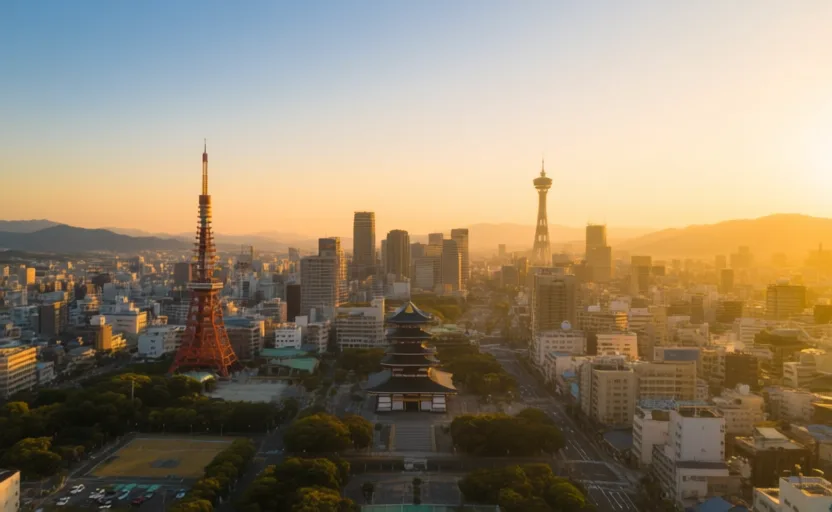 Fukuoka · AI city illustration · Artistic impression
City · East Asia
Fukuoka
Saved in this browser — no account needed. Sign in later and it comes with you.
Where it is
On the north coast of Kyushu, Fukuoka curves around Hakata Bay and looks out through the Genkai Sea toward Korea. Mountains close the city in on its other three sides. The surrounding plain was under water in Jōmon times, and the bay has been a harbour ever since people were crossing from the continent. Busan lies only about 180 kilometres away, closer than Tokyo, which is 1,100 kilometres off. The climate is humid subtropical, with a six-week rainy season in June and July, summer peaks near 37 °C and typhoons in late summer. A fault line, the Kego, runs through the centre of the city.
The land and water around it
Hakata Baybay
The curve of sheltered water on which the city is built, and the reason it has been an international trading port since ancient times.
The Genkai Seasea
The open water to the north that links the bay to the Korean coast. It is also where an offshore extension of the Kego fault produced the earthquake of 2005.
The Fukuoka Plainplain
Low land beneath mountains on three sides. It lay under water in the Jōmon period, so the earliest sites sit on higher ground at its edge.
Its history, in short
Because this is the point on the main islands nearest the Asian mainland, waves of settlers came through, among them some of the earliest Yayoi farmers. A Chinese record dates a diplomatic mission to the Han court to 57 CE. By the end of the Asuka period the nearby administrative centre at Dazaifu governed Kyushu and handled trade with Tang China. The Zen monk Eisai founded Shōfuku-ji here and brought tea to Japan. The city was the landing point for the Mongol fleets of 1274 and 1281. Through the Muromachi period Hakata, the old merchant port, was run by a council of twelve rich merchants and acted as a free city, trading with China and Korea. The name Fukuoka dates from 1600, when the daimyō Kuroda Nagamasa named his new castle town for his clan’s home district. Distance from Kyoto and Tokyo gave the city a local culture and dialect of its own. Firebombing in June 1945 destroyed over a fifth of the urban area, and the Shinkansen reached Hakata in 1975.
Timeline
Dates are shown on a timeline rather than as changing shapes on the map. The globe draws modern boundaries only, and tinting a modern outline to stand for a historical one would state something we cannot source.
Classical world
57 CE
A mission to the Han court
The Book of the Later Han records an envoy from this region at the court of Emperor Guangwu, which gave the ruler a gold seal. The seal was found in the 17th century.
Approximate dateWikipedia
Post-classical world
1241
Origin of the Yamakasa festival
A priest is said to have saved Hakata from a plague by being carried through the streets on a float. The July festival that continues the story is the city’s oldest.
Oral historyWikipediaThe festival’s own foundation story, as told in the city.
1274 and 1281
Mongol invasions
Kublai Khan first sends envoys, then in 1274 an armada of 900 vessels carrying 33,000 men, some of them from Goryeo, lands in northern Kyushu. Poor command and heavy storms undermine that first attempt, and the second invasion follows in 1281.
Well attestedWikipediaMuromachi period
Hakata as a free city
A council of twelve wealthy merchants called Tongyoji governs Hakata, which is the main port for trade with Song and Yuan China and with Korea.
Approximate dateWikipedia
Early modern & oceanic
1600
The name Fukuoka
The daimyō Kuroda Nagamasa names his new castle town for a district in Bizen Province, where his clan came from.
Well attestedWikipedia
Contemporary
19 June 1945
Firebombing
An air raid destroys 21.5 per cent of the urban area. The region had also held Fukuoka 17, the largest prisoner-of-war camp in Japan, from 1943.
Well attestedWikipedia1975
The Shinkansen arrives
The Sanyō Shinkansen reaches Hakata Station, a high-speed link to Tokyo and the rest of the country.
Well attestedWikipedia20 March 2005
Genkai earthquake
A quake of lower 6 on the Japanese scale, centred in the Genkai Sea on an extension of the Kego fault, kills one person and injures more than 400. Genkai island is mostly evacuated.
Well attestedWikipedia
Places that carry meaning
Shōfuku-jiKamakura period
Founded by the monk Eisai, who also established the Rinzai sect and is credited with bringing tea culture to Japan. It is known as the oldest Zen temple in Japan.
Fukuoka Castle ruins1600 onward
Stone walls and ramparts remain beside Ōhori Park, left after a fire during the upheaval of the Meiji Restoration.
Hakata DontakuMedieval onward
A festival on 3 and 4 May, with over 800 years of history, and the best-attended festival of Golden Week at more than two million people.
Languages here
Places are usually multilingual. This lists what is actually spoken, not one language per border.
Japanese (Kyushu dialect)Japonic family
The everyday language, with a regional dialect.
Distance from the old centres of Kyoto, Osaka and Edo gave Fukuoka a distinct local dialect that has persisted; Kyūshū Japanese is classed as a branch of Western Japanese. Standard Japanese is based on the Tokyo dialect.
Korean
The language of the nearest neighbour across the sea, and of Korean communities in Japan.
Fukuoka is the nearest large city to the Korean Peninsula, and the majority of its foreign visitors come from South Korea. Ethnic Koreans make up about 0.5% of Japan’s population, and many keep their language in private.
ChineseSino-Tibetan family
Heard from visitors, from the foreign-born and from long-settled communities.
The foreign-born share of Fukuoka’s residents rose faster than in any other large Japanese city between 2012 and 2017, and China and Taiwan are among the largest sources of visitors. Nationally, ethnic Chinese are about 0.4% of the population.
Learn the language here
- 1Understand which languages are spoken hereFukuoka is multilingual. Start with which languages are used, by whom, and for what — the phrase list only covers one of them.Written by Globe Quest
- 2Learn 11 phrasesCurated everyday phrases for Fukuoka, with audio and a written form.Written by Globe Quest
- 3Say them out loudSpeaking practice with pronunciation feedback, one phrase at a time.Globe Quest material, your own additions
- 4Come back to themSpaced review, so what you learned this week is still there next month.Written by Globe Quest
Check yourself
Why has Fukuoka long been called the gateway to Japan?
It is the nearest point of the main islands to the Asian mainland
Hakata Bay faces Korea across the Genkai Sea, so migrants, envoys, monks, traders and invaders all arrived through northern Kyushu first.
Who governed Hakata as a free city in the Muromachi period?
A council of twelve wealthy merchants
The Tongyoji council ran the port, which traded with China and Korea, making it the first free city in Japanese history.
Worth arguing about
- Fukuoka is closer to Busan than to Tokyo and has become Japan’s youngest big city. Does proximity to the mainland now matter more than closeness to the capital?
- A fault runs under the downtown, yet the city has planned only for earthquakes up to 6.5. How should a city weigh a rare but large risk against ordinary growth?
What we have not established
These are open questions, listed rather than filled in. We would rather show a gap than a plausible guess.
How large is Fukuoka?
Estimates of the city’s population range from about 1.58 million in 2018 to about 1.63 million in 2023, and the wider Fukuoka–Kitakyushu zone is much bigger, so any single figure depends on the date and boundary.
Sources
- Wikipedia · FukuokaWikipedia · encyclopedia · checked 2026-11-24
- Wikipedia · Languages of JapanWikipedia · encyclopedia · checked 2026-11-24
Reviewed by Globe Quest editorial on 2026-11-24. Drafted with AI assistance and checked against the sources above before publication.