 Globe Quest
 Human Quest · LearningSign in
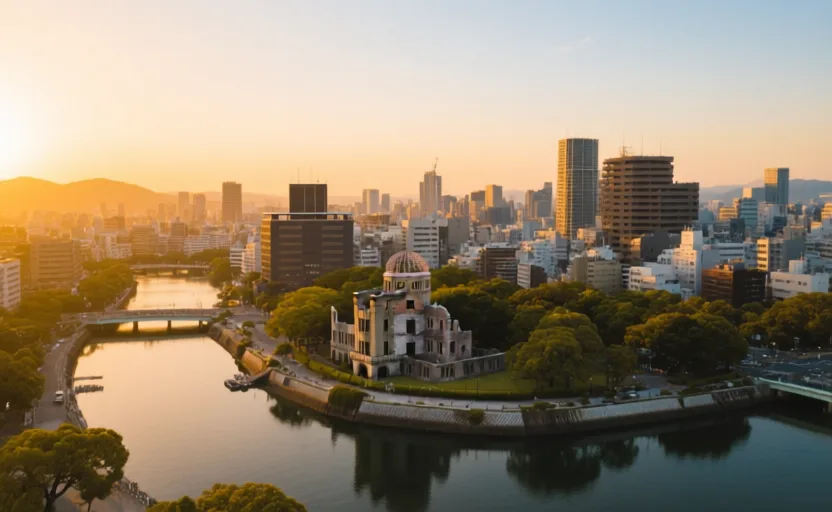 Hiroshima · AI city illustration · Artistic impression
City · East Asia
Hiroshima
Saved in this browser — no account needed. Sign in later and it comes with you.
Where it is
The city is spread across the delta of the Ōta River, where the land runs out into Hiroshima Bay on the Seto Inland Sea. Its name means “wide island”, which suits flat ground carved up by water. Mountains in the Chūgoku and Shikoku regions shelter this stretch of the inland sea from the seasonal winds, so winters are cool to mild and summers hot and humid, with the heaviest rain in June and July. The municipality covers about 905 square kilometres and held roughly 1.18 million people in 2023, the biggest city in Chūgoku, the western end of Honshu.
The land and water around it
Ōta River deltadelta
The castle town was laid out on the delta coastline in 1589, close to the water for trade and defence. The same low ground meant the bomb of 1945 fell on a flat, densely built plain with almost nothing to shield it.
Seto Inland Seasea
The sea that Hiroshima Bay opens onto gave the city its harbour. Ujina Harbour, built in the 1880s, turned the delta into an important port, and the sacred island of Itsukushima lies a short way along the same coast.
Mountain shelter and monsoon climateclimate
The mountains of the Chūgoku and Shikoku regions block much of the wind that reaches the inland sea. The result is a humid subtropical climate with a dry winter, a rainy peak in June and July, and August as the warmest month.
Its history, in short
Hiroshima is a young city by Japanese standards. A fishing village on the bay was tied to the Zen temple of Mitaki-dera from the 12th century, but the city proper begins in 1589, when the warlord Mōri Terumoto founded a castle town on the delta. He lost most of his lands after the Battle of Sekigahara, and from 1619 the Asano clan ruled the domain until the han system was abolished in 1871. Hiroshima then became a prefectural capital and, with the harbour at Ujina and the railway of 1894, a military and industrial hub. During the First Sino-Japanese War the emperor kept his headquarters in the castle and the government sat here for a time. On 6 August 1945 an American bomber dropped an atomic bomb on the city at 8:15 in the morning. The centre was wrecked, and injuries and radiation killed tens of thousands more before 1945 was over. A national law of 1949 funded reconstruction and declared Hiroshima a city of peace, and the ruined exhibition hall beside the river was kept as it stood.
Timeline
Dates are shown on a timeline rather than as changing shapes on the map. The globe draws modern boundaries only, and tinting a modern outline to stand for a historical one would state something we cannot source.
Early modern & oceanic
1589
A castle town on the delta
Mōri Terumoto founds Hiroshima on the Ōta River delta and builds the castle, into which he moves in 1593.
Well attestedWikipedia1619–1871
Asano rule
After Sekigahara the Mōri lose Hiroshima to a Tokugawa ally, and the Asano clan takes over the domain in 1619. It holds it until the han are abolished and the city becomes a prefectural capital.
Well attestedWikipedia
Industrial & imperial
1894–1895
Headquarters in wartime
The San’yō Railway reaches the city and a spur is laid to the harbour for military transport. Emperor Meiji directs the First Sino-Japanese War from Hiroshima Castle, and the first round of peace talks with China is held in the city in February 1895.
Well attestedWikipedia1914 or 1915
The exhibition hall is built
A trade exhibition hall goes up beside the river. Renamed the Prefectural Industrial Promotion Hall, it is the building known today as the Genbaku Dome. Sources give the year of construction as 1914 or 1915.
Contemporary
6 August 1945
The atomic bombing
The first nuclear weapon used in war destroys about 70 per cent of the city’s buildings. Estimates of the dead by the end of 1945 run from 90,000 to 166,000, depending on how deaths from injury and radiation are counted, against a population of about 345,000 before the attack.
Well attestedWikipedia1949
City of Peace
The Hiroshima Peace Memorial City Construction Law provides national money and former military land for rebuilding. The same year the Diet proclaims Hiroshima a City of Peace and a design is chosen for the Peace Memorial Park.
Well attestedWikipedia1996
World Heritage listing
The Genbaku Dome, the only structure left standing near the hypocentre, is inscribed as a World Heritage Site for what it stands for rather than for its architecture.
Places that carry meaning
Genbaku Dome (Hiroshima Peace Memorial)Built 1914 or 1915; preserved since 1945
The skeleton of the former Industrial Promotional Hall, kept in the condition it was in just after the explosion. It was reinforced lightly in 1967, 1989–1990 and 2002–2003 so that it would not change. The inscribed property is only 0.40 hectares, with a much larger buffer zone that takes in the Peace Memorial Park.
Peace Memorial Park and MuseumDesign chosen 1949; museum opened 1955
The park fills ground at the centre of the destroyed city and serves both as a place of prayer for the victims and as a call for lasting peace. The Peace Memorial Museum opened here in 1955.
Hiroshima Castle1590s; rebuilt 1958
The seat of the Mōri and later the Asano, and the emperor’s headquarters in 1894–1895. The present building is a reconstruction of 1958.
Itsukushima Shrine6th century origins; present buildings 13th century
A Shinto shrine on an island in the inland sea, with buildings that stand over the water in front of a forested mountain. The first structures were probably raised in the 6th century, and the present ones follow a 12th-century style under the patronage of Taira no Kiyomori. It lies outside the city but is the best-known place near it.
Languages here
Places are usually multilingual. This lists what is actually spoken, not one language per border.
JapaneseJaponic family
The everyday and official language of the city.
Written with Chinese characters (kanji) and two syllabaries (kana), alongside Latin letters and Arabic numerals. Hiroshima has a long record of international gatherings on peace, and an interpreters’ and guides’ association was founded in 1992 to support them.
EnglishGermanic family
A compulsory school subject and the main language of outside contact.
English is taught in junior and senior high school across Japan and serves as a business link language. Hiroshima was home to one of seven government-sponsored English-language schools set up in the 1870s.
Learn the language here
- 1Understand which languages are spoken hereHiroshima is multilingual. Start with which languages are used, by whom, and for what — the phrase list only covers one of them.Written by Globe Quest
- 2Learn 12 phrasesCurated everyday phrases for Hiroshima, with audio and a written form.Written by Globe Quest
- 3Say them out loudSpeaking practice with pronunciation feedback, one phrase at a time.Globe Quest material, your own additions
- 4Come back to themSpaced review, so what you learned this week is still there next month.Written by Globe Quest
Check yourself
Who founded Hiroshima as a castle town in 1589?
Mōri Terumoto
Mōri Terumoto built the castle on the Ōta River delta. The Asano clan came later, ruling from 1619 after the Mōri were stripped of most of their lands.
Why is the Genbaku Dome a World Heritage Site?
It is the surviving ruin near the hypocentre and a symbol of peace
The listing rests on what the ruin stands for, a warning about destructive power and a hope for peace, not on its design as a building.
Worth arguing about
- The city kept a ruin as it stood instead of clearing the site. What are the arguments for and against preserving damage rather than rebuilding?
- Hiroshima was a military headquarters and port before it became a symbol of peace. How should a city carry both parts of its story?
What we have not established
These are open questions, listed rather than filled in. We would rather show a gap than a plausible guess.
How many people died in the bombing of Hiroshima?
Figures for the end of 1945 vary between roughly 90,000 and 166,000, because the number of civilians, soldiers and conscripted workers present is uncertain and deaths from radiation continued for months. The year the exhibition hall was built is also given as both 1914 and 1915.
Sources
- Wikipedia · HiroshimaWikipedia · encyclopedia · checked 2026-11-24
- Wikipedia · JapanWikipedia · encyclopedia · checked 2026-11-24
- UNESCO · Hiroshima Peace Memorial (Genbaku Dome)UNESCO World Heritage Centre · intergovernmental · checked 2026-11-24
- UNESCO · Itsukushima Shinto ShrineUNESCO World Heritage Centre · intergovernmental · checked 2026-11-24
Reviewed by Globe Quest editorial on 2026-11-24. Drafted with AI assistance and checked against the sources above before publication.