 Globe Quest
 Human Quest · LearningSign in
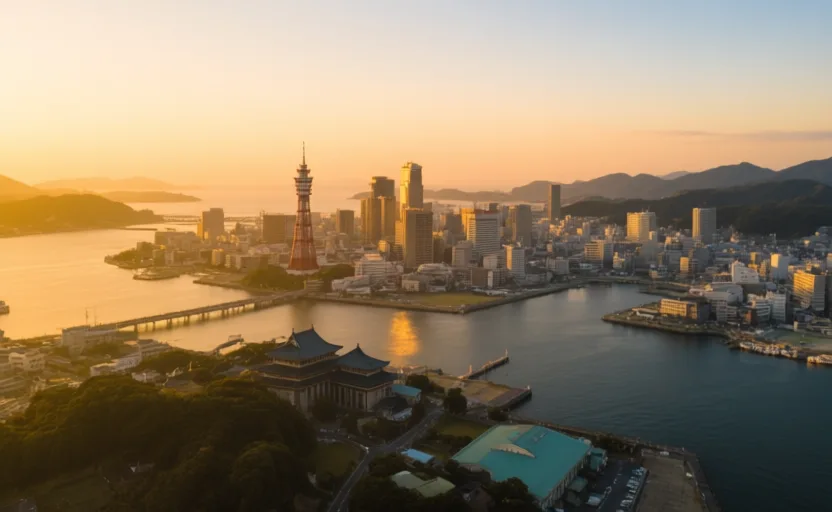 Nagasaki · AI city illustration · Artistic impression
City · East Asia
Nagasaki
Saved in this browser — no account needed. Sign in later and it comes with you.
Where it is
A long, narrow bay on the west coast of Kyushu forms what is described as the best natural harbour on the island, and Nagasaki crowds itself around the head of it. The main commercial and residential area fills a small plain at the inner end, where two rivers, separated by a mountain spur, have cut the two valleys that hold most of the city. The heavily built-up part is squeezed by the hills into an area of under four square miles. Climate is humid subtropical, with mild winters and long, hot, humid summers, and the city is among the wettest large cities in Japan, with rain peaking sharply in June and July.
The land and water around it
Nagasaki Baybay
The long inlet that makes the best natural harbour on Kyushu. It was what the Portuguese and Kyushu’s lords needed in the 16th century, and it later anchored the shipyards of the Meiji period.
The two valleysvalley
Two rivers, divided by a mountain spur, carve the two valleys that hold the centre. Steep terrain keeps the dense core small.
Nagasaki and Nishisonogi peninsulaspeninsula
Both peninsulas lie inside the city limits, which widened in 2005 and 2006 when several surrounding towns, among them Iōjima and Takashima, were merged into it.
Its history, in short
Nagasaki grew from foreign trade. After Portuguese ships first reached Japan in 1543, Kyushu’s lords wanted a proper harbour for them, and the Portuguese founded the port that became the centre of Christianity and trade in the region. Under the Tokugawa shogunate it was a shogunal city, run by a magistrate, and from the 16th to the 19th centuries it was the only port open for trade with the Portuguese and then the Dutch. It was never Japan’s only window on the world, since Korea, Ryūkyū and Russia were reached through other domains, but it was the one that writers and painters pictured as cosmopolitan. After 1720 scholars flocked here to study European books, in what was called Dutch learning. Nagasaki became a treaty port in 1859, was proclaimed a city in 1889 and grew into a shipbuilding centre, with Mitsubishi’s dockyards supplying the navy. That made it a target in 1945, and on 9 August the second atomic bomb used in war fell on it. Rebuilding was slow, and a national law of 1949 recast Nagasaki as an international culture city with foreign trade, shipbuilding and fishing in place of war industry.
Timeline
Dates are shown on a timeline rather than as changing shapes on the map. The globe draws modern boundaries only, and tinting a modern outline to stand for a historical one would state something we cannot source.
Early modern & oceanic
1543
Portuguese contact
A ship carrying Portuguese sailors is blown off course and lands on Tanegashima. Regular Portuguese trade follows, and Kyushu’s lords look for a harbour where they can host the ships.
Well attestedWikipedia1663
The Great Fire
A fire destroys much of the city, including the Mazu shrine at Kofuku Temple, which was patronised by visiting Chinese sailors and merchants.
Well attestedWikipedia1720
Dutch learning
The ban on Dutch books is lifted, and hundreds of scholars come to Nagasaki to study European science and art. The city becomes a centre of rangaku, or Dutch learning.
Well attestedWikipedia
Industrial & imperial
1859
Treaty port
With the end of seclusion Nagasaki is opened to foreign trade and diplomacy. Modernisation begins in earnest in 1868, and it is proclaimed a city on 1 April 1889.
Well attestedWikipedia
Contemporary
9 August 1945
The second atomic bomb
The plutonium bomb Fat Man is dropped from the B-29 Bockscar. About 263,000 people were in the city that day, a number that included Korean residents and conscripted workers, Chinese labourers and Allied prisoners of war as well as Japanese civilians and soldiers.
Well attestedWikipedia1949
International Culture City law
The Nagasaki International Culture City Reconstruction Law is passed in May. Redevelopment turns toward foreign trade, shipbuilding and fishing, and new temples and churches are built.
Well attestedWikipedia
Places that carry meaning
Dejima and Oranda-zakaClosed-country era
Sites in the city tied to the Dutch presence that made Nagasaki the centre of Dutch learning. A museum covers the history of Dejima, and the slope called Oranda-zaka takes its name from the Dutch.
Nagasaki Peace Park and hypocentreAfter 1945
The park, the Atomic Bomb Museum and the hypocentre sit close together. Some ruins were left as memorials, including a one-legged stone torii at Sannō Shrine.
Urakami Cathedral and the Twenty-Six MartyrsCatholic Nagasaki, 16th century onward
Christianity arrived with the Portuguese, and after it was legalised the Kakure Kirishitan, the hidden Christians, came out of hiding. Nagasaki regained its role as a centre of Roman Catholicism in Japan, with the Basilica of the Twenty-Six Holy Martyrs and Urakami Cathedral among its landmarks.
Nagasaki Chinatown and Kofuku-jiBy 1663
Chinese sailors and merchants who visited the port patronised a Mazu shrine at Kofuku Temple, which the Great Fire of 1663 destroyed. The temple and Nagasaki Chinatown are both counted among the city’s main sites today.
Languages here
Places are usually multilingual. This lists what is actually spoken, not one language per border.
JapaneseJaponic family
The everyday language of the city.
Written in kanji and kana, Japanese is the de facto national language. The port’s history brought Portuguese, Dutch and Chinese traders to the city, and about 10,000 Korean residents lived here in 1945, but Japanese is the language of everyday life.
EnglishGermanic family
A school subject and a business link language.
English is compulsory in Japanese junior and senior high schools and serves as a business and international link language.
Learn the language here
- 1Understand which languages are spoken hereNagasaki is multilingual. Start with which languages are used, by whom, and for what — the phrase list only covers one of them.Written by Globe Quest
- 2Learn 12 phrasesCurated everyday phrases for Nagasaki, with audio and a written form.Written by Globe Quest
- 3Say them out loudSpeaking practice with pronunciation feedback, one phrase at a time.Globe Quest material, your own additions
- 4Come back to themSpaced review, so what you learned this week is still there next month.Written by Globe Quest
Check yourself
What is the modern view of Nagasaki as Japan’s “window on the world”?
It was the main Western port, but not the only link; Korea, Ryūkyū and Russia were reached through other routes
Historians once treated Nagasaki as Japan’s sole opening, but trade and contact also ran with the Ryūkyū Kingdom, Korea and Russia, by way of three other domains.
What limits the built-up area of Nagasaki?
Two rivers and a mountain spur around the head of a bay
The city fills a small plain and two valleys, and steep ground confines the heavily built-up area to less than four square miles.
Worth arguing about
- A harbour that welcomed foreign ships in the 16th century later became a shipbuilding target. How does a city’s geography decide the fate of its people across centuries?
- Nagasaki was never Japan’s only contact with the outside world, yet it is remembered that way. Why do places become symbols of a larger idea?
What we have not established
These are open questions, listed rather than filled in. We would rather show a gap than a plausible guess.
How many people live in Nagasaki?
Published totals disagree: about 506,000 for 2017 and about 392,000 for early 2024, a fall larger than seems likely in seven years, so no single total is given.
Sources
- Wikipedia · NagasakiWikipedia · encyclopedia · checked 2026-11-24
- Wikipedia · JapanWikipedia · encyclopedia · checked 2026-11-24
Reviewed by Globe Quest editorial on 2026-11-24. Drafted with AI assistance and checked against the sources above before publication.