 Globe Quest
 Human Quest · LearningSign in
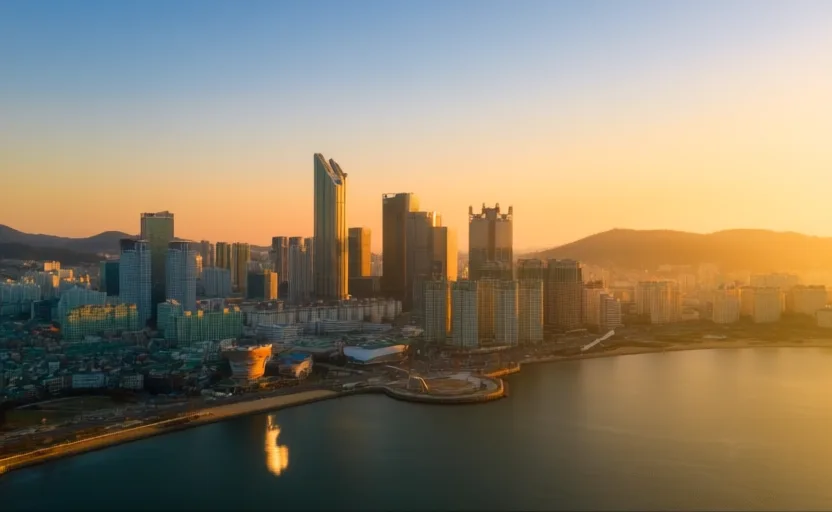 Incheon · AI city illustration · Artistic impression
City · East Asia
Incheon
Saved in this browser — no account needed. Sign in later and it comes with you.
Where it is
Incheon is Seoul’s door to the sea. It occupies the northwest coast of South Korea, with Seoul and Gyeonggi Province along its eastern edge and the Yellow Sea to the west, and together with them it forms the Seoul metropolitan area. Its territory covers about 1,047 square kilometres and spills offshore: the city administers several western islands, including Ganghwa, Yeongjong and Baengnyeongdo, the westernmost point of South Korea. The climate is humid subtropical or humid continental depending on the classification used. Winter winds come from the northwest and warm southwesterlies reach the city in summer, and the temperature never swings to an extreme.
The land and water around it
The western islandsisland
Ganghwa, Yeongjong and Baengnyeongdo are among the islands within the city’s boundary, with Baengnyeongdo the farthest west in South Korea. The city took in neighbouring islands in 1989 and Ganghwa and Onjin counties in 1995.
Yellow Sea coastcoast
Modern Incheon grew on its port, helped by the natural advantages of a coastal site and its closeness to the capital. The Yellow Sea is on its western side.
Ara Canalcanal
A waterway that links the Han River with the Yellow Sea, now lined with parks and a popular bike path.
Its history, in short
The first written mention is from 475, when Goguryeo’s King Jangsu recorded a place called Michuhol, probably on Munhak Hill. Over the next centuries it was renamed Gyeongwon and Inju, and in 1413 it received its present name, Incheon, later becoming a prefecture with its centre at Gwangyo-dong. The real change came in 1883, when the port opened to the outside world. Fewer than five thousand people lived here then, and the centre of town moved to the harbour district of Jemulpo, known to the Japanese as Jinsen. The first shots of the Russo-Japanese War were fired in the Battle of Chemulpo Bay. In 1914 the colonial government folded the old centre into Bucheon County, and parts were returned between 1936 and 1940. In the Korean War North Korean troops occupied the city on 4 July 1950, and a United Nations landing here, meant to relieve the Pusan Perimeter and start an offensive northward, retook it on 19 September. It was split from Gyeonggi as a directly governed city in 1981, and in 2003 became South Korea’s first free economic zone. Its airport and port now make it a major transport hub of northeast Asia.
Timeline
Dates are shown on a timeline rather than as changing shapes on the map. The globe draws modern boundaries only, and tinting a modern outline to stand for a historical one would state something we cannot source.
Classical world
475
Michuhol
The first historical record of the Incheon area comes from the reign of King Jangsu of Goguryeo, who names the place Michuhol. It is supposed to have stood at what is now Munhak Hill.
Approximate dateWikipedia
Post-classical world
1413
The name Incheon
After earlier names such as Gyeongwon and Inju, the area takes its current name. It later becomes a prefecture centred on Gwangyo-dong.
Well attestedWikipedia
Industrial & imperial
1883
The port opens
Incheon becomes an international port when it has only about 4,700 inhabitants. The centre of the city shifts from Gwangyo to the harbour district of Jemulpo.
Well attestedWikipedia1914
Reorganisation under colonial rule
The Japanese colonial government merges the outer parts of old Incheon, including the former centre at Gwangyo, with Bupyeong County to form Bucheon County. Some of this ground is returned between 1936 and 1940.
Well attestedWikipedia
Contemporary
1950
Occupation and the Battle of Inchon
North Korean troops occupy the city on 4 July. United Nations forces land to relieve pressure on the Pusan Perimeter and begin an offensive northward, and the city is recaptured on 19 September.
Well attestedWikipedia1 July 1981
Separate from Gyeonggi
Incheon is made a directly governed city, now called a metropolitan city, and leaves the province it had belonged to.
Well attestedWikipedia2003
First free economic zone
The Incheon Free Economic Zone is designated, the first in South Korea. It draws investment to Songdo International City, including a bio-industry campus chosen by Samsung.
Well attestedWikipedia2014
Asian Games
The city hosts the 17th Asian Games, beginning on 19 September. UNESCO later names it World Book Capital for 2015.
Well attestedWikipedia
Places that carry meaning
Incheon Dohobu Cheongsa15th century or earlier
The former government complex of the Incheon prefecture, which goes back at least to the reign of King Sejong. The two original buildings stand in a school compound, with newer ones across from the Munhak baseball stadium.
Jayu Park1888
Korea’s first Western-style park, opened in 1888. It stands near Incheon Chinatown, the only official Chinatown in the country.
WolmidoLanding of 1950
A former military site on the shore at Green Beach, used in the Incheon landing. It is now a promenade with an amusement park and seafood restaurants, and ferries leave from it for Yeongjong and Jakyak islands.
Languages here
Places are usually multilingual. This lists what is actually spoken, not one language per border.
Korean
The language of daily life and administration.
Standard Korean, based on the Seoul dialect and written in Hangul, is the everyday language of a city that forms part of the Seoul metropolitan area.
EnglishGermanic family
A school subject and the language of international events.
Nearly every South Korean student studies English. Incheon has hosted international events from the 2009 Global Fair and Festival to the 2014 Asian Games and the 2018 OECD World Forum.
Learn the language here
- 1Understand which languages are spoken hereIncheon is multilingual. Start with which languages are used, by whom, and for what — the phrase list only covers one of them.Written by Globe Quest
- 2Learn 11 phrasesCurated everyday phrases for Incheon, with audio and a written form.Written by Globe Quest
- 3Say them out loudSpeaking practice with pronunciation feedback, one phrase at a time.Globe Quest material, your own additions
- 4Come back to themSpaced review, so what you learned this week is still there next month.Written by Globe Quest
Check yourself
About how many people lived in Incheon when its port opened in 1883?
About 4,700
Incheon was small when the port opened. The harbour trade and later industry made it one of South Korea’s largest cities, with around 3 million people today.
What happened at Incheon on 19 September 1950?
The city was recaptured after the Battle of Inchon
North Korea had occupied the city on 4 July. The UN landing relieved pressure on the Pusan Perimeter and let UN forces launch an offensive northward.
Worth arguing about
- Incheon grew because it was the sea gate for the capital, and then became a free economic zone and an airport hub. Is a city like this defined by its own people or by the larger place it serves?
- The first Western-style park, the only official Chinatown and a statue of a foreign general all sit within a short walk. How should a port city remember its different foreign connections?
Sources
- Wikipedia · IncheonWikipedia · encyclopedia · checked 2026-11-24
- Wikipedia · South KoreaWikipedia · encyclopedia · checked 2026-11-24
Reviewed by Globe Quest editorial on 2026-11-24. Drafted with AI assistance and checked against the sources above before publication.