 Globe Quest
 Human Quest · LearningSign in
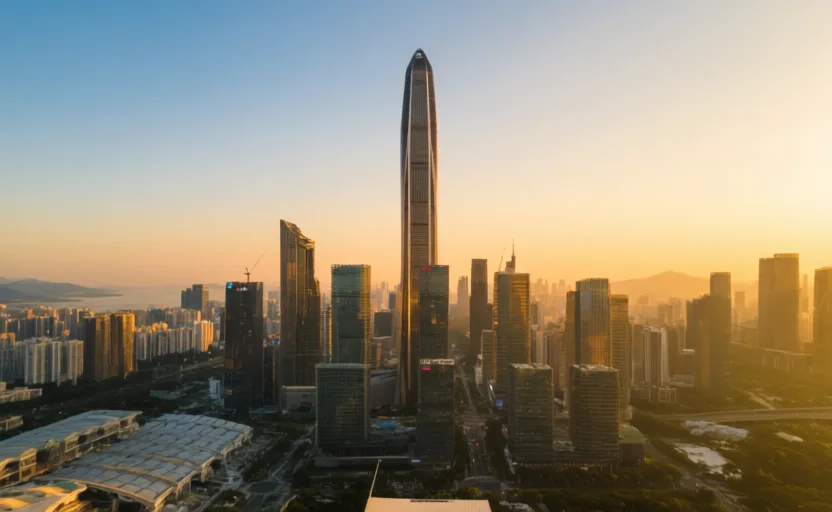 Shenzhen · AI city illustration · Artistic impression
City · East Asia
Shenzhen
Saved in this browser — no account needed. Sign in later and it comes with you.
Where it is
Shenzhen is a long thin city, about 81 kilometres from east to west and at its narrowest barely 11 from north to south, squeezed between the Pearl River estuary and Mirs Bay. Its southern edge is the border with Hong Kong, and the Shenzhen River marks part of it. More than 160 rivers and channels cross the territory and 24 reservoirs store water. Though it lies just below the Tropic of Cancer, the climate is mild and humid subtropical: heavy rain from April to early autumn, typhoons from the east, and very rare frost. The city is a link in the Pearl River Delta urban belt, about 100 kilometres south-east of Guangzhou.
The land and water around it
The Pearl River estuaryestuary
Shenzhen sits on the east bank of the estuary, where the Pearl River widens into Lingdingyang, with Hong Kong to the south and Macau to the south-west. The coast made it a port and a salt, spice and pearl trading area long before the special economic zone.
The Shenzhen Riverriver
The village of Shenzhen stood on a border once the south of the old county went to Britain. The name itself means “deep ditch”, from the local word for an irrigation channel.
Monsoon and typhoon rainclimate
Annual rainfall averages around 1,933 millimetres, some of it from typhoons that strike in summer and early autumn. About 10 days a year bring 50 millimetres or more.
Its history, in short
People have lived here for around 6,700 years, and counties were created in the area some 1,700 years ago, with the towns of Nantou and Dapeng more than 600 years old. In the twelfth century the Nantou area traded salt and spices on the South China Sea, and in the thirteenth it was known for pearls. The Opium Wars cut the county in two: Hong Kong Island and Kowloon went to Britain, and the New Territories were leased in 1898. The old Shenzhen market town ended up on the border, at the last mainland stop of the Kowloon–Canton Railway. Between the 1950s and 1970s the county took in large numbers of people trying to reach Hong Kong. In 1979 Bao’an County became the city of Shenzhen, and in 1980 it became China’s first special economic zone, then home to some 30,000 people. Migrants came from across the country, and the city now has well over 17 million permanent residents.
Timeline
Dates are shown on a timeline rather than as changing shapes on the map. The globe draws modern boundaries only, and tinting a modern outline to stand for a historical one would state something we cannot source.
Classical world
214 BCE
Under the Qin
When the Qin unify China, the area becomes part of Nanhai Commandery in the far south, and is drawn into the culture of the Central Plain.
Well attestedWikipedia
Post-classical world
1410
First mention of the name
The name Shenzhen is first recorded under the Ming, though a market town was not founded here until the Qing.
Well attestedWikipedia
Early modern & oceanic
1669
Shifting boundaries
After residents were resettled northward to defend against pirates, Bao’an County lost two-thirds of its land to Dongguan and was merged into it.
Well attestedWikipedia
Industrial & imperial
1898
The New Territories leased
China leases the New Territories to Britain for 99 years. Of the 3,076 square kilometres of Xin’an County, 1,055.61 passed to Britain, which left Shenzhen as a border town.
Well attestedWikipedia
Contemporary
1953
The county seat moves
Bao’an’s government relocates to Shenzhen town, closer to the railway and a larger economy than Nantou.
Well attestedWikipedia5 March 1979
Bao’an County becomes Shenzhen
The State Council approves the change to a city named Shenzhen. A month earlier the Shekou Industrial Zone was approved, to become the first export processing zone in mainland China.
Well attestedWikipediaMay 1980
The first special economic zone
Shenzhen is designated as China’s first special economic zone, an experiment in market capitalism within a socialist system. The population is then 30,000.
Well attestedWikipediaDecember 1990
The Stock Exchange opens
The Shenzhen Stock Exchange is founded. In 1992 the city gains the power to make its own local laws.
Well attestedWikipedia
Places that carry meaning
Nantou old townMing dynasty onward
A historic town, also called Xin’an, in Nanshan District, with a few surviving buildings from the Ming dynasty such as the Guandi Temple. Most of its traditional fabric has been replaced.
Hakka walled villagesBefore the special economic zone
Villages such as Crane Lake and Gangeng in Longgang District, built around thick grey walls, narrow alleys and courtyards. They show the settlement pattern that predates the city.
ChiwanMing dynasty onward
A coastal area in Nanshan District holding a temple of Tianhou, said to have been built by Zheng He to ask Mazu to protect his treasure fleet, and the tomb of the last Southern Song emperor, Zhao Bing.
Urban villages1980s onward
Neighbourhoods such as Baishizhou in Nanshan, called chengzhongcun, where many migrants live. They are the leftovers of rural settlement that the city grew around.
Languages here
Places are usually multilingual. This lists what is actually spoken, not one language per border.
Mandarin ChineseSino-Tibetan family
The everyday common language, used by most residents.
The city has shifted strongly toward Mandarin, which the state promotes nationally and which most migrants from other provinces and their children speak natively.
CantoneseSino-Tibetan family
The traditional speech of the area, with a local revival effort.
Before the special economic zone, local communities spoke Cantonese or Hakka. Two Cantonese varieties existed, the standard one and the Weitou dialect used in villages south of Fuhua Road. Some residents, Cantonese-speaking or not, are now trying to bring the language back as part of the city’s culture.
HakkaSino-Tibetan family
The second indigenous language of the pre-1980 villages.
Hakka speakers were one of the two main local groups. Hakka, Cantonese and Teochew migrants from elsewhere in Guangdong joined settlers from Hunan, Guangxi, Jiangxi, Sichuan and Henan in the following decades.
Learn the language here
- 1Understand which languages are spoken hereShenzhen is multilingual. Start with which languages are used, by whom, and for what — the phrase list only covers one of them.Written by Globe Quest
- 2Learn 11 phrasesCurated everyday phrases for Shenzhen, with audio and a written form.Written by Globe Quest
- 3Say them out loudSpeaking practice with pronunciation feedback, one phrase at a time.Globe Quest material, your own additions
- 4Come back to themSpaced review, so what you learned this week is still there next month.Written by Globe Quest
Check yourself
What does the name Shenzhen mean in the local vernacular?
Deep ditch
Local speech uses zhen and yong for irrigation channels, so the name means “deep ditch”. The name for the city was chosen in 1978.
What made Shenzhen the first special economic zone in 1980?
Its closeness to Hong Kong could attract foreign investment and migrants
The reform leadership picked a place on the border with Hong Kong as a testing ground for market methods, and the city grew from about 30,000 people in 1980 to well over 17 million.
Worth arguing about
- Shenzhen was an experiment, planned as a test of market economics beside a capitalist border. What does it mean for a city to be built as an experiment?
- Only about a third of the permanent population holds local registration. How should a city treat residents who built it but are not counted as its citizens?
What we have not established
These are open questions, listed rather than filled in. We would rather show a gap than a plausible guess.
How many people live in Shenzhen?
The article gives 18.2 million for 2025, a permanent population of 17.56 million in the 2020 count, and an older figure of 12.5 million resident for 2017 alongside an administrative population above 20 million. These are counted on different bases, and migrants who live in the city without local registration make the total hard to pin down.
Sources
- Wikipedia · ShenzhenWikipedia · encyclopedia · checked 2026-11-24
Reviewed by Globe Quest editorial on 2026-11-24. Drafted with AI assistance and checked against the sources above before publication.