 Globe Quest
 Human Quest · LearningSign in
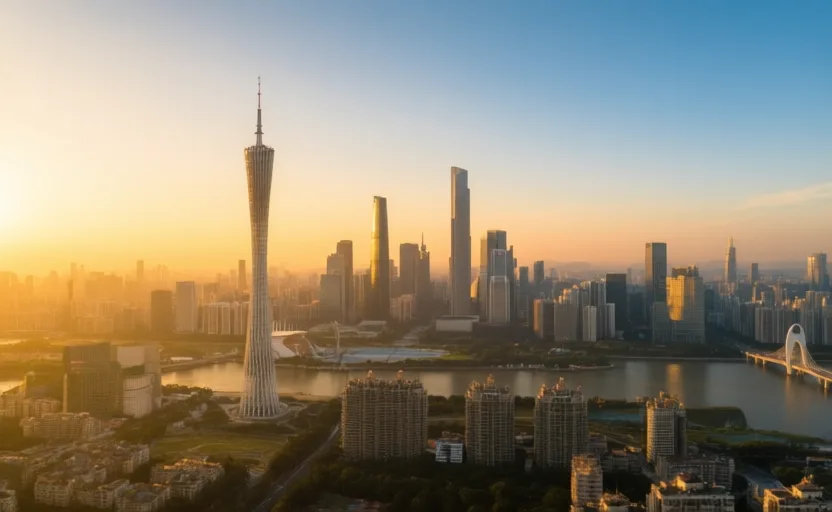 Guangzhou · AI city illustration · Artistic impression
City · East Asia
Guangzhou
Also known as Canton, 廣州
Saved in this browser — no account needed. Sign in later and it comes with you.
Where it is
Guangzhou, long known in English as Canton, grew at the head of the Pearl River delta, on a rich alluvial plain far enough upriver to be sheltered from the sea. The old town lay on the river’s east bank under Baiyun Mountain, with the approach from the ocean guarded at the Humen Strait. The present city spans some 7,400 square kilometres on both banks, rising from the delta in the south-west to mountains in the north-east; the highest point, Tiantang Peak, is 1,210 metres. The climate is humid subtropical, with a monsoon season from April to September, over 1,950 millimetres of rain a year, and mild, drier winters. Snow is almost unknown: the last fall was in January 2016.
The land and water around it
The Pearl Riverriver
The fourth-largest river in China. Guangzhou lies some 80 miles upstream from the sea and far below the limit of navigation, which made it a sheltered inland port. Tidal flats along the estuary have mostly been reclaimed for farming.
The Pearl River Deltadelta
The plain around the city is the core of one of the country’s leading commercial and manufacturing regions. The urban belt around it runs through Foshan, Dongguan, Shenzhen, Zhuhai and Macau and has about 70 million residents.
Baiyun Mountainmountains
The hills north of the old town form the backbone of the city’s upland. Locals now call Baiyun Mountain the city’s “lung”, a green space inside the built-up area.
Its history, in short
The place was inhabited by non-Chinese peoples known collectively as the Baiyue before the Qin founded a city, Panyu, on the Pearl River’s east bank in 214 BCE. After the Qin fell, General Zhao Tuo made it the capital of the kingdom of Nanyue; digs show it traded with Southeast Asia, India and even Africa. Under the Han it became a provincial capital, and in 226 CE the seat of Guang Prefecture was fixed here, the origin of the city’s present name. Arab and Persian merchants arrived by sea from the Tang period, and the relationship was sometimes violent: foreign pirates sacked the city in 758, and in 878 the rebel Huang Chao is said to have killed vast numbers of foreigners. Later it was the only Chinese port open to Europeans for a long time, until the First Opium War ended that monopoly and trade drifted to Hong Kong and Shanghai. In the twentieth century it was a base for revolution under Sun Yat-sen, and since the 1980s it has been one of the first beneficiaries of reform.
Timeline
Dates are shown on a timeline rather than as changing shapes on the map. The globe draws modern boundaries only, and tinting a modern outline to stand for a historical one would state something we cannot source.
Classical world
214 BCE
Panyu is founded
The city is set up on the east bank of the Pearl River as seat of the Qin empire’s Nanhai Commandery, used as the staging point for the first Qin campaign against the Baiyue.
Well attestedWikipedia204 BCE
Capital of Nanyue
General Zhao Tuo makes Panyu the capital of his independent kingdom of Nanyue. By 113 BCE the kingdom is formally part of the Han empire.
Well attestedWikipedia226
Guang Prefecture
The city becomes the seat of Guang Prefecture, from which the name Guangzhou derives. The Tang records later describe it as an important southern port with direct routes to the Middle East.
Well attestedWikipedia
Post-classical world
878
The Guangzhou massacre
The rebel Huang Chao sacks the port and, by one account, kills about 200,000 foreigners including Arabs, Persians, Jews, Christians and Parsis. The port is then closed for some fifty years.
Approximate dateWikipedia917–971
The Southern Han
Liu Yan builds a kingdom based at the city after the collapse of the Tang, and the region has a period of cultural and economic success.
Well attestedWikipedia
Industrial & imperial
1895 and 1911
Uprisings
Two failed uprisings against the Qing are staged in the city, the second preceding the successful 1911 Revolution. Seventy-two dead recovered after it are honoured at Huanghuagang Park.
Well attestedWikipedia1923–1926
The Kuomintang base
Sun Yat-sen and the Kuomintang use Guangzhou as the base from which to plan the campaign against northern warlords, building their own military force under Chiang Kai-shek.
Well attestedWikipedia
Contemporary
14 October 1949
Taken by the Communists
Retreating Nationalist forces blow up the Haizhu Bridge as the city falls. After a period when it briefly served as Republican capital, a large exodus goes to Hong Kong and Macau.
Well attestedWikipedia
Places that carry meaning
Huanghuagang Park1911 uprising
A memorial to 72 revolutionaries recovered dead following the 1911 uprising against the Qing.
Temple of the Five ImmortalsLegendary foundation
A Taoist temple dedicated to the five immortals credited in tradition with bringing rice to the area at the city’s foundation. Their five rams are said to have turned to stone, which gave the city nicknames such as the “City of Rice” and the “City of Rams”.
Local Taoist and folk tradition, as recounted in later histories
Guangxiao TempleAD 233 onward
The city’s Buddhist temple, said to have been founded in 233 on the estate of a Wu official and to include the residence of the last Nanyue king. It has had its present name since the Ming dynasty.
Zhujiang New Town21st century
A new central business district of about 6.4 square kilometres in Tianhe District, which pulled the city’s centre of gravity east of the old river-bank neighbourhoods.
Languages here
Places are usually multilingual. This lists what is actually spoken, not one language per border.
CantoneseSino-Tibetan family
The local and prestige variety of Yue Chinese, first language of most Cantonese people.
In 2010 roughly half the city counted Cantonese as a first language. Younger residents increasingly use Mandarin, and it is said that grandparents switch to Mandarin to speak with them, a change linked to local school policy and the standing of Mandarin-speaking Shenzhen.
Mandarin ChineseSino-Tibetan family
The first language of most migrants and the national standard.
About 40 per cent of the population in 2008 were migrants from other provinces, and the 2020 census counted nearly 9.4 million people in the floating population. Mandarin is the common language between them and locals.
HakkaSino-Tibetan family
A smaller local variety.
Hakka culture is the second main strand of the city’s heritage after Cantonese. Alongside it, communities of African and Middle Eastern origin settled in the city from the late 1990s.
Learn the language here
- 1Understand which languages are spoken hereGuangzhou is multilingual. Start with which languages are used, by whom, and for what — the phrase list only covers one of them.Written by Globe Quest
- 2Learn 11 phrasesCurated everyday phrases for Guangzhou, with audio and a written form.Written by Globe Quest
- 3Say them out loudSpeaking practice with pronunciation feedback, one phrase at a time.Globe Quest material, your own additions
- 4Come back to themSpaced review, so what you learned this week is still there next month.Written by Globe Quest
Check yourself
What was Guangzhou called before it took its present name?
Panyu
Panyu was the name of the Qin and Nanyue city, and survives today as a district. Guangzhou comes from Guang Prefecture, whose seat it became in 226.
What ended Guangzhou’s long role as the only Chinese port open to Europeans?
The First Opium War
After Britain captured the city in the First Opium War, the monopoly ended and trade moved to ports such as Hong Kong and Shanghai, though Guangzhou remained a major entrepôt.
Worth arguing about
- A city that has traded with Arab, Persian and African merchants for two thousand years, and also saw massacres of foreigners. How should a port city remember both?
- Mandarin is displacing Cantonese among the young in Guangzhou. Should a city’s schools protect its local language, or follow the national one?
What we have not established
These are open questions, listed rather than filled in. We would rather show a gap than a plausible guess.
How many people live in Guangzhou?
The 2020 census counted about 18.7 million permanent residents, and the end of 2024 figure is about 19 million. Earlier figures in the same sources run from about 13 million to 25 million for the wider metropolitan area, depending on the boundary and on whether migrants are counted.
Sources
- Wikipedia · GuangzhouWikipedia · encyclopedia · checked 2026-11-24
Reviewed by Globe Quest editorial on 2026-11-24. Drafted with AI assistance and checked against the sources above before publication.