 Globe Quest
 Human Quest · LearningSign in
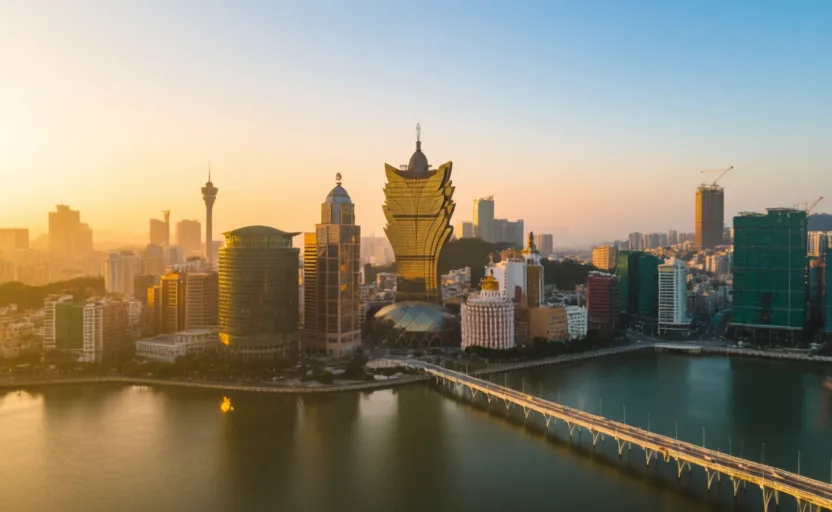 Macau · AI city illustration · Artistic impression
City · East Asia
Macau
Also known as Macao, 澳門
Saved in this browser — no account needed. Sign in later and it comes with you.
Where it is
Macau is a handful of small pieces of land on the west bank of the Pearl River’s mouth, about 60 kilometres west of Hong Kong and joined to the Chinese mainland city of Zhuhai on its north and west. The Macau Peninsula was once a separate hilly island; river silt built a sandbar that tied it to the shore. Taipa and Coloane lie to the south, and the reclaimed ground of Cotai now links them. The highest point, Coloane Alto, reaches only 170.6 metres. Two-thirds of the territory is made land, and the climate is humid subtropical, with a typhoon-prone monsoon summer and a dry winter.
The land and water around it
The Pearl River estuaryestuary
Macau sits on the estuary’s west bank, a position that allowed ships to avoid sailing up the river to Guangzhou. Under the Canton System of 1757, foreign ships still had to stop here before going on upriver.
The tombolo peninsulapeninsula
The Macau Peninsula began as an island and became a tombolo when a sandbar connected it to the land. Sedimentation and reclamation together tripled the territory’s area in a century, from 10.28 square kilometres to 32.9.
Taipa, Coloane and Cotaiisland
Two hilly islands to the south, now linked by the reclaimed strip of Cotai, where many of the casinos built after 1999 stand. Portugal annexed Taipa in 1851 and Coloane in 1864.
Its history, in short
Before the Portuguese arrived this was a refuge for passing ships and a fishing coast, where boat people raised a temple to the sea goddess A-Ma. Portuguese merchants, driven back from other parts of the delta after clashes with Ming forces, were allowed to settle here in the 1550s in return for payments. Macau became a relay between China and Japan until Japan closed its ports in 1639, and the loss of Malacca to the Dutch in 1641 broke the system further. The Qing then ran a tighter regime, with Chinese residents under Chinese courts. After Hong Kong was founded, Macau lost its role as the main port, and Portugal stopped paying rent in the 1840s and gained recognition of perpetual occupation in the 1887 treaty. Throughout, the land stayed under Chinese sovereignty even as Portugal came to treat it as a colony. Refugees swelled the population during the Second World War and again after the Chinese Civil War. After the Carnation Revolution Portugal called Macau a Chinese territory under Portuguese administration, and it returned to China in 1999 as a special administrative region.
Timeline
Dates are shown on a timeline rather than as changing shapes on the map. The globe draws modern boundaries only, and tinting a modern outline to stand for a historical one would state something we cannot source.
Post-classical world
1277
Refugees from the Mongol conquest
About 50,000 people fleeing the Mongol conquest of China settle along this coast.
Approximate dateWikipedia
Early modern & oceanic
1557
Permanent Portuguese settlement
The Portuguese gain a lasting lease at an annual rent of 500 taels of silver and establish a walled village. A local council follows in 1583 and a diocese in 1576.
1622
The Dutch attack repelled
The Portuguese fend off a Dutch attempt to take the city. The Fortaleza do Monte was built in response to Dutch naval incursions.
Well attestedWikipedia1639–1641
Trade routes collapse
Japan halts trade in 1639 and Malacca falls to the Dutch in 1641, cutting the commerce that had made Macau prosperous.
Well attestedWikipedia
Industrial & imperial
1887
Treaty of Peking
A treaty formalises perpetual Portuguese occupation of Macau but bars Portugal from ceding it without Chinese approval. Earlier, a 1862 attempt at a similar treaty had foundered on a misunderstanding about sovereignty.
Contemporary
1966
The 12-3 incident
Riots against colonial administration during the Cultural Revolution kill 8 people and injure more than 200. Portugal afterwards loses full control and agrees to cooperate with the Chinese Communist Party in return for continuing to administer the colony.
Well attestedWikipedia1999
Handover to China
Macau returns to Chinese sovereignty as a special administrative region, with a separate governing and economic system under the principle of “one country, two systems”. About 107,000 residents then held Portuguese passports.
Well attestedWikipedia
Places that carry meaning
Historic Centre of Macao16th century onward
Twenty-two buildings and open spaces, strung along narrow streets and squares around the old trading port, make up the inscribed area. The ruins of St Paul’s show how Chinese characters were worked into a baroque-mannerist church facade, and the Inner Harbour still works.
A-Ma TempleMing dynasty
Built by fishermen who came from Guangdong and Fujian, and devoted to the sea goddess Matsu, known locally as A-Ma. The Portuguese took the name of the temple area, Ma Kok, as the name of the place.
Fortaleza do Monte17th century
A hilltop fort raised against Dutch raids, despite early limits on Portuguese fortification of the settlement.
Languages here
Places are usually multilingual. This lists what is actually spoken, not one language per border.
CantoneseSino-Tibetan family
The everyday language of most residents.
Spoken by 87.5 per cent of the population, 80.1 per cent as a first language. Writing uses traditional characters, not the simplified ones of the mainland.
PortugueseRomance family
An official language alongside Chinese, but spoken by few.
Only 2.3 per cent can speak it; 0.7 per cent are native speakers. The territory is outside the Community of Portuguese Language Countries, since it is not a sovereign nation.
MandarinSino-Tibetan family
Growing with immigration from the mainland.
About half of residents (50.4 per cent) speak it, but 44.9 per cent as a second language. Filipino, Vietnamese and other migrant communities add further languages, since non-Chinese minorities make up 11.6 per cent of residents.
Macanese Patois (Patuá)
A creole now spoken by only a few older people.
The local creole of the Macanese community, descended from Portuguese settlers who married local women, survives mainly among its elders.
Learn the language here
- 1Understand which languages are spoken hereMacau is multilingual. Start with which languages are used, by whom, and for what — the phrase list only covers one of them.Written by Globe Quest
- 2Learn 11 phrasesCurated everyday phrases for Macau, with audio and a written form.Written by Globe Quest
- 3Say them out loudSpeaking practice with pronunciation feedback, one phrase at a time.Globe Quest material, your own additions
- 4Come back to themSpaced review, so what you learned this week is still there next month.Written by Globe Quest
Check yourself
Where does the name Macau come from?
From the temple of the sea goddess A-Ma, whose area locals called Ma Kok
When Portuguese sailors asked for the place name, locals answered with the name of the temple area, and the spelling shifted over the centuries into Macau.
How much of Macau is built on land reclaimed from the sea?
About two thirds
Silting and reclamation tripled the territory’s area in a century, which is why Cotai and much of the peninsula’s edge sit on made land.
Worth arguing about
- Macau was leased, not conquered, yet Portugal came to administer it as a colony. How should the years between 1557 and 1999 be described: as tenancy, as colonial rule, or as something in between?
- Cantonese, Mandarin, Portuguese and English each do a different job here. Which language marks someone as local, and has that changed since 1999?
What we have not established
These are open questions, listed rather than filled in. We would rather show a gap than a plausible guess.
Were the early Portuguese payments rent or bribes?
Some accounts describe the payments to Ming officials in the 1550s and 1570s as bribes to individuals, while Tan Shibao and Cao Guoqing argue this reflects a misreading of the sources. The record does not settle it.
Sources
- Wikipedia · MacauWikipedia · encyclopedia · checked 2026-11-24
- Wikipedia · History of MacauWikipedia · encyclopedia · checked 2026-11-24
- UNESCO · Historic Centre of MacaoUNESCO World Heritage Centre · intergovernmental · checked 2026-11-24
Reviewed by Globe Quest editorial on 2026-11-24. Drafted with AI assistance and checked against the sources above before publication.