 Globe Quest
 Human Quest · LearningSign in
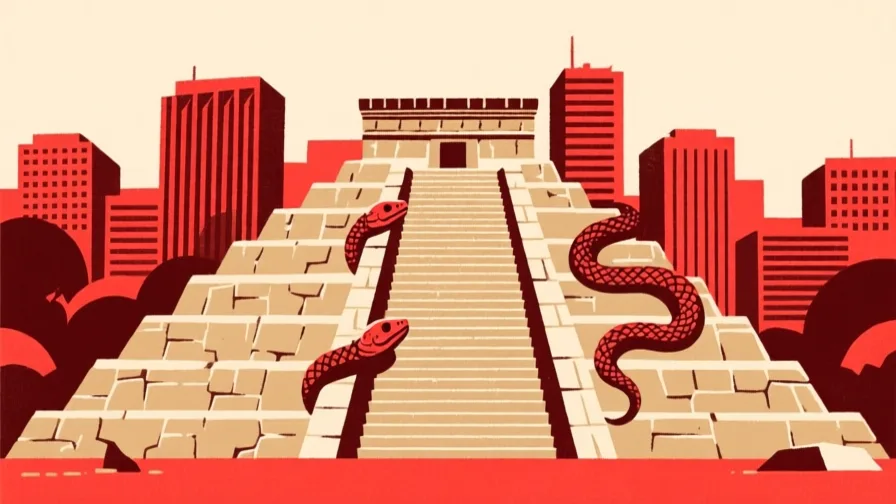 Templo Mayor · AI illustration, not a photograph
Historical place · Latin America
Templo Mayor
Also known as Huēyi Teōcalli, Tenochtitlan centre
The main temple precinct of Tenochtitlan, excavated beneath the centre of modern Mexico City.
Saved in this browser — no account needed. Sign in later and it comes with you.
Where it is
Tenochtitlan was a city on water. The Mexica raised their capital on an islet in the Lake of Texcoco, within the Valley of Mexico, and the first Spaniards to see it described a lake thick with canoes around a white city of towers. The conquerors razed it, began draining the lake and built Mexico City on the ruins, on a European plan shaped in part by the canals and rivers of the old city. The temple's remains now occupy a city block bounded by Seminario and Justo Sierra streets, north-east of the Zócalo and beside the Metropolitan Cathedral, in the historic centre. Water still shaped the spot in the 20th century: the slightly raised ground was nicknamed the ‘island of the dogs’, because strays gathered there when the streets flooded.
The land and water around it
The Lake of Texcocolake
The lake around the island capital, crossed by canoes and later drained by the Spanish. Canals and rivers that had organised the pre-Hispanic city still influenced the layout of the colonial one, and the residual lake at Xochimilco, its southern arm, keeps a little of the old lake country.
The Valley of Mexicovalley
The basin that held the lake and the city. At Xochimilco, 28 km south of the city, some chinampas, the so-called floating gardens, survive among small canals, the only remaining trace of the pre-Hispanic way of farming the basin's lagoons.
Its history, in short
The Mexica began their main temple after 1325 and rebuilt it six times, so seven temples were built on the spot; the second existed by 1375, and the biggest known enlargement came in 1454 under Moctezuma I. In its final form, Huēyi Teōcalli was a pyramid topped by two shrines with separate staircases, one for Huītzilōpōchtli, god of war, and one for Tlāloc, god of rain and agriculture, while a central spire honoured Quetzalcōātl as the wind god Ehēcatl. The Mexica understood it as the centre of the universe. Spaniards first mentioned the seventh temple in 1519, the Aztecs altered it for the last time in 1520, and in 1521 the conquerors sacked it and then quarried it for stone to build their colonial city. Even its location was forgotten. In the late 19th century Leopoldo Batres dug under the cathedral, wrongly thinking it stood on the ruins, and early in the 20th century Manuel Gamio found the south-west corner, but the district was an upper-class residential area and further digging found little public support. The breakthrough was an accident. On 21 February 1978 electricity workers hit a huge carved disc, and between 1978 and 1982 the Templo Mayor Project under Eduardo Matos Moctezuma demolished 13 buildings and recovered more than 7,000 objects, now kept in the site museum.
Timeline
Dates are shown on a timeline rather than as changing shapes on the map. The globe draws modern boundaries only, and tinting a modern outline to stand for a historical one would state something we cannot source.
Post-classical world
Early modern & oceanic
1454
Moctezuma I's enlargement
The temple undergoes its largest known expansion under the direction of Moctezuma I.
Well attestedWikipedia1519–1520
The seventh temple
The conquistadors first mention the temple in its final form in 1519, and the Aztecs make their last changes to it in 1520.
Well attestedWikipedia1521
Destruction
The Spanish sack the temple and nearly destroy it. Like most of Tenochtitlan, it is taken apart for building material, and the Metropolitan Cathedral rises nearby.
Well attestedWikipedia
Contemporary
21 February 1978
The Coyolxauhqui stone
Workers of the Comisión Federal de Electricidad, digging just over 2 metres down, strike a stone disc more than 3.25 metres across, 30 cm thick and weighing 8.5 tonnes. Its relief shows Coyolxauhqui, Huītzilōpōchtli's sister, and dates from the end of the 15th century.
Well attestedWikipedia1978–1982
The Templo Mayor Project
Authorised by presidential decree and led by the archaeologist Eduardo Matos Moctezuma, the excavation clears 13 buildings, 9 from the 1930s and 4 from the 19th century with colonial elements, and recovers more than 7,000 objects.
Well attestedWikipedia1987
World Heritage
The site is inscribed as part of the Historic Centre of Mexico City and Xochimilco. It received 801,942 visitors in 2017.
Places that carry meaning
The twin shrinesLate Postclassic
Two sanctuaries on the summit, each with its own staircase: Huītzilōpōchtli's for war and Tlāloc's for rain and farming. The temple dominated the Sacred Precinct, and a central spire was devoted to Quetzalcōātl in his wind-god form.
The Coyolxauhqui discEnd of the 15th century
The carved stone found in 1978 that set off the full excavation, depicting Huītzilōpōchtli's sister. A chance find by utility workers achieved what decades of scholarly digging had not.
The offerings and the Templo Mayor MuseumExcavated 1978–1982
More than 7,000 objects, mostly offerings: clay pots shaped as Tlāloc, skeletons of turtles, frogs, crocodiles and fish, coral, gold, alabaster, decorated skulls and obsidian and flint knives, along with Mixtec figurines, urns from Veracruz and masks from what is now Guerrero. The museum built since the early 1980s holds them.
The Metropolitan CathedralColonial
Built near the ruined temple and long believed to stand on top of it, which is why Leopoldo Batres dug beneath it. The temple turned out to lie to the north-east of the cathedral rather than under it.
Languages here
Places are usually multilingual. This lists what is actually spoken, not one language per border.
NahuatlUto-Aztecan family
The language of the Mexica who built the temple, and still Mexico's most widely spoken indigenous language.
In Nahuatl the temple was Huēyi Teōcalli, the great house of god, and the names of its gods, Huītzilōpōchtli, Tlāloc, Quetzalcōātl, Ehēcatl and Coyolxauhqui, are Nahuatl too, as is the name of the city, Tenōchtitlan. Philip II made Nahuatl an official language of New Spain's colonies in 1570, before Charles II banned all languages but Spanish in 1696. It is now the only indigenous language in Mexico with more than a million speakers, and since a 2003 law it counts, like the country's other indigenous languages, as a national language.
SpanishRomance family
The language of the conquerors, of the name used today, and of over 90% of Mexicans.
Templo Mayor simply means Main Temple. The Spanish name replaced Huēyi Teōcalli once the temple itself was gone, and the capital of New Spain, built partly from its stones, remained the capital of independent Mexico. The constitution names no official language, but Spanish is the working language of government and the de facto national language.
EnglishGermanic family
Spoken by about 5% of Mexicans and widely understood.
Because of the United States' cultural pull, American English is widely understood in Mexico, above all in the border states and tourist areas, and many people working in tourism speak some.
GermanGermanic family
One of the immigrant languages heard in the capital.
Small German-speaking communities live mainly in Mexico City and Puebla, and Greek is heard in Mexico City among other places; these and other immigrant languages are kept up by immigrants and their descendants, mostly in the larger cities.
Learn the language here
Check yourself
Which two gods had shrines on top of the Templo Mayor?
Huītzilōpōchtli and Tlāloc
Each had a shrine and staircase of its own: Huītzilōpōchtli, the war god, and Tlāloc, who ruled rain and agriculture. Quetzalcōātl, as the wind god Ehēcatl, had the central spire.
What finally led to the full excavation of the temple?
Electricity workers striking the Coyolxauhqui stone in 1978
Earlier finds by Batres and Gamio drew little public interest, partly because the area was an upper-class residential district. The 8.5-tonne disc uncovered in 1978 changed that and led to the Templo Mayor Project.
Worth arguing about
- The Spanish took the temple apart to build their city, and in 1978 the city knocked down 13 buildings, some with colonial elements, to uncover it. When the layers of a city sit on top of one another, which should give way?
- The Mexica saw the temple as the centre of the universe; today it is an archaeological site and museum in a capital's historic centre. What is lost, and what is gained, when a sacred centre becomes a place to visit?
What we have not established
These are open questions, listed rather than filled in. We would rather show a gap than a plausible guess.
When was the first temple built?
One account dates the first of the seven temples to 1325 itself, another only to some time after 1325, and the second temple is known only to have existed by 1375.
Sources
- Wikipedia · Templo MayorWikipedia · encyclopedia · checked 2026-11-24
- Wikipedia · Languages of MexicoWikipedia · encyclopedia · checked 2026-11-24
- UNESCO · Historic Centre of Mexico City and XochimilcoUNESCO World Heritage Centre · intergovernmental · checked 2026-11-24
Reviewed by Globe Quest editorial on 2026-11-24. Drafted with AI assistance and checked against the sources above before publication.
Related places
Themes: Indigenous & living cultures, Religion & pilgrimage, Empires & independence, How cities work