 Globe Quest
 Human Quest · LearningSign in
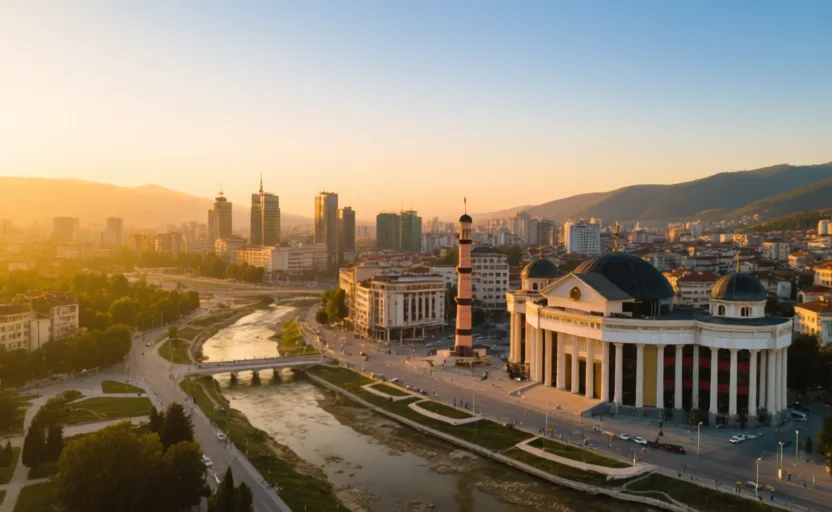 Skopje · AI city illustration · Artistic impression
City · Europe
Skopje
Saved in this browser — no account needed. Sign in later and it comes with you.
Where it is
Roughly halfway between Belgrade and Athens, Skopje fills a long, flat-floored valley about 245 metres above sea level. The valley runs west to east along the Vardar, is some 20 kilometres wide and is walled in by the Šar Mountains, the Jakupica range, the Osogovo hills and the Skopska Crna Gora. Those ranges cap the city’s growth sideways, so it stretches along the river: over 33 kilometres long but only about 10 wide. Mount Vodno, 1,066 metres, rises right behind the centre. Summers are long and hot, often above 31 °C, and the Accursed Mountains to the north-west cast a rain shadow, so rainfall is modest. The valley also sits close to a seismic fault between the African and Eurasian plates.
The land and water around it
The Vardar and its tributariesriver
The Vardar crosses the city about 60 kilometres from its source near Gostivar, and its flow swings from roughly 100 cubic metres a second in May to under 19 in July. The Serava joins from the north, the Lepenac from Kosovo, and the 130-kilometre Treska arrives from the west through Matka Canyon. The Ottoman town shifted toward the Serava’s mouth.
The Skopje Valleyvalley
A west–east basin with mountains on every side, which funnels traffic along the Danube-to-Aegean route and also limits where the city can spread. The urban area is mostly flat, with a few small wooded hills such as Gazi Baba and Zajčev Rid.
Mount Vodnomountains
The 1,066-metre peak of the Jakupica range is the highest point within city limits and the largest protected area inside them. A cable car links its summit with the downtown.
Its history, in short
Settlement began on the rocky promontory where the fortress stands, in the Chalcolithic. The Romans planted a colony of veterans nearby, Scupi, in the reign of Domitian, but an earthquake destroyed it in 518 and Justinian I rebuilt the town on the fortress promontory. After that Skopje changed hands often: Bulgarian capital for a time, then Byzantine, then in the fourteenth century the capital of Stefan Dušan’s Serbian empire. The Ottomans took it in 1392 and held it for over five centuries as Üsküb. They built the bazaar, caravanserais, mosques and baths, and Sephardic Jews expelled from Spain settled there. Fire in 1689 and decline left it with about 10,000 people in 1836, and the Salonika railway of 1873 brought trade back. Serbia took it in 1912. Another earthquake, in 1963, destroyed about 80 per cent of the city, and it was rebuilt with international help into a capital of Yugoslav modernism. Since 2010 the Skopje 2014 project has added neoclassical buildings and monuments to the centre, a plan that has drawn much controversy.
Timeline
Dates are shown on a timeline rather than as changing shapes on the map. The globe draws modern boundaries only, and tinting a modern outline to stand for a historical one would state something we cannot source.
Classical world
AD 81–96
Roman colony of Scupi
Under Domitian, Scupi becomes a colony of legionary veterans, named Colonia Flavia Scupinorum, and a seat of government in the province of Moesia Superior. Ptolemy lists it around AD 150.
Approximate dateWikipedia
Post-classical world
518
Earthquake and rebuilding
A violent earthquake destroys Scupi. Justinian I, born about 20 kilometres away, has a new town built on the promontory where the fortress now stands.
1346
Capital of Stefan Dušan
Stefan Dušan makes Skopje his capital and is proclaimed Tsar there, so that it becomes the capital of the Serbian Empire until his death in 1355.
Well attestedWikipedia1392
Ottoman conquest
The Ottomans take the city and rule it for about 520 years. Mehmed II’s patronage of the Stone Bridge falls between 1451 and 1469, and the Old Bazaar grows up around mosques, baths and inns.
Early modern & oceanic
1689
The Great Fire
Austrian forces under Piccolomini briefly occupy the city, plague spreads, and the retreating troops set it alight. Skopje had been among the largest towns in the Balkans and declines for two centuries.
Industrial & imperial
26 October 1912
Serbia enters the city
Serbian troops reach Skopje during the First Balkan War. The Albanian quarter is razed and many Albanian inhabitants killed, and hundreds of Muslim families leave in early 1913.
Well attestedWikipedia
Contemporary
1963
The earthquake
A major earthquake devastates the city, destroying about 80 per cent of it. Reconstruction with international assistance reshapes its layout and architecture.
Well attestedWikipedia1991
Capital of an independent state
Skopje becomes the capital of independent North Macedonia. In 2001 it sees rioting during the conflict between the government and Albanian insurgents.
Places that carry meaning
Skopje Fortress (Kale)Chalcolithic to Ottoman
The rocky promontory that was the first place settled, later the site of Justinian’s rebuilt town. It overlooks the modern centre.
The Stone Bridge1451–1469
Built under Sultan Mehmed II across the Vardar, it joins the Old Bazaar on one bank to the newer city on the other.
The Old BazaarOttoman, 15th century onward
An Ottoman market quarter of caravanserais, mosques and baths, among the largest surviving Ottoman urban complexes in Europe. Two of its former hammams now house the National Gallery.
Matka CanyonNatural
The gorge where the Treska reaches the Vardar at the city’s western edge, now a protected green space close to the city.
Languages here
Places are usually multilingual. This lists what is actually spoken, not one language per border.
MacedonianSlavic family
The official language and the city’s majority tongue.
Macedonians made up 58.7 per cent of the city in 2021, and Macedonian is the language of the city administration and its university.
AlbanianAlbanian family
The language of the largest minority, about a fifth of the city.
Albanians numbered 120,293 in 2021, and Albanian has been co-official at state level since 2019. The city’s Albanian name, Shkup, comes directly from the Roman Scupi.
Romani, Serbian, Turkish and Aromanian
Smaller community languages.
The 2021 census counted 18,498 Roma, 9,478 Serbs, 8,524 Turks and 2,778 Aromanians in the city. The Ottoman name Üsküb was used in Western languages until 1912.
Learn the language here
- 1Understand which languages are spoken hereSkopje is multilingual. Start with which languages are used, by whom, and for what — the phrase list only covers one of them.Written by Globe Quest
- 2Learn 13 phrasesCurated everyday phrases for Skopje, with audio and a written form.Written by Globe Quest
- 3Say them out loudSpeaking practice with pronunciation feedback, one phrase at a time.Globe Quest material, your own additions
- 4Come back to themSpaced review, so what you learned this week is still there next month.Written by Globe Quest
Check yourself
How much of Skopje did the 1963 earthquake destroy?
About 80 per cent
The earthquake destroyed roughly 80 per cent of the city, and the reconstruction that followed shaped the layout and the modernist architecture of the central districts.
Why is Skopje so long and narrow?
Mountain ranges on both sides of the Vardar valley confine it
The valley is about 20 kilometres wide and walled by mountains. The city spreads along the Vardar and the Serava rather than sideways, making it 33 kilometres long but 10 wide.
Worth arguing about
- A city rebuilt after an earthquake by an international effort, then reshaped again by a national government with columns and statues. Who decides what a capital should look like?
- Skopje has changed rulers many times, and its name changes with the language: Scupi, Üsküb, Skopje, Shkup. What does a name carry about whose city it is?
What we have not established
These are open questions, listed rather than filled in. We would rather show a gap than a plausible guess.
How many people live in Skopje?
The 2021 census counted 526,502 residents in the City of Skopje, a boundary that includes rural settlements. Counts for the urban core alone are lower, and the employment area reaches over a million.
Sources
- Wikipedia · SkopjeWikipedia · encyclopedia · checked 2026-11-24
- Wikipedia · History of SkopjeWikipedia · encyclopedia · checked 2026-11-24
- Wikipedia · North MacedoniaWikipedia · encyclopedia · checked 2026-11-24
Reviewed by Globe Quest editorial on 2026-11-24. Drafted with AI assistance and checked against the sources above before publication.