 Globe Quest
 Human Quest · LearningSign in
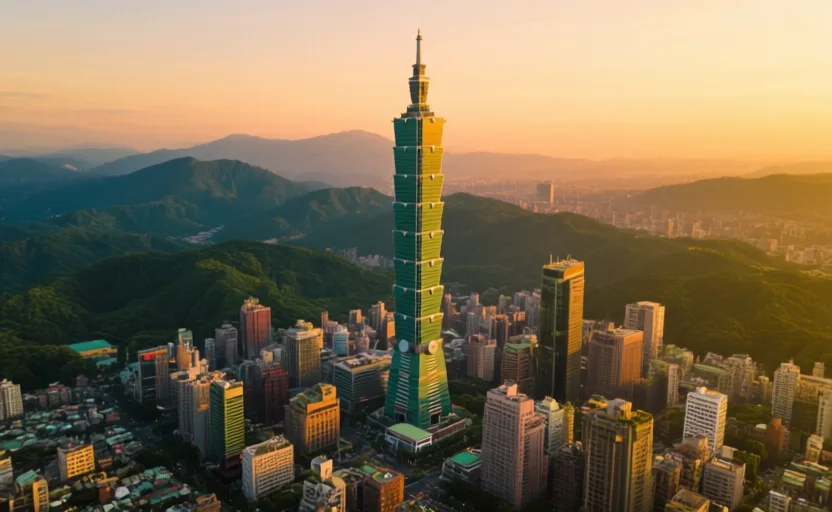 Taipei · AI city illustration · Artistic impression
City · East Asia
Taipei
Also known as Taihoku, 臺北
Saved in this browser — no account needed. Sign in later and it comes with you.
Where it is
Taipei lies in a basin at the northern end of Taiwan, the floor of an ancient lake. The Keelung and Xindian rivers run through narrow valleys and join as the Tamsui, which forms the city’s western edge. To the north the ground climbs to Qixing Mountain, 1,120 metres high and a dormant volcano in the Tatun group, and to the south-east the Songshan Hills form a wooded barrier. The basin traps cool air in winter, so the season is foggy and grey, while summers are long, hot and humid, with typhoons from June to October. The municipality is an enclave inside New Taipei City, which has taken the growth the basin floor could not hold.
The land and water around it
The Taipei Basinplain
A flat former lakebed ringed by hills and mountains, where the Keelung and Xindian rivers merge into the Tamsui. The shape of the basin gives the city its fog and its heat, and the lowland is crowded: Daan, Songshan and Datong are among the densest districts.
Yangmingshan and the Tatun volcanic groupvolcano
Qixing Mountain (1,120 m) and Mt Datun (1,092 m) rise north-east of the city as the highest rim of the basin. They are former volcanoes, and Yangmingshan National Park covers their western section, including the marshy Datun Pond on a broad saddle between the peaks.
The Tamsui Riverriver
Tamsui at its mouth was one of the designated overseas trade ports, handling the tea exports that made the area rich. The first market towns, Bangka, Dalongdong and Twatutia, grew up beside the river.
Its history, in short
Before Han Chinese settlers came, the basin belonged to Ketagalan peoples. Settlers from southern Fujian began arriving in 1709, and the tea trade through the nearby treaty port of Tamsui made the area wealthy in the late nineteenth century. In 1875 the Qing created Taipeh Prefecture here, and in 1887 the town was designated capital of the new province, a rank formally confirmed in 1894. When Japan took Taiwan in 1895, it kept the city as its colonial capital and renamed it Taihoku; it demolished most of the walls, laid out broad public streets and built government offices, among them the building that is now the Presidential Office. After 1945 Taiwan was handed to the Republic of China, and in 1947 an incident that began in Taipei led to island-wide martial law. In December 1949 the defeated Kuomintang government declared Taipei the provisional capital of the Republic of China. The city became a special municipality in 1967 and absorbed several outlying districts the next year. In 1990 student rallies at Liberty Square pushed Taiwan toward multi-party democracy.
Timeline
Dates are shown on a timeline rather than as changing shapes on the map. The globe draws modern boundaries only, and tinting a modern outline to stand for a historical one would state something we cannot source.
Early modern & oceanic
1709
Han settlement begins
Settlers from southern Fujian start to arrive in the basin, which until then was home to Ketagalan tribes. Their numbers rise over the following decades as the Qing allow development.
Industrial & imperial
1875
Taipeh Prefecture
The northern part of Taiwan is separated from Taiwan Prefecture, and a new prefectural capital, known as Chengnei, “the inner city”, grows beside the market towns of Bangka, Dalongdong and Twatutia.
Well attestedWikipedia1887–1894
Provincial capital
Taipei is designated the capital of the new province in 1887 and formally made provincial capital in 1894.
Approximate dateWikipedia1895
Japanese colonial capital
The Qing cede Taiwan to Japan under the Treaty of Shimonoseki. Taipei, now Taihoku, stays the capital, gains new public buildings and housing for civil servants, and loses its west gate and walls.
Contemporary
1947
The 28 February Incident
Incidents in Taipei set off an island-wide crackdown by forces loyal to Chiang Kai-shek, and martial law is declared across Taiwan.
7 December 1949
Provisional capital of the ROC
After losing the civil war on the mainland, the Kuomintang government moves to Taiwan and declares Taipei its provisional capital.
1967–1968
Special municipality and expansion
Taipei becomes a special municipality on 1 July 1967. The next year it annexes Shilin, Beitou, Neihu, Nangang, Jingmei and Muzha, multiplying its area fourfold.
Well attestedWikipedia1990
The Wild Lily rallies
Student rallies at the memorial hall to Chiang Kai-shek push Taiwan away from single-party rule, and by 1996 it has competitive multi-party politics. The same year, Taipei’s 16 districts are consolidated into the present 12.
Well attestedWikipedia
Places that carry meaning
Bangka Lungshan Temple1738
A temple in Wanhua District, in the area once called Bangka, with southern Chinese architecture common in Taiwan’s older buildings.
Presidential Office BuildingJapanese colonial era
Built as the office of the Governor-General of Taiwan, it is one of many Taipei buildings from the Japanese period that are still in public use.
The north gateQing era
The only surviving gate of the walled inner city from the Qing period. The west gate and walls were demolished, and the south, little south and east gates were heavily altered.
National Palace Museum20th century
A collection of more than 650,000 Chinese bronzes, jades, paintings, calligraphy and porcelain, one of the largest collections of Chinese art in the world.
Languages here
Places are usually multilingual. This lists what is actually spoken, not one language per border.
MandarinSino-Tibetan family
The main language of government, business and schooling.
Spoken by the vast majority of Taiwan’s people and dominant in schools and in television and radio. It is written in traditional characters. The Republic of China has no legally designated official language.
Taiwanese HokkienSino-Tibetan family
The mother tongue of the Hoklo majority.
About 70 per cent of the island belongs to the Hoklo group, and Hoklos and Waishengren together form the majority in Taipei. Hokkien and other non-Mandarin varieties have returned to public life since the 1990s, when limits on using them were removed.
HakkaSino-Tibetan family
A minority language, with a growing presence in the city.
Hakkas make up roughly 14 to 18 per cent of Taiwan, and in recent decades many have moved into Taipei.
Austronesian languagesAustronesian family
Spoken by the Indigenous peoples.
Taipei’s Indigenous population was 16,713 at the end of 2018. Taiwan is the only place where all the branches of the Austronesian family other than Malayo-Polynesian are found.
Learn the language here
- 1Understand which languages are spoken hereTaipei is multilingual. Start with which languages are used, by whom, and for what — the phrase list only covers one of them.Written by Globe Quest
- 2Learn 12 phrasesCurated everyday phrases for Taipei, with audio and a written form.Written by Globe Quest
- 3Say them out loudSpeaking practice with pronunciation feedback, one phrase at a time.Globe Quest material, your own additions
- 4Come back to themSpaced review, so what you learned this week is still there next month.Written by Globe Quest
Check yourself
What gives Taipei its basin shape?
An ancient lakebed ringed by hills, where the Keelung and Xindian rivers join the Tamsui
Most of the city sits on a former lakebed. The enclosing hills trap cool air in winter, which is why the season is foggy.
What happened in Taipei in December 1949?
The Kuomintang government declared it the provisional capital of the Republic of China
The Kuomintang had lost the mainland to the Communists and made Taipei its seat. The special municipality status came later, in 1967.
Worth arguing about
- Taipei’s main government buildings date from the Japanese colonial era and were reused by the Republic of China. What should a city do with buildings built by a former ruler?
- Taipei is often used as shorthand for the government of Taiwan, while the island’s international status is contested. What does a capital city’s name do when its country’s status is argued over?
What we have not established
These are open questions, listed rather than filled in. We would rather show a gap than a plausible guess.
How many people live in Taipei?
The municipality had about 2.5 million residents in 2022, while Greater Taipei, with New Taipei City and Keelung, had about 7 million. Registered residents and the people who actually live in the city differ, so any single figure depends on which boundary is used.
Sources
- Wikipedia · TaipeiWikipedia · encyclopedia · checked 2026-11-24
- Wikipedia · History of TaipeiWikipedia · encyclopedia · checked 2026-11-24
- Wikipedia · TaiwanWikipedia · encyclopedia · checked 2026-11-24
Reviewed by Globe Quest editorial on 2026-11-24. Drafted with AI assistance and checked against the sources above before publication.