 Globe Quest
 Human Quest · LearningSign in
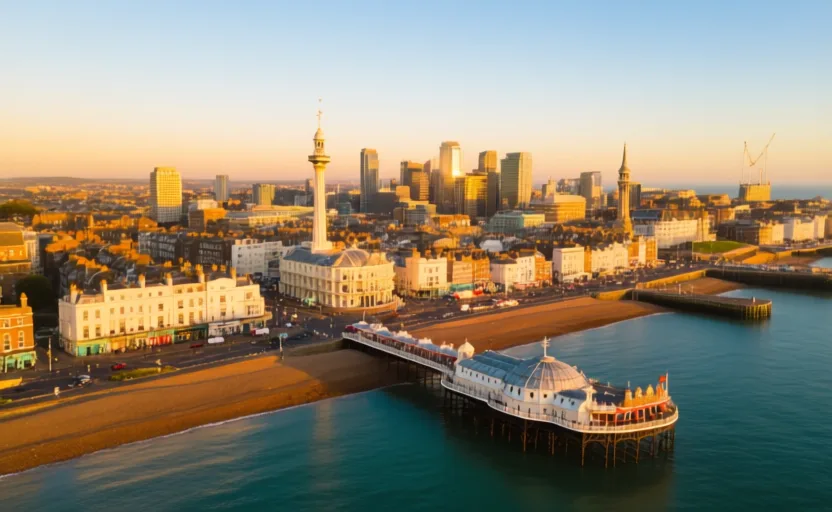 Brighton · AI city illustration · Artistic impression
City · Europe
Brighton
Saved in this browser — no account needed. Sign in later and it comes with you.
Where it is
Halfway along a wide, shallow bay on the Sussex coast, bounded by the headlands of Selsey Bill and Beachy Head, the South Downs come down almost to the sea. The town grew where a seasonal stream, the Wellesbourne, once ran off the chalk above Patcham and reached the beach near the East Cliff. That stream has been built over, but its old pond survives in a street name. The shore is shingle rather than sand, about eight miles of it within the city limits, and the climate is cool and mild with frequent cloud. Rainfall climbs with height, from about 740 mm on the seafront to around 1,000 mm on top of the Downs.
The land and water around it
The South Downsmountains
The chalk escarpment that backs the town. It shelters the coastal strip, shapes the rainfall pattern, and holds the Iron Age earthworks of Hollingbury Castle above the city.
The Wellesbourne and the Poolriver
A seasonal stream drained the Downs through what is now the town centre. Behind its mouth lay a stagnant pond, the Pool, built over from 1793 when the stream was culverted to prevent floods. In prolonged heavy rain the water can still rise.
The shingle baycoast
A shingle beach with a flat sandy foreshore at low tide, rather than a harbour. Brighton never became a major port and was treated as part of Shoreham, though storms repeatedly damaged the seafront, notably in 1703.
Its history, in short
The Anglo-Saxon settlers who founded the village chose a sheltered spot with easy access for boats and better conditions than the damp, misty Weald behind. By 1086 it was a fishing and farming place of about 400 people, paying rent in herring. Mackerel fishing carried it to about 4,000 people in the 1640s, the largest town in Sussex, but French raiders had burned it in 1514, and storms, sea erosion and the rise of nearby Shoreham as a port brought it down to about 2,000 by the early 18th century. Its second life began in the 1730s, when a doctor from Lewes sent patients to drink and bathe in seawater. Road improvements, a boat to France, and the Prince Regent’s patronage from 1783 made it fashionable. The railway from London in 1841 added day-trippers. Boundaries grew in stages, and in 1997 Brighton joined Hove into one authority that received city status in 2000.
Timeline
Dates are shown on a timeline rather than as changing shapes on the map. The globe draws modern boundaries only, and tinting a modern outline to stand for a historical one would state something we cannot source.
First cities & states
3500–2700 BC
Whitehawk Camp
A Neolithic causewayed enclosure on Whitehawk Hill, one of six in Sussex, marks the earliest known settlement in the area.
Approximate dateWikipedia
Post-classical world
1086
Domesday Book
The village appears as Bristelmestune, a fishing and farming settlement with about 400 people and a rent of 4,000 herring.
Well attestedWikipedia
Early modern & oceanic
June 1514
Burned by the French
French raiders under Admiral Pregent de Bidoux burn the village. A painting of this raid, around 1520, is the earliest known picture of the town.
1703
The Great Storm
A devastating storm, followed by another in 1705 that destroyed the lower town, helps push Brighton into decline.
1783
The Prince Regent arrives
The future George IV makes his first visit and later builds the Royal Pavilion. Georgian terraces had been rising since 1780.
Well attestedWikipedia
Industrial & imperial
1841
The London railway
The London and Brighton Railway brings day-trippers within reach. The population, 7,339 in 1801, had reached 46,661 by this year and passed 120,000 by 1901.
Well attestedWikipedia1928
A fivefold enlargement
The borough grows nearly fivefold, taking in Ovingdean, Rottingdean and parts of other parishes. Council estates follow, including Moulsecoomb and Whitehawk.
Well attestedWikipedia
Contemporary
2000
City status
Brighton and Hove, joined as one unitary authority in 1997, is granted city status as part of the millennium celebrations.
Well attestedWikipedia
Places that carry meaning
The Royal PavilionEarly 19th century
Built for the Prince Regent to designs by John Nash, in an Indo-Saracenic style with an Oriental interior. In the First World War it served as a military hospital, first for Indian soldiers.
The Lanes16th century onward
The tight grid of the Old Town streets, already laid out by the 16th century on the quarter-mile-square site shown on the earliest picture of the town.
St Nicholas ChurchAnglo-Saxon church recorded 1086
Possibly the oldest building in Brighton, known as the Mother Church. Its churchyard holds the tomb of the boat-owner who helped Charles II escape to France.
The Chain Pier and the seafront1823 to 1899
The Royal Suspension Chain Pier stood from 1823 to 1896 and was painted by Turner and Constable. The West Pier followed in 1866 and the Palace Pier in 1899.
Languages here
Places are usually multilingual. This lists what is actually spoken, not one language per border.
EnglishGermanic family
The everyday language of a city whose accents differ sharply from neighbouring places.
English is the most widely spoken language in the United Kingdom, and accents and dialects can vary strongly between nearby places. Brighton’s Anglo-Saxon name, from a personal name plus the Old English word for homestead, shows how long the language has been spoken on this stretch of coast.
Languages of newer communities
Spoken by migrants and their descendants across the UK.
Across the country, immigrants and their descendants speak many languages, among them Polish, Hindi and Urdu. Those are national findings; the mix in Brighton itself is not given.
British Sign Language
The language of some 125,000 Deaf adults in the UK.
British Sign Language, received formal recognition from the UK Government in 2003, and more people use it as their only language than any other indigenous minority language in the country. Many relatives and others also use it fluently.
Learn the language here
- 1Understand which languages are spoken hereBrighton is multilingual. Start with which languages are used, by whom, and for what — the phrase list only covers one of them.Written by Globe Quest
- 2Learn 13 phrasesCurated everyday phrases for Brighton, with audio and a written form.Written by Globe Quest
- 3Say them out loudSpeaking practice with pronunciation feedback, one phrase at a time.Globe Quest material, your own additions
- 4Come back to themSpaced review, so what you learned this week is still there next month.Written by Globe Quest
Check yourself
What started Brighton’s rise as a resort in the 1730s?
Seawater cures prescribed by a doctor from Lewes
Richard Russell sent patients to drink and bathe in the sea at Brighton and wrote a treatise on it. The Prince Regent and the railway came decades later.
What happened to the stream that once drained the Downs through the town?
It was culverted from 1793 and the pond behind it built over
The Wellesbourne was culverted to stop flooding and the Pool behind it was built over. Only the name Pool Valley marks the site.
Worth arguing about
- A shingle beach, no harbour and a poor economy in 1730: how did a place with so few natural assets become the model of the seaside town?
- Brighton went from retirement destination in the 1970s to fashionable again in the 1990s while homelessness rose. Who does a resort city’s revival serve?
What we have not established
These are open questions, listed rather than filled in. We would rather show a gap than a plausible guess.
Which languages are spoken at home in Brighton and Hove?
Census language data for the city was not available to check, so only the national picture is described and the city’s immigrant languages are left out rather than guessed.
Sources
- Wikipedia · BrightonWikipedia · encyclopedia · checked 2026-11-24
- Wikipedia · History of BrightonWikipedia · encyclopedia · checked 2026-11-24
- Wikipedia · United KingdomWikipedia · encyclopedia · checked 2026-11-24
- Wikipedia · Languages of the United KingdomWikipedia · encyclopedia · checked 2026-11-24
Reviewed by Globe Quest editorial on 2026-11-24. Drafted with AI assistance and checked against the sources above before publication.