 Globe Quest
 Human Quest · LearningSign in
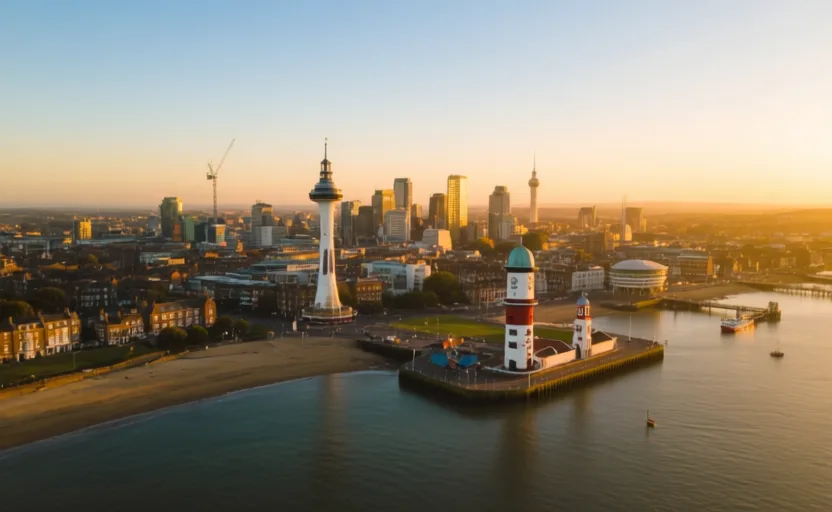 Southampton · AI city illustration · Artistic impression
City · Europe
Southampton
Saved in this browser — no account needed. Sign in later and it comes with you.
Where it is
Water decides everything here. At the head of Southampton Water, a drowned river valley dating from the close of the last glaciation, the Test and the Itchen converge, and the city centre lies on the tongue of land between them. The estuary opens into the Solent, and the Hamble joins from the south. The tide helps: Southampton Water has a double high tide, two peaks that give large ships a longer window to move, and the cause is the shape and depth of the English Channel rather than the Isle of Wight. The climate is oceanic, low-lying and sheltered, and among the warmest and sunniest in the UK. Much of the dockland is reclaimed mudflat.
The land and water around it
Southampton Waterestuary
A deep estuary, a drowned valley from the close of the last glaciation, that opens into the Solent. Its double high tide eases movement for large ships, and the port has dredged it to keep it open.
The Test and the Itchenriver
The Test runs along the western edge of the city through salt marsh, the Itchen splits it east from west, and the centre lies between them. The Anglo-Saxons moved the town across the Itchen to higher ground.
The reclaimed docksmarsh
The Eastern Docks were made in the 1830s by reclaiming the mud flats between the two estuaries. The Western Docks were built in the 1930s, with material dredged from Southampton Water.
Its history, in short
The site has had three towns. Romans built the fortified trading port of Clausentum at Bitterne and left around 410. The Anglo-Saxons then founded a larger planned town, Hamwic, on the other side of the Itchen in what is now the St Mary’s district. It had a mint and perhaps 2,000 or 3,000 people between about 700 and 850, and it gave Hampshire its name. After 1066 the medieval walled town became the main crossing point between Winchester and Normandy, trading French wine for English wool and cloth. It was raided in 1338, and the walls were rebuilt and strengthened afterwards. The Pilgrim Fathers left for America on the Mayflower from here in 1620. The modern city was made by the docks of the 1840s and the railway to London. Southampton became the Gateway to the Empire, the main liner port of the 20th century, and today the biggest cruise liners afloat are based here. Much of the city was levelled in the Blitz of November 1940.
Timeline
Dates are shown on a timeline rather than as changing shapes on the map. The globe draws modern boundaries only, and tinting a modern outline to stand for a historical one would state something we cannot source.
Classical world
From about AD 70
Clausentum
After the Romans conquer the local Britons, a fortress settlement is founded at Bitterne as a trading port and outpost of Winchester. It was not abandoned until around 410.
Approximate dateWikipedia
Post-classical world
c. 700–850
Hamwic
A planned Anglo-Saxon trading town on 110 acres, with 68 houses and workshops excavated, a royal mint from 786 to 858, and possibly 2,000 or 3,000 inhabitants.
1338
Sacked by the French
The raid prompts extensive work on the town walls, parts of which date from 1175. Merchant houses were joined together to form part of the defence.
Well attestedWikipedia
Early modern & oceanic
1620
The Mayflower
The Pilgrim Fathers leave Southampton, though the ship was forced to return to Plymouth. The port later became the last stop for millions of emigrants.
Industrial & imperial
29 August 1842
The first dock opens
A dock company was formed in 1835, and a railway link to London was fully open by May 1840. The town became known as the Gateway to the Empire.
1912
The Titanic sails
497 of the crew, about four in five of the men on board, were from Southampton, and about a third of those who died came from the city.
Well attestedWikipediaNovember–December 1940
The Southampton Blitz
Luftwaffe raids kill 137 people, 96 of them in direct hits on public shelters. The city was a target as a port and because the Spitfire was designed and built here.
Well attestedWikipedia
Places that carry meaning
The medieval walls and the BargateFrom 1175; reinforced after 1338
A large part of the town walls remains. God’s House Tower, built in 1417, was the first purpose-built artillery fortification in England.
Hamwic and St Mary’sc. 700–850
Excavations in St Mary’s have uncovered a section of the street plan and a collection of Saxon finds rated among Europe’s best.
God’s House bowling green1299
A green next to God’s House Hospital where bowls was first played regularly, and which is said to be the world’s oldest surviving bowling green.
The Titanic memorials1914
The Engineers’ Memorial in East Park, built in 1914 for the ship’s engineers, and a nearby memorial to its musicians.
Languages here
Places are usually multilingual. This lists what is actually spoken, not one language per border.
EnglishGermanic family
The everyday language, shaped by a port that sent millions abroad.
In 2021, 80.7 per cent of residents were White and 10.6 per cent Asian or British Asian. The city has been the last port of call for emigrants to the United States, Australia, Canada and elsewhere, but little in the written record shows which languages are now spoken at home.
Polish, Hindi and Urdu
Among the many languages of immigrant families in the United Kingdom.
Nationally, migrant languages such as Polish, Hindi and Urdu are heard alongside English. This is a picture for the whole country, as the city’s own home-language figures are not given here.
Learn the language here
- 1Understand which languages are spoken hereSouthampton is multilingual. Start with which languages are used, by whom, and for what — the phrase list only covers one of them.Written by Globe Quest
- 2Learn 13 phrasesCurated everyday phrases for Southampton, with audio and a written form.Written by Globe Quest
- 3Say them out loudSpeaking practice with pronunciation feedback, one phrase at a time.Globe Quest material, your own additions
- 4Come back to themSpaced review, so what you learned this week is still there next month.Written by Globe Quest
Check yourself
What was Hamwic?
A planned Anglo-Saxon trading town that gave Hampshire its name
Hamwic, on the east bank of the Itchen, evolved into Hamtun and then Hampton. The county name Hampshire comes from it. Clausentum was the earlier Roman port.
What causes Southampton Water’s double high tide?
The shape and depth of the English Channel
The popular explanation is the Isle of Wight, but the double high is a function of the Channel’s shape and depth, which distorts the water flow. It gives big ships extra time to enter and leave the port.
Worth arguing about
- Southampton has been a gateway for troops, emigrants and ocean liners. Which does a port town owe more to: the people who pass through or the people who stay?
- Much of the older city was destroyed in 1940 and rebuilt for the car. What should a port city rebuild, and what should it leave lost?
Sources
- Wikipedia · SouthamptonWikipedia · encyclopedia · checked 2026-11-24
- Wikipedia · History of SouthamptonWikipedia · encyclopedia · checked 2026-11-24
- Wikipedia · Languages of the United KingdomWikipedia · encyclopedia · checked 2026-11-24
Reviewed by Globe Quest editorial on 2026-11-24. Drafted with AI assistance and checked against the sources above before publication.