 Globe Quest
 Human Quest · LearningSign in
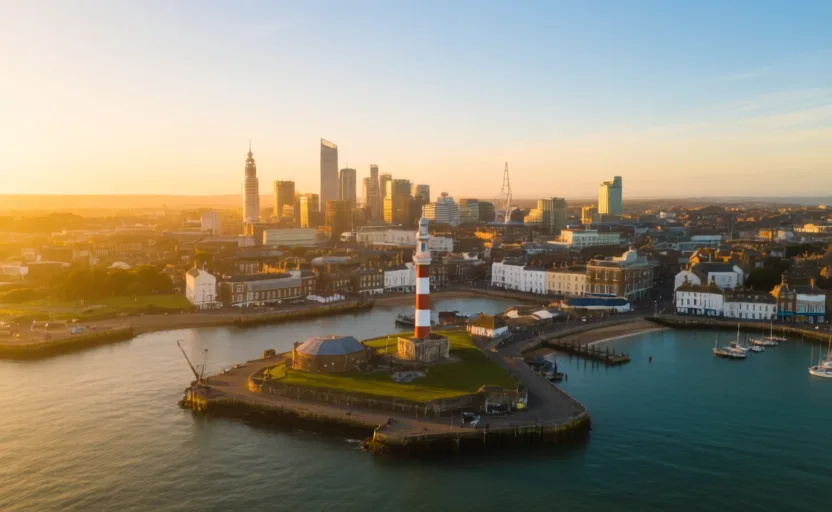 Portsmouth · AI city illustration · Artistic impression
City · Europe
Portsmouth
Saved in this browser — no account needed. Sign in later and it comes with you.
Where it is
Most of the city is an island. Portsea Island is a flat, low block of London Clay and sand, mostly under three metres above sea level, cut off from the mainland by a creek that three roads and a railway cross. A tidal harbour opens to its west, with a narrow channel past Old Portsmouth and Gosport, and another large inlet, Langstone Harbour, lies to the east. To the south lie Spithead, then the Solent, then the Isle of Wight. Behind it a chalk ridge, Portsdown Hill, dominates the skyline. The climate is mild and oceanic, sunnier than much of Britain, with about 645 mm of rain a year.
The land and water around it
Portsea Islandisland
England’s only island city. Almost all of it lies below three metres, and the single natural high point is a road junction at Kingston Cross. Portsbridge Creek separates it from the mainland, which made the northern edge a natural line for fortification.
Portsmouth and Langstone harboursharbour
Two tidal inlets frame the island. The western harbour, with its branching lakes, shelters the naval base. The eastern one is quieter, and Farlington Marshes on its shore is a grazing marsh and saline lagoon reclaimed in 1771.
Portsdown Hillmountains
A band of chalk north of the island, unlike the clay and sand beneath the rest of the city. Six of the Palmerston Forts stand along its ridge, which looks down on the harbour.
Its history, in short
The harbour mattered before the city did. The Romans built a fort at nearby Portchester in the late 3rd century, and the Old English name Portesmuða means the mouth of a haven. The town proper was founded around 1180 by the merchant Jean de Gisors and received a royal charter from Richard I in 1194. Because it lay a short sail from France, it was raided and burned repeatedly in the 13th and 14th centuries, and was repeatedly fortified in return. The Tudors built the country’s first dry dock and a castle at Southsea, and the navy’s need for ships and supplies made the dockyard the largest industrial site in the world around 1800, with the first mass-production line in the Block Mills. Nelson sailed from here for Trafalgar in 1805. By the 1850s a ring of forts guarded the approaches. The city was bombed heavily in the Second World War, was a key embarkation point for the D-Day landings, and sent the 1982 Falklands task force; today still holds the Royal Navy’s main surface base.
Timeline
Dates are shown on a timeline rather than as changing shapes on the map. The globe draws modern boundaries only, and tinting a modern outline to stand for a historical one would state something we cannot source.
Classical world
Late 3rd century
Portus Adurni
The Romans put up a fort on the harbour shore at Portchester, close to the island.
Approximate dateWikipedia
Post-classical world
2 May 1194
Royal charter
Richard I, gathering an army and about 100 ships here after his captivity in Austria, grants a fifteen-day annual fair, weekly markets and a local court.
1338
A French fleet sails in under English flags
French ships burn most of the town before anyone realises they are hostile. Edward III exempts the survivors from national taxes so they can rebuild. Further French raids followed in 1369, 1377 and 1380.
Well attestedWikipedia
Early modern & oceanic
1545
The Mary Rose sinks
Henry VIII watches his vice-flagship founder off Southsea Castle with the loss of about 500 lives, on its way to fight the French fleet.
Well attestedWikipedia
Industrial & imperial
1803–1805
The Block Mills
Marc Brunel installs the first mass-production line, making pulley blocks for the navy’s rigging. Nelson leaves Portsmouth on 14 September 1805 to command the fleet at Trafalgar.
Well attestedWikipediaBy 1859
The Palmerston Forts
A ring of land and sea forts is complete, built because an invasion from continental Europe was feared.
Well attestedWikipedia21 April 1926
City status
Granted after a long campaign by the council, on the grounds that Portsmouth was the first naval port of the kingdom.
1940s
The Blitz
The Portsmouth Blitz kills 930 people. More than 700 prefabricated houses were built between 1945 and 1947, and new estates such as Leigh Park went up on the mainland.
Approximate dateWikipedia
Places that carry meaning
Portsmouth Historic DockyardTudor to present
The naval base holds the world’s oldest dry dock still in use, begun in 1698, along with the Mary Rose, Nelson’s flagship and the Royal Navy’s first ironclad.
Old PortsmouthFrom about 1180
The original town on the island’s south-west tip, including Portsmouth Point, nicknamed Spice Island. Its first chapel, to Thomas Becket, stands on the site of today’s Anglican cathedral.
The Palmerston FortsMid-19th century
Six forts on Portsdown Hill and four in the Solent, among them Spitbank and No Man’s Land Fort, guard the harbour approaches.
The two cathedrals12th century and 1882
St Thomas, the Anglican cathedral, and St John the Evangelist, the Catholic one, built in 1882 for a growing Catholic population, many of them Irish people drawn by the dockyard.
Languages here
Places are usually multilingual. This lists what is actually spoken, not one language per border.
EnglishGermanic family
The common language of a naval city that drew people from across Britain and Ireland.
The dockyard drew workers from across the British Isles, particularly Irish Catholics. In 2021, 78 per cent of residents were White British.
ChineseSino-Tibetan family
Heard in a long-established community with roots in the Royal Navy and British Hong Kong.
Chinese residents were about 1 per cent of the city in 2021. Bangladeshi, Indian and other Asian communities are larger, so several South and East Asian languages are also spoken in the city.
Polish, Hindi and Urdu
Among the many languages of immigrant families in the United Kingdom.
Nationally, migrant languages such as Polish, Hindi and Urdu are heard alongside English. This is a picture for the whole country, as the city’s own home-language figures are not given here.
Learn the language here
- 1Understand which languages are spoken herePortsmouth is multilingual. Start with which languages are used, by whom, and for what — the phrase list only covers one of them.Written by Globe Quest
- 2Learn 13 phrasesCurated everyday phrases for Portsmouth, with audio and a written form.Written by Globe Quest
- 3Say them out loudSpeaking practice with pronunciation feedback, one phrase at a time.Globe Quest material, your own additions
- 4Come back to themSpaced review, so what you learned this week is still there next month.Written by Globe Quest
Check yourself
What is unusual about Portsmouth’s location?
It is England’s only city located mainly on an island
Most of the city lies on low-lying Portsea Island, separated from the mainland by Portsbridge Creek.
What was made at the Block Mills in Portsmouth?
Pulley blocks made on a mass-production line
Marc Brunel’s machines made pulley blocks for the navy’s rigging, starting in 1803, and the mills produced 130,000 blocks in 1808.
Worth arguing about
- A city fortified for centuries against France, now a base for a much smaller fleet. What should a place organised around defence be organised around next?
- Portsmouth is the most densely populated city in the UK outside London, yet confined by water and forts. What does a city lose when it cannot spread?
What we have not established
These are open questions, listed rather than filled in. We would rather show a gap than a plausible guess.
How many people live in Portsmouth?
The 2021 census counted 208,100 residents, but earlier estimates run higher, and the number depends on whether the mainland districts and the wider South Hampshire area are included.
Sources
- Wikipedia · PortsmouthWikipedia · encyclopedia · checked 2026-11-24
- Wikipedia · History of PortsmouthWikipedia · encyclopedia · checked 2026-11-24
- Wikipedia · Languages of the United KingdomWikipedia · encyclopedia · checked 2026-11-24
Reviewed by Globe Quest editorial on 2026-11-24. Drafted with AI assistance and checked against the sources above before publication.