 Globe Quest
 Human Quest · LearningSign in
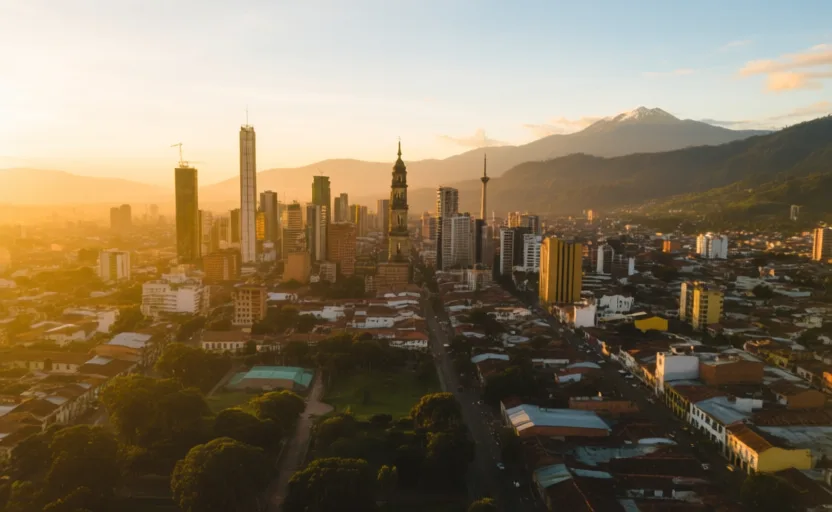 Cali · AI city illustration · Artistic impression
City · Latin America
Cali
Saved in this browser — no account needed. Sign in later and it comes with you.
Where it is
Cali spreads across the floor of the Cauca Valley at about 1,000 metres, with the Cauca River along its eastern side and the Western Cordillera, topped locally by the Farallones de Cali, closing off the west. The ground is mostly flat, and short rivers drop from the mountains across the city to join the Cauca. The Pacific port of Buenaventura is only about 100 kilometres away over the range, yet one of the wettest places in the world; the mountains shield Cali in a rain shadow, so it gets roughly 1,480 millimetres a year and stays warm, around 24 °C, with two rainy seasons.
The land and water around it
The Cauca Valleyvalley
A broad plain between the Western Cordillera and the Cauca River, with Yumbo's factories to the north and the town of Jamundí to the south, both part of the metropolitan area. Cali is the main urban and economic centre of the south, linked to the world through Buenaventura and an important stop on the road to Ecuador.
The Western Cordillera and its rain shadowmountains
The range rises from about 2,000 metres in the north of the city to roughly 4,000 metres in the south, so the north-west is drier than the south-west. Buenaventura sits on the windward side and receives the Pacific rain; the same mountains leave Cali comparatively dry.
The rivers that cross the cityriver
The Aguacatal flows into the Cali River, and the Cañaveralejo, Lilí and Meléndez join a southern channel; all drain to the Cauca. Farther south the Pance River is a favoured place for recreation.
Its history, in short
The area was home to groups such as the Gorrones, Timbas and Jamundíes when Sebastián de Belalcázar, a veteran of the conquest of Peru, arrived. The Jamundíes resisted with poisoned darts, and the chief Petecuy raised an army from several peoples before the Spanish won in 1536. Belalcázar founded Santiago de Cali that year a few kilometres north of the present site, and the town moved to its location in 1537. It never became a colonial capital: Belalcázar moved the governorship to Popayán in 1540, citing its better weather. Cali was a quiet town of no more than 20,000 in the nineteenth century, living from cattle, sugar cane, panela, cheese and Pacific gold. It broke with Spain early. In July 1810 it refused to recognise the Spanish Regency and set up its own junta, 17 days before Bogotá. The twentieth century brought both disaster and celebration: in 1956 army trucks loaded with dynamite exploded and killed more than a thousand people, and in 1971 the city hosted the Pan American Games. In 2021 it became a focus of nationwide protests.
Timeline
Dates are shown on a timeline rather than as changing shapes on the map. The globe draws modern boundaries only, and tinting a modern outline to stand for a historical one would state something we cannot source.
Early modern & oceanic
25 July 1536
Founded by Belalcázar
Sebastián de Belalcázar founds Santiago de Cali on the feast day of Saint James, a few kilometres north of where the city now stands. In 1537 Captain Miguel Muñoz moves it to the present site.
Well attestedWikipedia1540
The governorship moves to Popayán
Belalcázar shifts the capital of the governorship to Popayán because of its better weather. Cali remains part of the governorship, under the Audiencia of Quito.
Well attestedWikipedia
Industrial & imperial
3 July 1810
Cali breaks with the Regency
The town refuses to recognise the Spanish Council of Regency and sets up its own junta, seventeen days ahead of Bogotá.
Well attestedWikipedia28 March 1811
Battle of Bajo Palacé
A force from the Cauca Valley under Antonio Baraya and the Cabal brothers defeats the royalists in what is described as the first battle of Colombia's independence. Cali and other valley towns had declared independence from the governorship of Popayán on 1 February.
Well attestedWikipedia
Contemporary
7 August 1956
The dynamite explosion
Seven army trucks carrying 42 tonnes of dynamite explode near the train station at about one in the morning, destroying eight blocks and killing over a thousand people. The Cali Fair is created the following year to lift the city's spirits and its economy.
Well attestedWikipedia1971
Pan American Games
The city hosts the Games, which many see as the height of its golden age as a model of civic order. Afterwards Cali is named the sports capital of Colombia.
Well attestedWikipediaFrom 28 April 2021
A centre of the national protests
Demonstrations in Cali are mostly peaceful but include clashes with police, rioting and looting.
Well attestedWikipedia
Places that carry meaning
La Merced churchFrom 1537
Stands on the spot where the chaplain Brother Santos de Añasco celebrated mass after the move to the present site in 1537, the year Belalcázar named Pedro de Ayala the first municipal authority.
Plaza de CayzedoColonial centre
The main square of the old centre, surrounded by the cathedral, the Palace of Justice and the Otero building, close to San Francisco church and the municipal theatre.
The railway station area7 August 1956
Around the station the 1956 explosion levelled eight city blocks and the nearby army barracks, and broke windows for miles.
Languages here
Places are usually multilingual. This lists what is actually spoken, not one language per border.
SpanishRomance family
The language of the city's life.
Spanish is the language of the city and the region; Cali is known as the capital of salsa music. Jewish merchants who arrived in the eighteenth and nineteenth centuries often assimilated; some adopted Spanish forms of their names, such as James Martin Eder, who became Santiago Eder.
Indigenous languages of the valley
Spoken before the conquest by peoples who gave the city its name.
The word Cali comes from the Calima, an Amerindian people, and before the Spanish most local groups spoke Cariban languages. Colombia today recognises 65 Amerindian languages.
Learn the language here
- 1Understand which languages are spoken hereCali is multilingual. Start with which languages are used, by whom, and for what — the phrase list only covers one of them.Written by Globe Quest
- 2Learn 11 phrasesCurated everyday phrases for Cali, with audio and a written form.Written by Globe Quest
- 3Say them out loudSpeaking practice with pronunciation feedback, one phrase at a time.Globe Quest material, your own additions
- 4Come back to themSpaced review, so what you learned this week is still there next month.Written by Globe Quest
Check yourself
Why is Cali dry compared with the nearby port of Buenaventura?
Buenaventura sits on the windward side of the range, while Cali is in a rain shadow
Pacific rain falls on the windward slopes near Buenaventura, one of the rainiest places in the world, and the Western Cordillera shields Cali on its eastern side. The two cities are only about 80 to 100 kilometres apart.
What did the people of Cali do in July 1810?
Refused to recognise Spain's Regency and set up their own junta
The town formed its own junta on 3 July 1810, seventeen days before the uprising in Bogotá. The first battle of Colombia's independence followed in 1811, at Bajo Palacé.
Worth arguing about
- A city known for salsa and sport that also lived through a catastrophic explosion and protests that turned violent in places. How do residents' ideas of the city change after such events?
- Cali lies in a fertile valley with a Pacific port beyond the mountains, but the road between them crosses a rain-soaked range. How much does a region's geography decide which cities become the main hubs?
What we have not established
These are open questions, listed rather than filled in. We would rather show a gap than a plausible guess.
How many people live in Cali?
An estimate of 2.3 million applies to 2026, while a count from 2018 gives about 2.5 million; the two come from different dates and methods. The city is the third most populous in Colombia, but its metropolitan area, which takes in Yumbo and Jamundí, is larger than the municipality.
Sources
- Wikipedia · CaliWikipedia · encyclopedia · checked 2026-11-24
- Wikipedia · ColombiaWikipedia · encyclopedia · checked 2026-11-24
Reviewed by Globe Quest editorial on 2026-11-24. Drafted with AI assistance and checked against the sources above before publication.