 Globe Quest
 Human Quest · LearningSign in
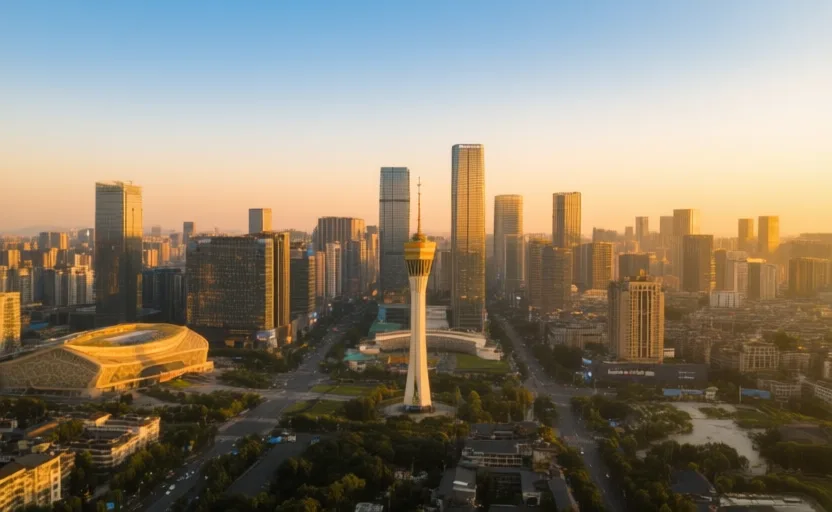 Chengdu · AI city illustration · Artistic impression
City · East Asia
Chengdu
Saved in this browser — no account needed. Sign in later and it comes with you.
Where it is
The Chengdu Plain is a flat floor at the western edge of the Sichuan Basin, about 500 metres above sea level, with mountains standing up abruptly behind it. The Longmen and Qionglai ranges to the north-west and west exceed 3,000 metres and reach 5,364 metres at Miaojiling, and their forested slopes shelter giant panda habitat. Several rivers converge on the plain, three of them, the Jin, Fu and Sha, through the urban area. Fertile soil and a mild, damp, humid subtropical climate have long earned the plain names such as the “Land of Abundance”. It is cloudy: the city gets about 1,000 hours of sun a year, less than much of northern Europe. The Qin Mountains far to the north screen it from Siberian winter winds.
The land and water around it
The Chengdu Plainplain
A flat plain around 500 metres up, known as the “Country of Heaven”. The Dujiangyan irrigation system, a World Heritage site, is part of why it was so farmable, and the plain gave Chengdu its place as the hub of western China.
The Qionglai and Longmen Mountainsmountains
The wall of mountains to the north-west and west, with peaks above 5,000 metres and forests that shelter the giant panda. The city’s panda breeding base takes advantage of the nearby habitat.
The Sichuan Basin’s grey wintersclimate
A dull, humid basin: January averages 5.9 °C, snow is rare, and sunshine is among the lowest in China. The Qin Mountains block cold air, and summers are hot and humid but not as fierce as in Chongqing, Wuhan and Nanjing, the cities known as the “Three Furnaces”.
Its history, in short
Bronze-working peoples lived on this plain more than four thousand years ago; the Sanxingdui and Jinsha sites show a culture quite unlike the Central Plain’s, which later became known to the Chinese as Shu. Its king moved the capital to Chengdu around the fourth century BCE, and Qin conquered Shu in 316 BCE and refounded the settlement. Under the Han, Chengdu brocade became fashionable and was sold across China, and after the Han fell, Liu Bei ruled the Shu Han state of the Three Kingdoms from here. The Tang valued it as the second-richest city in China, and poets Li Bai and Du Fu lived in it. The Song brought the earliest widely used paper money here, and the city was the capital of several local kingdoms in between. In 1937 and 1938 the Nationalist government retreated into Sichuan to escape the Japanese, bringing business owners, labourers and scholars who set up many of the industries and cultural institutions still found in Chengdu. After 1949, railways to Chongqing, Kunming and Tibet made it the link between east and west China.
Timeline
Dates are shown on a timeline rather than as changing shapes on the map. The globe draws modern boundaries only, and tinting a modern outline to stand for a historical one would state something we cannot source.
First cities & states
18th–10th centuries BCE
Sanxingdui and Jinsha
A separate bronze-using culture occupies the plain, known to later Chinese as Shu. Finds at the Sanxingdui and Jinsha sites include a gold mask from the Shang and Zhou periods.
Approximate dateWikipedia
Classical world
c. 4th century BCE
Capital of Shu
King Kaiming, the fifth of the Shu kings, moves the capital to Chengdu. The origin of the name is unclear, with a traditional story that it was chosen in a line about a place taking three years to become a metropolis, which modern scholars do not generally accept.
Approximate dateWikipedia316 BCE
Qin conquest
Qin conquers Shu, and the general Zhang Yi refounds the settlement. Chengdu is one of few Chinese cities to have kept the same name since.
Well attestedWikipedia
Post-classical world
760
Du Fu in Chengdu
The poet raises a humble dwelling called Caotang in the city, during a stay of four years. The present Caotang, or Grass Hall, was built in 1078 in his honour.
Well attestedWikipedia965
Song rule and paper money
The Song take the city, and what is described as the earliest widely circulating paper money is introduced.
Well attestedWikipedia
Industrial & imperial
1911
The Railway Protection Movement
Protests in Chengdu help trigger the Wuchang Uprising, which leads to the revolution that overthrows the Qing.
Well attestedWikipedia1937–1938
A wartime refuge
As the Nationalist government retreats before Japan, Chengdu becomes a refuge and military centre on its way to Chongqing. Business owners, workers and scholars settle in the city, and Japanese bombers repeatedly attack it.
Well attestedWikipedia
Contemporary
1952 onward
A railway hub
A railway to Chongqing opens in 1952, and links to Kunming and Tibet follow. In the 1960s the city becomes a defence industry hub.
Well attestedWikipedia
Places that carry meaning
Sanxingdui and Jinsha18th–10th centuries BCE
Archaeological sites of the ancient Shu bronze culture. Jinsha lies inside Chengdu’s urban area and is called a pinnacle of ancient Shu culture; Sanxingdui is believed to have been a major city of a previously unknown Bronze Age culture.
Dujiangyan Irrigation SystemAncient
An ancient irrigation scheme that waters the plain and is a World Heritage site, cited as one reason the plain is so fertile.
Caotang, the Grass Hall1078
A memorial to the poet Du Fu, built in 1078 on the site of the humble house he built in 760.
Qingyang Gong9th century
The Taoist “Green Goat Temple”, built in the ninth century.
Languages here
Places are usually multilingual. This lists what is actually spoken, not one language per border.
Mandarin ChineseSino-Tibetan family
The national standard, used in schools and government.
Standard Chinese, called Putonghua, is based on the Beijing dialect and works as a lingua franca across the Mandarin-speaking regions. Chinese sources count some variety of Mandarin as the first language of about 71% of the country’s people.
Southwestern MandarinSino-Tibetan family
The local Chinese speech of Sichuan and its capital.
The Mandarin spoken around Chengdu belongs to the Southwestern group, one of several Mandarin groups that differ from the Beijing-based standard. Speakers of different Chinese varieties are taught to write the same written Mandarin at school, which is how they communicate across the divides.
Minority and other Chinese languages
Spoken by the rest of the country, and by newcomers to the city.
Nationally, about 300 minority languages are spoken by the remaining 8% of the population, and the most strongly supported are Mongolian, Tibetan, Uyghur and Zhuang. Around 300 million people in China speak other Chinese languages at home, among them Wu, Yue (Cantonese), Min and Hakka.
Learn the language here
- 1Understand which languages are spoken hereChengdu is multilingual. Start with which languages are used, by whom, and for what — the phrase list only covers one of them.Written by Globe Quest
- 2Learn 11 phrasesCurated everyday phrases for Chengdu, with audio and a written form.Written by Globe Quest
- 3Say them out loudSpeaking practice with pronunciation feedback, one phrase at a time.Globe Quest material, your own additions
- 4Come back to themSpaced review, so what you learned this week is still there next month.Written by Globe Quest
Check yourself
What is unusual about the name Chengdu?
It has been unchanged since the settlement’s founding, through empire, republic and People’s Republic
Chengdu is attested from the Warring States period and is called the only major Chinese city to keep one name at one location. It was briefly called Xijing, the Western Capital, in the seventeenth century, so the claim has limits.
Why did many industries and institutions arrive in Chengdu around 1938?
The Nationalist government and its people retreated into Sichuan from Japan
Chengdu lay beyond the reach of Japanese ground forces. Businesspeople, workers and academics came with the retreating government and built institutions that remain today.
Worth arguing about
- Chengdu has kept one name for more than two thousand years while the state around it changed. What does a place keep when everything else is replaced?
- The city is planning dense satellite districts and calls itself a city within a park. Can a fast-growing city expand without losing the character that made it attractive?
What we have not established
These are open questions, listed rather than filled in. We would rather show a gap than a plausible guess.
How many people live in Chengdu?
The 2020 census counted about 20.9 million in the municipality, but only about 16 million in the 12 urban districts and Guanghan. The OECD estimated 18.1 million for the metropolitan area in 2015, so the figure depends on which boundary is used.
Sources
- Wikipedia · ChengduWikipedia · encyclopedia · checked 2026-11-24
- Wikipedia · ChinaWikipedia · encyclopedia · checked 2026-11-24
- Wikipedia · Languages of ChinaWikipedia · encyclopedia · checked 2026-11-24
Reviewed by Globe Quest editorial on 2026-11-24. Drafted with AI assistance and checked against the sources above before publication.