 Globe Quest
 Human Quest · LearningSign in
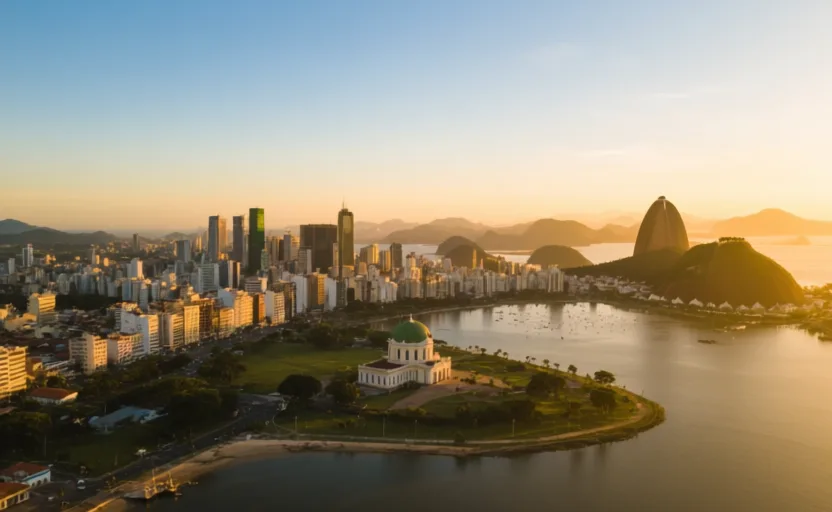 Florianópolis · AI city illustration · Artistic impression
City · Latin America
Florianópolis
Saved in this browser — no account needed. Sign in later and it comes with you.
Where it is
Most of Florianópolis is an island. Santa Catarina Island lies just off the southern Brazilian coast, joined to the mainland part of the municipality by three bridges, and it is ringed by beaches, lagoons and small fishing coves. The population clusters on the mainland and in the centre and north of the island, while the southern half stays thinly settled. The city is in the Atlantic Forest zone, and the hills behind it still carry forest that supplies much of the drinking water. The climate is warm and humid subtropical with no dry season, about 1,500 millimetres of rain a year, and well-defined summers and winters.
The land and water around it
Santa Catarina Islandisland
A long, hilly island with dozens of beaches, enclosing the channel the Carijós called Meiembipe. Its bays gave ships a sheltered stop on the way to the River Plate, and fortresses were built at its entrances.
Lagoa da Conceiçãolagoon
The largest lagoon on the island, ringed by hills and linked to the ocean by a canal. Its shores keep old Portuguese buildings and a lace-making and netting tradition, and the district is where many newcomers settle.
The Atlantic Forestforest
Forest still covers the hills of the municipality. The Serra do Tabuleiro State Park protects the sources of the rivers that supply most of the drinking water of greater Florianópolis and the south coast.
Its history, in short
Before the Portuguese came, Tupi-speaking Carijós lived here, leaving shell mounds called sambaquis up to four thousand years old, and called the place Meiembipe, meaning mountain along the channel. Portuguese ships called around 1514 and named it first the Island of the Ducks and then, in 1526, Santa Catarina. Real settlement began in 1673 with a bandeirante, and in 1678 the settlers built a chapel to Nossa Senhora do Desterro. The island’s position halfway between Rio de Janeiro and Buenos Aires made it strategic, so the crown made it a captaincy in 1739 and ringed it with fortresses. Between 1747 and 1756 about 6,000 settlers arrived from the Azores and Madeira, and their dialect and crafts still shape the south of the island. Desterro became the capital of Santa Catarina province in 1823. After it served as the rebel capital during the Federalist Revolt, the republic’s president Floriano Peixoto crushed the rising, and in 1893 the city took his name.
Timeline
Dates are shown on a timeline rather than as changing shapes on the map. The globe draws modern boundaries only, and tinting a modern outline to stand for a historical one would state something we cannot source.
Early modern & oceanic
c. 1514
Portuguese landing
Portuguese sailors land and call the place the Island of the Ducks. In 1526 it is renamed for Saint Catherine.
Approximate dateWikipedia1673–1678
Settlement begins
The bandeirante Francisco Dias Velho brings an agricultural company in 1673, and a chapel to Nossa Senhora do Desterro is built in 1678.
Well attestedWikipedia1739
A captaincy and its fortresses
The crown creates the Captaincy of Santa Catarina Island with Desterro as capital, because the port lay halfway between Rio de Janeiro and Buenos Aires. A ring of coastal fortresses follows.
Well attestedWikipedia1747–1756
Azorean settlers
About 6,000 settlers from the Azores and Madeira arrive. Agriculture, cotton and linen, and trade follow their occupation.
Well attestedWikipedia
Industrial & imperial
1823
Provincial capital
Desterro becomes the capital of Santa Catarina province under the empire, opening a prosperous period of urban works.
Well attestedWikipedia1893
Desterro becomes Florianópolis
After the Federalist Revolt, in which the city served as the rebels’ capital, President Floriano Peixoto suppresses the rising and many are shot at the Anhatomirim fortress. The state capital takes his name, possibly to show loyalty.
Well attestedWikipedia1926
Hercílio Luz Bridge
A bridge links the island to the mainland, and it becomes the symbol of the city.
Well attestedWikipedia
Places that carry meaning
Anhatomirim Island FortressColonial
One of the defensive ring of fortresses of the captaincy, and later the place where the rebels of the Federalist Revolt were shot.
Ribeirão da IlhaColonial
The oldest part of the capital, where residents still speak in an accent closer to that of the Azorean settlers. Its church of Our Lady of Lapa was built in 1806.
Lagoa da Conceição18th century onward
A lagoon district with a church from the eighteenth century on a hilltop and a festival of the Holy Spirit held forty days after Easter, a custom dating from the colonial era.
Languages here
Places are usually multilingual. This lists what is actually spoken, not one language per border.
PortugueseRomance family
The everyday language, with local Azorean-flavoured speech in the south of the island.
The cultural inheritance of the Azorean settlers is audible in the dialect of the old villages, and in handicrafts and festivals.
German and Italian
Heritage languages of the immigrant communities of Santa Catarina.
Germans and Italians were among the groups that made up the local population, and in the wider state Talian and Hunsrik are recognised as heritage languages.
Learn the language here
- 1Understand which languages are spoken hereFlorianópolis is multilingual. Start with which languages are used, by whom, and for what — the phrase list only covers one of them.Written by Globe Quest
- 2Learn 11 phrasesCurated everyday phrases for Florianópolis, with audio and a written form.Written by Globe Quest
- 3Say them out loudSpeaking practice with pronunciation feedback, one phrase at a time.Globe Quest material, your own additions
- 4Come back to themSpaced review, so what you learned this week is still there next month.Written by Globe Quest
Check yourself
Why is the city called Florianópolis?
After Marshal Floriano Peixoto, who put down the Federalist Revolt
It was called Desterro until 1893, when the capital took the name of the president who crushed the rebellion, combined with the Greek polis.
Who arrived in large numbers between 1747 and 1756?
Settlers from the Azores and Madeira
About 6,000 islanders came from the Azores and Madeira, and their dialect, crafts and festivals still mark the south of the island.
Worth arguing about
- The city stayed small and strategic for centuries because of where it lay between Rio and Buenos Aires. Does location still matter as much now that the economy runs on technology and tourism?
- Building rules on the island have been enforced more strictly than in most Brazilian resort areas. What is gained and lost by capping growth on a place people want to move to?
What we have not established
These are open questions, listed rather than filled in. We would rather show a gap than a plausible guess.
How many people live in the Florianópolis area?
The 2022 census counted about 537,000 in the municipality, while the metropolitan area is estimated at over a million. The figure depends on whether the mainland and neighbouring towns are included.
Sources
- Wikipedia · FlorianópolisWikipedia · encyclopedia · checked 2026-11-24
- Wikipedia · Languages of BrazilWikipedia · encyclopedia · checked 2026-11-24
Reviewed by Globe Quest editorial on 2026-11-24. Drafted with AI assistance and checked against the sources above before publication.