 Globe Quest
 Human Quest · LearningSign in
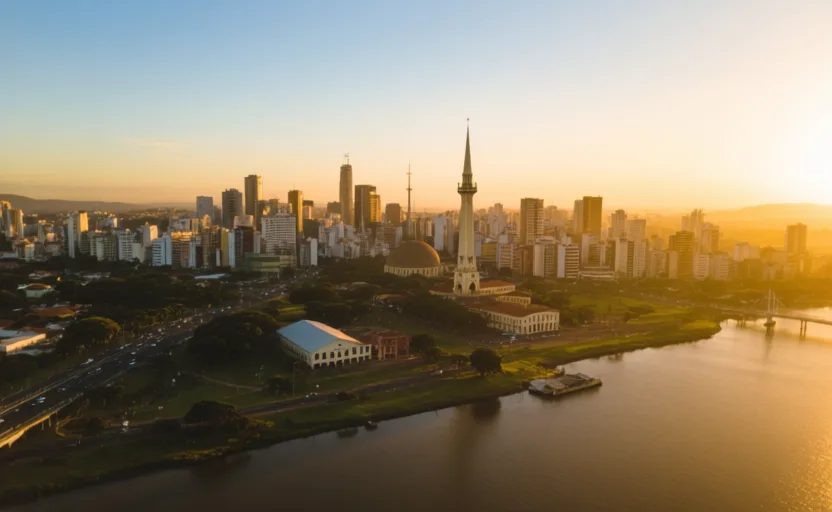 Porto Alegre · AI city illustration · Artistic impression
City · Latin America
Porto Alegre
Saved in this browser — no account needed. Sign in later and it comes with you.
Where it is
Four rivers, the Jacuí, Sinos, Gravataí and Caí, empty into the Guaíba, a broad stretch of fresh water that in turn drains into the Lagoa dos Patos, a vast freshwater lagoon that even large ships can navigate. Porto Alegre lies on the eastern shore of the Guaíba, at the northern end of that system, among about forty hills. It is the southernmost state capital in Brazil, on the border between subtropical forest and the open grassland of the pampa. Its latitude gives it the sharpest contrast between seasons of any Brazilian capital, with about 14 hours of daylight in December and 10 in June.
The land and water around it
Guaíba Lake and the Lagoa dos Patoslake
The city has a long waterfront on the Guaíba, which carries the combined flow of its four tributary rivers toward the lagoon. The junction made the site an important river port.
The Jacuí delta islandsdelta
Opposite the city a maze of islands forms an archipelago that shelters wildlife. It is protected as the Delta do Jacuí State Park.
Between forest and pampaplain
Porto Alegre stands where subtropical forest gives way to the Pampas grassland, the region from which the gaúcho tradition comes. The urban area is broken by around forty hills, and the humid subtropical climate brings rain through the year rather than in a single season.
Its history, in short
The town grew from a landing place used by Azorean settlers. In the early 1750s sixty couples from the Azores were brought to southern Brazil under the Treaty of Madrid, which handed the Portuguese a missions territory in exchange for the Sacramento colony on the River Plate; the land survey dragged on, and they stayed on the lakeshore at a spot first called Porto de Viamão. It became a parish in 1772 and the provincial capital the following year. After 1824 immigrants from Germany, Italy, Spain, Poland and the Lebanese and Jewish communities arrived. In 1835 the Farroupilha revolt, a republican and separatist rising against the Brazilian Empire, began here with a clash at the Azenha bridge. Rebels held the city until mid-1836, and it then withstood three sieges under imperial control, earning the title Loyal and Valiant. The port grew and the city became the commercial hub of its state. In 1989 it launched participatory budgeting, letting residents decide public spending, and between 2001 and 2003 it hosted the first three World Social Forums. Heavy rain flooded it in 2024.
Timeline
Dates are shown on a timeline rather than as changing shapes on the map. The globe draws modern boundaries only, and tinting a modern outline to stand for a historical one would state something we cannot source.
Early modern & oceanic
1752
Azorean couples settle the shore
Sixty couples from the Azores are brought south under the Treaty of Madrid and settle at Porto de Viamão, the first name of the place. Altogether about 2,300 Azoreans were sent to the region between 1748 and 1756.
Approximate dateWikipedia26 March 1772
Official founding
The settlement becomes the parish of São Francisco do Porto dos Casais, soon renamed Nossa Senhora da Madre de Deus de Porto Alegre. It becomes capital of the province in July 1773.
Industrial & imperial
1824
Immigration from many countries
Settlers from Germany, Italy, Spain and Poland arrive, along with Jewish and Lebanese newcomers, adding to the Azorean base.
Well attestedWikipedia20 September 1835
The Farroupilha revolt starts here
Economic and political grievances against the central government boil over in the first combat, at the Azenha bridge. Rebel forces take the city the next day; imperial troops retake it in 1836.
19 October 1841
Loyal and Valiant
Emperor Pedro II grants the city a title it still carries on its coat of arms, for holding out through the sieges of the revolt.
Well attestedWikipedia
Contemporary
1989
Participatory budgeting begins
The first full process lets residents shape public investment, aimed at a city where a third of residents lived in isolated slums on the outskirts without water, sanitation or health care. It operated in its fullest form from 1991 to 2004 and has been cut back since.
Well attestedWikipedia2001–2003
World Social Forum
The city hosts the first three editions of the forum, a gathering meant to challenge the neoliberal model. The third drew 20,763 delegates from 130 countries.
Well attestedWikipedia2024
Floods
Heavy rain floods the city and neighbouring areas, a reminder of how closely the settlement is tied to the Guaíba and its tributaries.
Well attestedWikipedia
Places that carry meaning
The Azenha bridge1835
The site of the opening battle of the Farroupilha revolt. The war it opened gave rise to the myth of the gaúcho, still celebrated in songs, street names and annual pageants across Rio Grande do Sul.
Rio Grande do Sul Museum of Art (MARGS)Former revenue office
A building in an eclectic style by the German architect Theo Wiederspahn, which began as the headquarters of a federal revenue agency and now houses the state's art museum.
Cidade BaixaModern neighbourhood
The Lower City, a historic district whose João Alfredo street is the best-known stretch for music and nightlife, from Brazilian popular music to rock. Érico Verissimo's novel Noite drew on this nightlife.
Languages here
Places are usually multilingual. This lists what is actually spoken, not one language per border.
PortugueseRomance family
The everyday and official language.
Portuguese arrived with Azorean families in the 1750s and became the one language of public life across Brazil. The population is mostly of European descent, with 73.6% of residents identifying as White in the 2022 census. The gaúcho tradition of the southern grasslands is part of local identity, and chimarrão, an infused drink, is the traditional beverage.
Hunsrik and German dialectsGermanic family
Heritage languages of German-descended families in Rio Grande do Sul.
Hunsrik, from the Hunsrück dialect, is recognised by the state as part of its cultural heritage, and German dialects are official in nine southern municipalities. The nineteenth-century arrivals from Germany reached Porto Alegre, though how many speak Hunsrik in the city is not given.
Italian and other immigrant languages
Languages of later European and Asian arrivals.
Nineteenth-century arrivals from Italy, Spain, Poland and Lebanon, and Jewish settlers, came into a Portuguese-speaking city. Across Brazil, Italian, German and Japanese are the best-known languages of later immigrant communities.
Learn the language here
- 1Understand which languages are spoken herePorto Alegre is multilingual. Start with which languages are used, by whom, and for what — the phrase list only covers one of them.Written by Globe Quest
- 2Learn 12 phrasesCurated everyday phrases for Porto Alegre, with audio and a written form.Written by Globe Quest
- 3Say them out loudSpeaking practice with pronunciation feedback, one phrase at a time.Globe Quest material, your own additions
- 4Come back to themSpaced review, so what you learned this week is still there next month.Written by Globe Quest
Check yourself
Who were the first settlers of the place that became Porto Alegre?
Azorean couples brought under the Treaty of Madrid
Around 1752 sixty couples from the Azores were sent to Rio Grande do Sul. They settled the lakeshore at Porto de Viamão, and the settlement later took the name Porto Alegre. German and other immigrants came after 1824.
Why did Porto Alegre grow as an inland port?
Several rivers join at the Guaíba, which feeds a navigable lagoon
The Jacuí, Sinos, Gravataí and Caí all enter the Guaíba, which empties into the Lagoa dos Patos, a lagoon that even large ships can navigate. That made the city a collecting point for goods from the interior.
Worth arguing about
- Porto Alegre pioneered letting residents decide part of the municipal budget, then saw it hollowed out. What keeps a participatory institution alive across changes of government?
- The 2024 flood hit a city that sits where several rivers meet a lake. How should such a place decide between defending the waterfront and giving ground to the water?
What we have not established
These are open questions, listed rather than filled in. We would rather show a gap than a plausible guess.
When was Porto Alegre founded?
Accounts give 1752, when the first Azorean couples settled; 1769, the year an administrator working under a pseudonym is credited; and 26 March 1772, the date on which the parish was created and the one the city treats as official.
Sources
- Wikipedia · Porto AlegreWikipedia · encyclopedia · checked 2026-11-24
- Wikipedia · History of Porto AlegreWikipedia · encyclopedia · checked 2026-11-24
- Wikipedia · BrazilWikipedia · encyclopedia · checked 2026-11-24
- Wikipedia · Languages of BrazilWikipedia · encyclopedia · checked 2026-11-24
Reviewed by Globe Quest editorial on 2026-11-24. Drafted with AI assistance and checked against the sources above before publication.