 Globe Quest
 Human Quest · LearningSign in
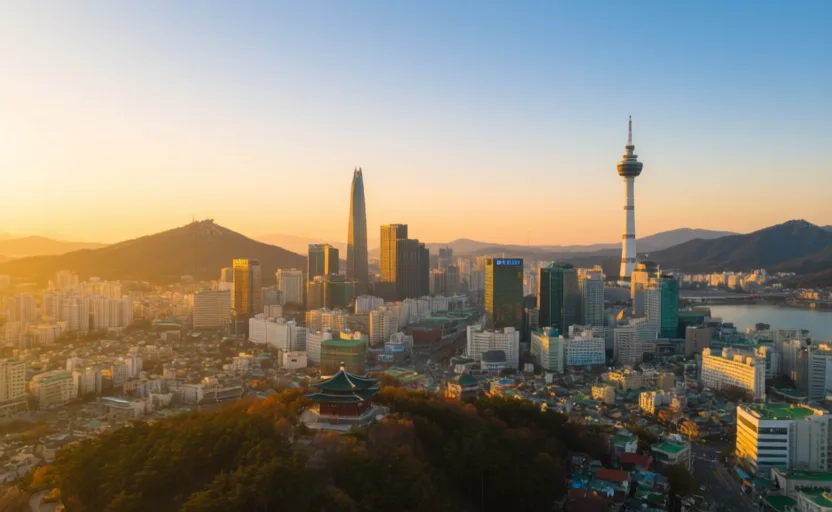 Gwangju · AI city illustration · Artistic impression
City · East Asia
Gwangju
Saved in this browser — no account needed. Sign in later and it comes with you.
Where it is
Gwangju stands in the southwest of the Korean Peninsula, in the heart of the agricultural Jeolla region, a region known for its farming and its varied cooking. The city’s position gives it a milder winter than Seoul and the cities to the north, and one of the hottest summers in the country. Rain falls all year but peaks in the East Asian monsoon, and summers bring heavy thunderstorms. Daejeon, the nearest of the large central cities, is about 169 kilometres to the north. As of July 2026 the municipality no longer exists as a separate unit: it has been folded together with South Jeolla Province.
The land and water around it
The Jeolla farmlandplain
The city sits in the middle of an agricultural region, and the city is known for designated food streets serving barley meals, duck stew, grilled meat patties and soy-preserved crab.
Southwestern climateclimate
The climate is a cooler form of humid subtropical, with four distinct seasons. Its southwesterly position keeps winters milder than in Seoul, while summers are hot, humid and wet, among the warmest in Korea.
Its history, in short
The city counts its founding to 57 BCE and was one of Baekje’s administrative centres in the Three Kingdoms period. Its name joins the words for “light” and “province”, and the area was recorded in Silla’s time as Muju. Under Japanese rule it was called Kōshū. A fight between Korean and Japanese students at Naju Station on 30 October 1929 set off the Gwangju Student Independence Movement, which began in the city on 3 November and spread through Korea. A railway to Seoul and a cluster of cotton mills, rice mills and breweries gave it a modern industrial base, and a designated industrial zone in 1967 added automobile-related industry. In May 1980 peaceful protests against Chun Doo-hwan, who had led the military coup of 12 December 1979, were crushed by troops, including elite units. The violence led civilians to raid armouries and arm themselves in the Gwangju Uprising, which lasted nine days and left many hundreds of civilians dead. After civilian rule returned in 1987 a national cemetery honoured the victims. The city became a directly governed city in 1986 and a metropolitan city later, and has long voted for liberal and progressive parties.
Timeline
Dates are shown on a timeline rather than as changing shapes on the map. The globe draws modern boundaries only, and tinting a modern outline to stand for a historical one would state something we cannot source.
Classical world
57 BCE (traditional)
Founding of the city
The city is said to have been established in 57 BCE and was an administrative centre of Baekje during the Three Kingdoms period.
Approximate dateWikipedia
Industrial & imperial
30 October–3 November 1929
Student independence movement
A clash between Korean and Japanese students at Naju Station is the immediate cause of protests that begin in Gwangju on 3 November and then spread across Korea.
Well attestedWikipedia
Contemporary
1967
Industrial zone
A designated industrial zone is built, encouraging growth in industry, especially firms linked to the automobile sector.
Well attestedWikipediaMay 1980
The Gwangju Uprising
Peaceful demonstrations against Chun Doo-hwan are put down by military forces. After a violent crackdown civilians seize armouries and take up arms, and the uprising is suppressed after nine days with many hundreds of civilians and several police officers and soldiers dead.
Well attestedWikipedia1995
Metropolitan city and the Biennale
Gwangju, a directly governed city since 1986, becomes a metropolitan city, and the Gwangju Biennale, a contemporary art festival now held every two years, is launched.
Approximate dateWikipediaJuly 2026
Merger with South Jeolla
Gwangju stops being a metropolitan city of its own. Joined to what had been South Jeolla Province, it becomes a new unit at provincial level called Jeonnam-Gwangju, also named Gwangju Special City.
Well attestedWikipedia
Places that carry meaning
May 18th National CemeteryEstablished after 1987
The cemetery set up to honour the victims of the 1980 uprising once civilian rule was reinstated. A walking route called Gwangju 5.18 Road links places connected with the democracy movement of that year.
Asia Culture CenterContemporary
A largely underground complex in the downtown, built to celebrate and study the city’s artistic and democratic culture, with theatres, archives and a children’s facility.
Gwangju HyanggyoTraditional houses estimated from 1392
A Confucian school in Gwangju Park with traditional houses thought to date from the first year of the Joseon period. It still holds ceremonies for Confucius twice a year.
Gwangju Koryoin VillageModern
One of South Korea’s largest enclaves of Koryo-saram, ethnic Koreans from the former Soviet Union. Nearby schools have many Russian-speaking pupils.
Languages here
Places are usually multilingual. This lists what is actually spoken, not one language per border.
Korean
The language of daily life, spoken in the regional speech of the Jeolla provinces.
Jeolla is one of the four regional dialects of Korean, used alongside the Seoul standard. Hangul is the writing system.
RussianSlavic family
Spoken by the Koryo-saram community.
Ethnic Koreans from the former Soviet Union live in a village in the city, and schools nearby have significant proportions of Russian speakers.
Learn the language here
- 1Understand which languages are spoken hereGwangju is multilingual. Start with which languages are used, by whom, and for what — the phrase list only covers one of them.Written by Globe Quest
- 2Learn 12 phrasesCurated everyday phrases for Gwangju, with audio and a written form.Written by Globe Quest
- 3Say them out loudSpeaking practice with pronunciation feedback, one phrase at a time.Globe Quest material, your own additions
- 4Come back to themSpaced review, so what you learned this week is still there next month.Written by Globe Quest
Check yourself
What set off the Gwangju Student Independence Movement in 1929?
A clash between Korean and Japanese students at Naju Station
The confrontation on 30 October led to protests that began in Gwangju on 3 November and spread across Korea.
How long did the Gwangju Uprising of May 1980 last before it was suppressed?
Nine days
It began as peaceful protest against Chun Doo-hwan, escalated when troops cracked down, and was put down after nine days.
Worth arguing about
- A city that rose against a military government in 1980 now keeps a national cemetery and an arts centre devoted to democracy. How should a place remember an uprising so that it informs the present?
- Gwangju has merged with its surrounding province in 2026. What does a city gain and lose when it stops being a separate unit?
What we have not established
These are open questions, listed rather than filled in. We would rather show a gap than a plausible guess.
When did Gwangju become a metropolitan city?
One account gives 1995, following its separation from South Jeolla as a directly governed city in 1986. Another links the move of the provincial office to Muan County with a promotion to metropolitan status in 2005, so the dates of the city’s change of status remain unclear.
Sources
- Wikipedia · GwangjuWikipedia · encyclopedia · checked 2026-11-24
- Wikipedia · South KoreaWikipedia · encyclopedia · checked 2026-11-24
Reviewed by Globe Quest editorial on 2026-11-24. Drafted with AI assistance and checked against the sources above before publication.