 Globe Quest
 Human Quest · LearningSign in
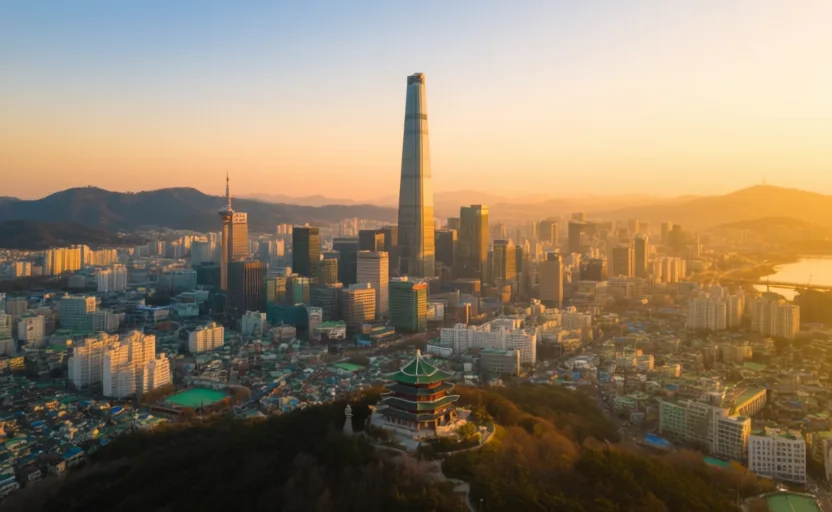 Daejeon · AI city illustration · Artistic impression
City · East Asia
Daejeon
Saved in this browser — no account needed. Sign in later and it comes with you.
Where it is
Daejeon fills a wide, flat valley close to the middle of South Korea, about 167 kilometres south of Seoul and 294 kilometres from Busan. Low mountains ring the valley: Gyeryongsan National Park straddles the western boundary, and the foot of the Sobaek range lies just beyond the south and east. Three streams, the Gapcheon, Yudeungcheon and Daejeoncheon, cross the centre from south to north and run into the Geum River, which loops around the northeast of the city before turning southwest to reach the Yellow Sea near Gunsan. Winters are cold and dry, with a January mean of about −1 °C, and summers hot and humid, with the heaviest rain from July to August.
The land and water around it
The Hanbat basinvalley
The city sits in a broad lowland, the “great fields” that give Daejeon its name. Mountains surround it on every side.
Gapcheon, Yudeungcheon and Daejeoncheonriver
Three rivers flow roughly south to north through the middle of the city and join the Geum River on its northeastern edge. The Geum then turns southwest and reaches the Yellow Sea near Gunsan, so all the water of the city drains to the west coast.
Gyeryongsanmountains
The national park on the western boundary of the city, with the foot of the Sobaek range just outside the city to the south and east.
Its history, in short
For most of its history this was a quiet rural district. It was Baekje territory, known as Usul, with a mountain fortress that survives, and later a set of small counties under the control of nearby Gongju, with scholars such as Song Si-yeol living in the villages. The name Daejeon, a translation of the native word Hanbat, “great fields”, is first recorded in 1481. The city is a creation of the railway. In 1914 the Japanese colonial government merged Hoedeok and Jinjam counties with part of Gongju and named the new unit after the village by the train station, instead of keeping the traditional name Hoedeok. As a railway town it grew into a transport hub, and from the 1980s the state moved administrative offices here from Seoul. It became a metropolitan city in 1989, hosted the Expo in 1993, and has since built its identity on science. A research district in the north, Daedeok Innopolis, brings together universities, government institutes and corporate laboratories, among them the Korea Advanced Institute of Science and Technology.
Timeline
Dates are shown on a timeline rather than as changing shapes on the map. The globe draws modern boundaries only, and tinting a modern outline to stand for a historical one would state something we cannot source.
Early modern & oceanic
1481
The name Daejeon
The geography book Tongguk yŏji sŭngnam records the name Daejeon, a Hanja rendering of the older place name Hanbat, meaning “great fields”.
Well attestedWikipedia
Industrial & imperial
1914
Daejeon County
Hoedeok and Jinjam counties are merged with Yuseong township of Gongju into a new county named for the village where the railway station stood, which replaces the traditional name Hoedeok.
Well attestedWikipedia
Contemporary
1977
Wards are created
A ward system is introduced with two wards, Jung-gu and Dong-gu. Seo-gu is split from Jung-gu in 1988, and Yuseong and Daedeok districts follow in 1989, completing today’s five.
Well attestedWikipedia1986
Asian Games sub-host
Daejeon is a secondary host of the Asian Games.
Well attestedWikipedia1989
Metropolitan status
Daedeok County is abolished and merged into the city, which is raised to a directly governed (now metropolitan) city.
Well attestedWikipedia1993
Daejeon Expo
The international exposition raises the city’s national profile, and its yellow alien mascot Kumdori becomes a local emblem. The site is reused as the Expo Science Park, though some exhibition halls have since closed.
Well attestedWikipedia2000
Mathematical Olympiad
The city hosts the International Mathematical Olympiad.
Well attestedWikipedia
Places that carry meaning
Daedeok InnopolisModern research district
A research district in Yuseong, north of the Gapcheon, with institutes for telecommunications, biotechnology, nuclear energy, space and fusion. It counts 898 corporations and 35 government-backed institutions, and its research produced technologies such as CDMA wireless systems and the KSTAR fusion experiment.
Usul FortressBaekje period
The remains of a Baekje mountain fortress in the area known as Usul, designated a city monument in 1989.
Expo Science Park1993 onward
The former exposition grounds, reused as a science park after 1993, with some of the exhibition halls now almost closed.
Languages here
Places are usually multilingual. This lists what is actually spoken, not one language per border.
Korean
The language of daily life, in the Chungcheong region.
The surrounding Chungcheong provinces give their name to one of four regional dialects of Korean used alongside the Seoul standard, and Daejeon was part of South Chungcheong before its promotion in 1989. Hangul is the writing system.
Vietnamese
The language of the largest foreign community.
In 2023 Daejeon had 21,949 registered foreign residents, 1.5 per cent of the population. Vietnamese were the biggest group at 0.5 per cent, followed by Chinese and Korean-Chinese at 0.2 per cent.
EnglishGermanic family
A school subject.
Almost all South Korean students study English throughout their schooling.
Learn the language here
- 1Understand which languages are spoken hereDaejeon is multilingual. Start with which languages are used, by whom, and for what — the phrase list only covers one of them.Written by Globe Quest
- 2Learn 11 phrasesCurated everyday phrases for Daejeon, with audio and a written form.Written by Globe Quest
- 3Say them out loudSpeaking practice with pronunciation feedback, one phrase at a time.Globe Quest material, your own additions
- 4Come back to themSpaced review, so what you learned this week is still there next month.Written by Globe Quest
- 5Practise with people: Vietnamese practice · Ho Chi Minh CityAn in-person practice circle. It is a prepared plan and needs a host before it runs.Run by members
Check yourself
Where does the name Daejeon come from?
A Hanja translation of Hanbat, meaning “great fields”
Daejeon is the Hanja form of the native name Hanbat, “great fields”, first recorded in 1481. The Japanese colonial government chose it for the county in 1914 because it was the name of the village around the station.
What is Daedeok Innopolis?
A research and technology district in Yuseong
It is the cluster of universities, government institutes and corporate laboratories that makes Daejeon the research hub of Korea.
Worth arguing about
- Daejeon was a village beside a station before it became a city of nearly 1.5 million. Does a place built around a railway have a different relationship to its history than an ancient capital?
- A planned science district and a government complex gave the city its modern role. What makes an institutional city feel like a home for the people who live there?
What we have not established
These are open questions, listed rather than filled in. We would rather show a gap than a plausible guess.
Was Daejeon the home of the ancient state of Sinheunguk?
Some scholars place Sinheunguk, one of the small states of the Mahan confederacy, in the Daejeon area by linking it to later place names, while others locate it in Seosan or Yesan County. Its exact location is not settled.
Sources
- Wikipedia · DaejeonWikipedia · encyclopedia · checked 2026-11-24
- Wikipedia · South KoreaWikipedia · encyclopedia · checked 2026-11-24
Reviewed by Globe Quest editorial on 2026-11-24. Drafted with AI assistance and checked against the sources above before publication.