 Globe Quest
 Human Quest · LearningSign in
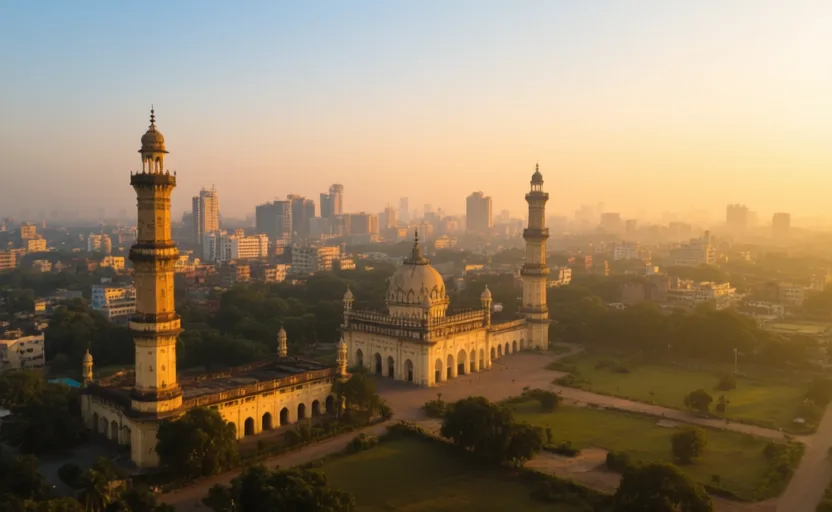 Lucknow · AI city illustration · Artistic impression
City · South Asia
Lucknow
Saved in this browser — no account needed. Sign in later and it comes with you.
Where it is
A river bend in the middle of the Indo-Gangetic plain defines Lucknow. The Gomti winds through the city and divides it into a Cis-Gomti and a Trans-Gomti half, with the old commercial core of Hazratganj, Aminabad and Chowk at the centre. The land is flat, about 123 m above sea level, and orchard towns such as Malihabad lie around it. Summers run well past 40 °C, nearly all of the 827 mm of annual rain comes with the southwest monsoon between July and October, and winter brings dense fog from mid-December to late January. In some cold spells Lucknow has been colder than Himalayan hill stations such as Shimla and Mussoorie.
The land and water around it
The Gomti Riverriver
A slow meandering river that cuts the city in two and sets the main division of its geography, between the Cis-Gomti and Trans-Gomti districts. The central business district of Hazratganj, Aminabad and Chowk is fully built up, with a looser zone around it and villages beyond.
The Indo-Gangetic plainplain
Lucknow rests at about 123 m on alluvial plain, with farming villages around it and Barabanki, Unnao, Raebareli, Sitapur and Hardoi as its neighbouring districts. In 2019 the municipal area grew from 402 to 631 km² when 88 villages were added.
Monsoon and winter fogclimate
A humid subtropical climate with more than nine-tenths of the rain falling between July and October. Winter fog is common, and a cold spell in 2012–2013 brought two consecutive days below freezing.
Its history, in short
Lucknow was a regional town under successive sultanates until it became a court city. Awadh, the province around it, passed from the Delhi Sultanate to the Sharqi rulers of Jaunpur and then the Mughals, whose governors gradually made it a state of their own. The nawabs first ruled from Faizabad. In 1775 Asaf-ud-Daula moved the court to Lucknow, and over the next decades it became North India’s cultural capital, known for music, dance, cuisine and the monuments the nawabs built, including the great imambaras. The 1801 treaty reduced Awadh to dependence on the East India Company, which annexed it in 1856. The next year Lucknow was one of the main centres of the 1857 rebellion, and the British garrison in the Residency was besieged for months. Under the Raj, the city joined the United Provinces and in 1916 hosted the Congress session that produced the Lucknow Pact. The seat of provincial government moved here from Allahabad in 1920, and Lucknow remained capital of Uttar Pradesh after independence. In 2011 its population was about 2.8 million.
Timeline
Dates are shown on a timeline rather than as changing shapes on the map. The globe draws modern boundaries only, and tinting a modern outline to stand for a historical one would state something we cannot source.
Post-classical world
1394–1478
Under the Sharqi Sultanate
For about 84 years Awadh is part of the Sharqi Sultanate of Jaunpur, one in a succession of rulers that also includes the Delhi Sultanate and the Mughals.
Approximate dateWikipedia
Early modern & oceanic
1775
The court moves to Lucknow
Asaf-ud-Daula, fourth Nawab of Awadh, shifts his court from Faizabad. Lucknow becomes a capital and attracts poets, musicians and craftsmen.
Well attestedWikipedia1784
The Bara Imambara and Rumi Darwaza
Asaf-ud-Daula builds the great imambara and the gate beside it, reportedly to give work to people hit by a famine. About 22,000 labourers are said to have been employed.
Approximate dateWikipedia
Industrial & imperial
1801
A treaty with the Company
Nawab Saadat Ali Khan gives up a large part of Awadh and agrees to disband his own troops in favour of a costly army under British control, making Awadh a vassal of the East India Company.
Well attestedWikipedia1856
Awadh annexed
The Company moves troops to the border and annexes Awadh. Nawab Wajid Ali Shah is imprisoned and then exiled to Calcutta.
DisputedWikipediaThe East India Company, which gave maladministration as its reason; the Nawab’s court had been a ceremonial king under a treaty that already made Awadh a Company vassal
1857–1858
The Siege of Lucknow
After the rebellion begins, the Company garrison at the Residency is besieged by rebel forces. The siege is relieved first by Havelock and Outram and then by a stronger force under Colin Campbell. Birjis Qadra, the 14-year-old son of Wajid Ali Shah and Begum Hazrat Mahal, is crowned ruler by the rebels. It takes the British 18 months to reconquer the region.
Well attestedWikipedia1916
The Lucknow Pact
The Congress session brings Gandhi, Nehru and Jinnah together for the first time and ends with the Lucknow Pact, which unites moderates and extremists.
Well attestedWikipedia1920
Seat of provincial government
The government of the United Provinces moves from Allahabad to Lucknow. After independence in 1947 the city is made the capital of Uttar Pradesh.
Well attestedWikipedia
Places that carry meaning
Bara Imambara and Rumi Darwaza1784
A vast Shia congregation hall in Hussainabad, said to be the largest hall in Asia without wood, iron or stone beams holding up the roof, and a gateway about 60 ft high beside it, nicknamed the Turkish Gateway after a mistaken comparison with Constantinople.
The Residency1857
The ruined garrison buildings where British defenders were besieged, with the nearby Shaheed Smarak, a memorial to those who died in 1857. Together they are the clearest place to see the city’s role in the rebellion.
Chattar Manzil and Lal BaradariLate 18th to early 19th century
The umbrella-domed palace of the rulers of Awadh and their wives faces the Lal Baradari, built by Saadat Ali Khan I between 1789 and 1814 as a coronation throne room and now a museum of portraits of the kingdom’s administrators.
Dilkusha Kothic. 1800
The ruins of a hunting lodge and summer retreat in English Baroque style, built by the British resident Major Gore Ouseley for the nawabs, an example of the mixed styles the city absorbed.
Languages here
Places are usually multilingual. This lists what is actually spoken, not one language per border.
HindiIndo-Aryan family
The first language of nearly nine in ten residents.
Hindi was recorded as the mother tongue of 88.16 per cent of the population at the 2011 census.
UrduIndo-Aryan family
The language of the old court culture and of about one resident in ten.
Urdu was spoken by 10.26 per cent of residents. The city’s architecture, customs and speech reflect Persian, Arabic, Shia and British influence, and the nawabs’ blended Hindu–Muslim culture is known as the Ganga-Jamuni Tehzeeb.
Learn the language here
- 1Understand which languages are spoken hereLucknow is multilingual. Start with which languages are used, by whom, and for what — the phrase list only covers one of them.Written by Globe Quest
- 2Learn 12 phrasesCurated everyday phrases for Lucknow, with audio and a written form.Written by Globe Quest
- 3Say them out loudSpeaking practice with pronunciation feedback, one phrase at a time.Globe Quest material, your own additions
- 4Come back to themSpaced review, so what you learned this week is still there next month.Written by Globe Quest
Check yourself
Which ruler moved the Awadh court from Faizabad to Lucknow?
Asaf-ud-Daula
Asaf-ud-Daula, fourth Nawab, relocated in 1775 and made Lucknow a capital, followed by the building programme that includes the Bara Imambara.
What happened at the 1916 Congress session in Lucknow?
Gandhi, Nehru and Jinnah met for the first time and the Lucknow Pact was signed
The session brought moderates and extremists together, and the city entered the national story as the place where several later leaders first met.
Worth arguing about
- The nawabs of Awadh ruled as ceremonial kings under a treaty with the East India Company, yet built some of the finest buildings in North India. What does it mean for a court to be rich in culture and weak in power?
- Lucknow is known for a mixed Hindu–Muslim culture of manners and speech. Can a city keep such a culture alive once the court that sponsored it is gone?
What we have not established
These are open questions, listed rather than filled in. We would rather show a gap than a plausible guess.
Where does the name Lucknow come from?
One story ties it to Lakshmana of the Ramayana, another to the goddess Lakshmi, and a third to an architect named Lakhna Ahir who built a fort. None is documented, and the name was already in use as Lakhanpur by the 11th century.
Sources
- Wikipedia · LucknowWikipedia · encyclopedia · checked 2026-11-24
Reviewed by Globe Quest editorial on 2026-11-24. Drafted with AI assistance and checked against the sources above before publication.