 Globe Quest
 Human Quest · LearningSign in
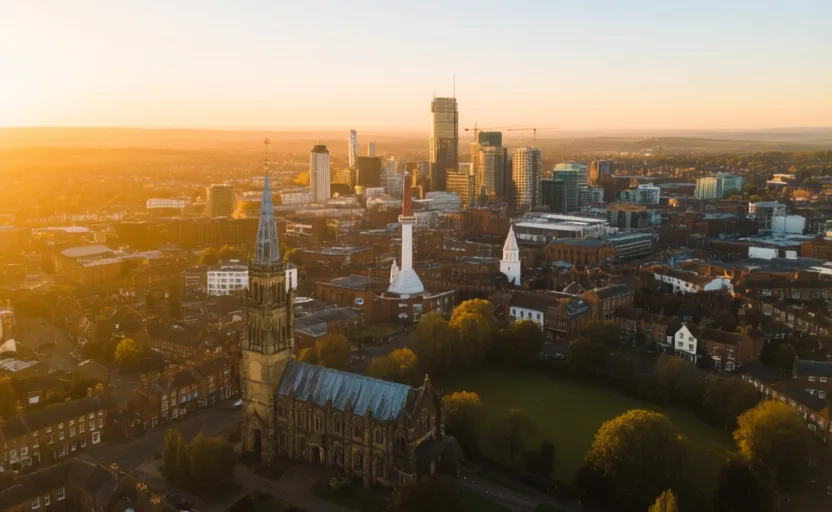 Luton · AI city illustration · Artistic impression
City · Europe
Luton
Saved in this browser — no account needed. Sign in later and it comes with you.
Where it is
Luton fills a break in the eastern end of the Chiltern Hills, where a river rises and the chalk ridge opens. The Lea starts in the Leagrave area on the town’s northern edge and runs south towards the Thames basin. The gap is one of the few routes through the hills for some miles, which is why the M1, the A6 and a main railway all squeeze through the town. The airport stands on high ground, 160 metres above sea level, and the hills keep Luton one to two degrees cooler than the surrounding towns. Clay deposits on the east side fed brickworks, and the average rainfall is about 698 mm a year.
The land and water around it
The Chiltern gapvalley
A break in the eastern Chilterns, where chalk from the Cretaceous mixes with deposits left by the last ice sheet. Roads and a main railway are squeezed through it, as there are few routes through the hills for miles around.
The source of the Leariver
The river rises in the Leagrave area, surrounded by Great Bramingham Wood, which is classified as ancient woodland. The river gave the town its name and its early mills, six of which were recorded in the Middle Ages.
The high-ground climateclimate
The airport’s height means snow that Heathrow, 25 metres above sea level, shrugs off can close Luton. Records at nearby Rothamsted show a low of -17.0°C in December 1981 and a high of 36.6°C in July 2019.
Its history, in short
Luton began as a Saxon outpost on the river, which gave it a name meaning the farm on the Lea. In 1086 it was an agricultural village of 700 to 800 people. The 12th century brought St Mary’s Church, one of the largest in Bedfordshire, and a short-lived castle. From the 17th century the town made hats, and by the 18th century straw hats were almost its only industry. Growth was fast: about 3,100 people in 1801, more than 10,000 by 1850 and almost 39,000 by 1901. Vauxhall Motors opened the largest car plant in Britain here in the early 20th century, and the airport followed in 1938. Both brought people. Irish and Scottish migrants came early in the 20th century, then South Asian and Caribbean communities, and more recently Albanians. Hats declined after the Second World War. Car production ended in 2002 and commercial vehicles in 2025, leaving the airport as one of the biggest employers.
Timeline
Dates are shown on a timeline rather than as changing shapes on the map. The globe draws modern boundaries only, and tinting a modern outline to stand for a historical one would state something we cannot source.
First cities & states
c. 3000 BC
Waulud’s Bank
A Neolithic henge on the site of the modern town. The area was fairly thickly populated from the Neolithic onwards, though never around a single large settlement.
Approximate dateWikipedia
Post-classical world
6th century
A Saxon outpost
The traditional date for the founding of Luton on the Lea. The name first appears in the 8th century as Lygetun.
1121–1137
St Mary’s Church
Robert, Earl of Gloucester starts work on the church in the town centre, completed by 1137. A castle built in 1139 during the Anarchy was demolished by 1154.
Industrial & imperial
3 May 1858
The first train
Luton gets a railway late, because of objections to the release of land. A main-line connection to London on the Midland Railway followed in 1867.
Well attestedWikipedia1905 or 1907
Vauxhall Motors
Vauxhall opens what becomes the largest car plant in the United Kingdom. Wikipedia’s articles give different years, 1905 in one place and 1907 in another.
Wikipedia’s Luton article and its History of Luton article
19 July 1919
The Peace Day riot
Ex-servicemen angry about unemployment, and refused the use of a park for celebrations, set the town hall on fire. A replacement opened in 1936.
1938
The airport opens
Owned and run by the council, it grows into one of the largest employers in the area.
Well attestedWikipedia
Places that carry meaning
St Mary’s Church12th century
One of the largest churches in Bedfordshire, begun in 1121 in the centre of the town.
Luton Hoo1767; rebuilt after a fire in 1843
A Grade I listed country house south of the town, designed by Robert Adam and later transformed by Robert Smirke.
Marsh Farm estateMid to late 1960s
A large council estate built mostly to house overspill population from London. It later became known for poverty and unemployment and was the scene of riots in 1992 and 1995.
Wardown Park1904
The estate was bought by two councillors and donated to the town. The main house became the museum, which explores the hat trade and local history.
Languages here
Places are usually multilingual. This lists what is actually spoken, not one language per border.
EnglishGermanic family
The shared language of a town where White British people are less than a third of residents.
In 2021 only 31.8 per cent of residents were White British, the second lowest proportion outside London among local authorities in England and Wales. Irish and Scottish migrants came early in the 20th century, and the town still holds a large St Patrick’s festival.
Albanian
Spoken by one of the town’s newer immigrant communities.
Albanians are among the more recent arrivals from European countries. The town’s largest ethnic groups are Pakistani (18.3 per cent) and Bangladeshi (9.2 per cent), attracted first by work at the Vauxhall plant, so several South Asian languages are also spoken here.
Learn the language here
- 1Understand which languages are spoken hereLuton is multilingual. Start with which languages are used, by whom, and for what — the phrase list only covers one of them.Written by Globe Quest
- 2Learn 13 phrasesCurated everyday phrases for Luton, with audio and a written form.Written by Globe Quest
- 3Say them out loudSpeaking practice with pronunciation feedback, one phrase at a time.Globe Quest material, your own additions
- 4Come back to themSpaced review, so what you learned this week is still there next month.Written by Globe Quest
Check yourself
Why do the M1, the A6 and the main railway all pass through Luton?
There are few routes through the hills around it, and Luton sits in a gap
Luton lies in a break in the eastern Chilterns, one of the few ways through the hills for some miles, so transport routes were forced together there.
What was Luton famous for making before cars?
Hats, especially straw hats
Hatmaking began in the 17th century and dominated the town in the 18th, and it is why the football club is known as the Hatters. Brickmaking also grew from the 16th century.
Worth arguing about
- Luton’s largest employers have been a hat trade, a car plant and now an airport. What does a town owe the industry that built it when it leaves?
- White British residents are under a third of the town’s population. What does that make of the idea of a “local” culture?
What we have not established
These are open questions, listed rather than filled in. We would rather show a gap than a plausible guess.
In which year did Vauxhall open its Luton plant?
The accounts consulted give 1905 and 1907, and the discrepancy is not resolved here.
Sources
- Wikipedia · LutonWikipedia · encyclopedia · checked 2026-11-24
- Wikipedia · History of LutonWikipedia · encyclopedia · checked 2026-11-24
Reviewed by Globe Quest editorial on 2026-11-24. Drafted with AI assistance and checked against the sources above before publication.