 Globe Quest
 Human Quest · LearningSign in
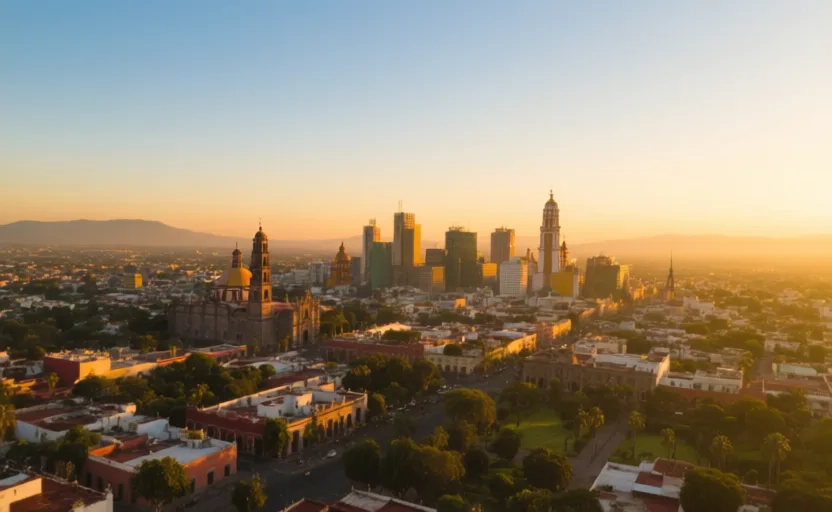 Merida · AI city illustration · Artistic impression
City · Latin America
Merida
Saved in this browser — no account needed. Sign in later and it comes with you.
Where it is
The ground under Mérida is almost level, only about nine metres above the sea, on a limestone plain in the north-west of the Yucatán Peninsula, around 35 kilometres inland from the Gulf coast. There are almost no rivers or lakes on the surface. Water lies underground and shows itself in cenotes, sinkholes that open onto springs and streams below. The city is close to the centre of the buried Chicxulub impact crater. Lying in the trade-wind belt near the Tropic of Cancer, it is hot all year, with highs averaging about 33 degrees and often above 38 in the spring, and a rainy season from June to October.
The land and water around it
The Yucatán limestone plainplain
A very flat shelf with scrub and former henequen fields. Rain sinks straight through the rock, so almost no surface water exists.
The cenotessinkhole
Sinkholes in the limestone open onto underground springs and rivers, the region’s main source of fresh water.
The Chicxulub cratercrater
Mérida lies close to the centre of this ancient impact crater, which is not visible from the ground but lies under the whole area.
Its history, in short
The Spanish city stands on the site of a Maya town, Ti’ho, which people also called Ichkanzihó, “City of Five Hills”, after its pyramids. Montejo the Younger and Juan de la Cámara founded Mérida in 1542, naming it after a town in Extremadura and using carved stones from the Maya ruins in new buildings, notably the cathedral. For three centuries it was a walled city, meant to shelter Spanish and creole residents from periodic revolts by the Maya. The conquest of Yucatán as a whole took far longer than the conquest of central Mexico, running from 1551 to 1697. In the late nineteenth century the region prospered on henequen, a fibre used for rope and twine, and the first Korean immigrants, more than a thousand, arrived in 1905 to work the plantations around the city. Mérida has since become the cultural and financial capital of the peninsula, hosting the 2007 bilateral meeting that created the Mérida Initiative, and has twice been American Capital of Culture, in 2000 and 2017.
Timeline
Dates are shown on a timeline rather than as changing shapes on the map. The globe draws modern boundaries only, and tinting a modern outline to stand for a historical one would state something we cannot source.
Early modern & oceanic
1542
Spanish Mérida founded
The conquistadors Francisco de Montejo the Younger and Juan de la Cámara founded the city on the Maya town of Ti’ho, reusing carved stones from its ruins.
Well attestedWikipedia1551–1697
The long conquest of Yucatán
The Spanish campaign against the Maya peoples of the peninsula lasted over a century and a half, long after central Mexico had fallen.
Well attestedWikipedia
Industrial & imperial
Mid-19th century
A walled colonial city
Through the colonial period and into the 1800s, walls enclosed the city to shield its Spanish and creole residents from recurring Maya uprisings.
Approximate dateWikipediaLate 19th century
The henequen boom
Fibre from the henequen plant, used for rope and twine and for a traditional drink, made the surrounding country rich.
Approximate dateWikipedia1905
Korean workers arrive
More than a thousand people from Jemulpo came to work on the henequen plantations around Mérida, the start of Korean immigration to Mexico.
Well attestedWikipedia
Places that carry meaning
Cathedral of MéridaLate 16th century
The oldest cathedral on the mainland of the Americas, built from stones of nearby Maya ruins. Its walls are visible evidence of the Maya city beneath.
Plaza Grande and the historic centreColonial era
A street grid in which odd numbers run east to west and even numbers north to south, centred on the Plaza Grande between Calles 60 and 61. The city has the third-largest old town on the continent.
Paseo de MontejoModern
A grand avenue lined with sculpture. The MACAY museum mounts a new sculpture exhibit each year with work from Mexico and one guest country.
Languages here
Places are usually multilingual. This lists what is actually spoken, not one language per border.
Yucatec Maya
The Indigenous language of the peninsula, spoken by about a third of the state’s people.
A melodic language with ejective consonants and the “sh” sound written x. Its influence gives Yucatán Spanish its distinctive accent. Despite its presence, there is stigma attached to speaking it, and attitudes differ by age and class.
SpanishRomance family
The main language of the city, with a recognisably Yucatecan accent.
Yucatán Spanish is readily distinguished from other varieties, even by non-native ears, and is shaped by Maya.
Korean
The language of an immigrant community that began arriving in 1905.
The first Korean immigrants to Mexico came to Yucatán and settled around Mérida as henequen plantation workers.
Learn the language here
- 1Understand which languages are spoken hereMerida is multilingual. Start with which languages are used, by whom, and for what — the phrase list only covers one of them.Written by Globe Quest
- 2Learn 11 phrasesCurated everyday phrases for Merida, with audio and a written form.Written by Globe Quest
- 3Say them out loudSpeaking practice with pronunciation feedback, one phrase at a time.Globe Quest material, your own additions
- 4Come back to themSpaced review, so what you learned this week is still there next month.Written by Globe Quest
Check yourself
What stood on the site of Mérida before 1542?
A Maya city called Ti’ho
Ti’ho, “City of Five Hills”, was a Maya city. Its carved stones were reused in the first Spanish buildings, and are still visible in the cathedral.
Where does fresh water in the Mérida area mostly lie?
Underground, reached through cenotes
The limestone plain has almost no surface water. Rain drains into underground rivers, which show at the surface in sinkholes called cenotes.
Worth arguing about
- The first cathedral on the American mainland is built from Maya stones. What does it mean when a building carries the traces of what it replaced?
- Yucatec Maya is spoken by a third of the state’s people but still carries stigma. Why do some languages hold onto speakers while losing status?
Sources
- Wikipedia · Mérida, YucatánWikipedia · encyclopedia · checked 2026-11-24
- Wikipedia · History of MexicoWikipedia · encyclopedia · checked 2026-11-24
Reviewed by Globe Quest editorial on 2026-11-24. Drafted with AI assistance and checked against the sources above before publication.