 Globe Quest
 Human Quest · LearningSign in
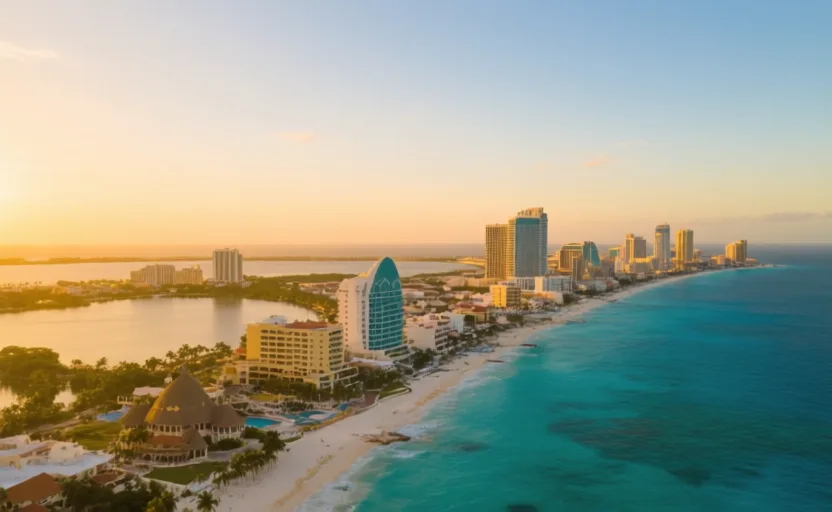 Cancún · AI city illustration · Artistic impression
City · Latin America
Cancún
Saved in this browser — no account needed. Sign in later and it comes with you.
Where it is
On the northeast corner of the Yucatán Peninsula, Cancún is built on two very different pieces of ground: a narrow island strip that juts into the Caribbean, and a mainland grid behind it. The island carries the Hotel Zone and is part of the Mesoamerican Barrier Reef System. The climate is tropical, with a mean temperature of 27.1 °C, about 1,340 millimetres of rain a year and a hurricane season from June to November. The sea stays warm all year because the Yucatán current carries water up from the south, and onshore trade winds keep afternoon highs below about 36 °C.
The land and water around it
The Hotel Zone islandisland
The tourist strip is a narrow island between the sea and a lagoon, so it is surrounded by water on both sides. Daytime temperatures there run a degree or so cooler than at the airport inland, and the winds are stronger.
The Caribbean coast and its reefreef
The island zone belongs to the Mesoamerican Barrier Reef System. Warm water brought north by the Yucatán current keeps the sea between 79 and 84 °F through the year, but it also feeds the hurricanes and, since 2015, the summer arrivals of sargassum.
Hurricane alleyclimate
Cancún lies in one of the main impact areas for Caribbean hurricanes. Gilbert in 1988 was the second most intense hurricane then recorded in the Atlantic basin, and Wilma made landfall as a Category 4 storm in October 2005 near Playa del Carmen.
Its history, in short
Cancún is unusual among Mexican cities because it was designed before it existed. After the Spanish conquest of Yucatán, disease, warfare and famine emptied most of the Maya coast, leaving small settlements on Isla Mujeres and Cozumel. When federal planners started work on 23 January 1970, the island had three residents, caretakers of a coconut plantation, and the nearby fishing village and military post of Puerto Juárez had about 117. In 1967 the government had set aside a fund through the Bank of Mexico to find places for new resorts, and the project passed to a tourism agency that became FONATUR. Private investors hesitated, so the federal government paid for the first nine hotels. Growth outran every forecast: between 1970 and 1980 the population rose by an average of 62.3 per cent a year. Hurricane Gilbert hit in 1988 and the hotels had to be rebuilt, and Wilma struck in 2005. Since 2015, mats of sargassum seaweed have arrived on the beaches each summer. The city has also struggled to provide services to the constant flow of new arrivals, many of whom settle in irregular districts on its fringes.
Timeline
Dates are shown on a timeline rather than as changing shapes on the map. The globe draws modern boundaries only, and tinting a modern outline to stand for a historical one would state something we cannot source.
Contemporary
1967
A fund to find new resort sites
Mexico’s government allocates two million dollars, run by the Bank of Mexico, to study where new recreation zones could be created, preferably where no other development was viable.
Well attestedWikipedia23 January 1970
Development begins
Work starts on an island with three inhabitants. The nearby village of Puerto Juárez has about 117 people.
Well attestedWikipedia1970–1980
Faster growth than anyone planned
The population grows by 62.3 per cent a year on average, well beyond the expectations of state planners, and outpaces the rest of Quintana Roo.
Well attestedWikipedia1974
An Integrally Planned Center
The city begins as a tourism project of FONATUR, the national tourism fund, which pioneered the model here. The federal government finances the first nine hotels because investors will not risk an unknown coast.
Well attestedWikipediaSeptember 1988
Hurricane Gilbert
A direct hit from one of the most intense Atlantic hurricanes on record forces the tourist hotels to be rebuilt. The loss from reduced tourism over the last three months of the year is estimated at 87 million dollars.
Well attestedWikipedia21 October 2005
Hurricane Wilma
A Category 4 storm crosses Cozumel and makes landfall near Playa del Carmen with winds around 140 miles per hour.
Well attestedWikipedia2015 onward
Sargassum on the beaches
Large masses of brown seaweed start reaching the white-sand beaches every summer, and by 2021 the season has become an annual event across the Caribbean.
Well attestedWikipedia2023
A record visitor year
About 21 million tourists visit Cancún, above the 20.5 million that was forecast.
Well attestedWikipedia
Places that carry meaning
The Hotel Zone1970s onward
The island strip where the planned resort was built, and still the main area for tourism. Its hotels were the first financed by the federal government.
El Centro and the supermanzanas1970s onward
The mainland residential city follows a master plan of giant trapezoidal blocks, each with an open non-residential centre and U-shaped residential streets cut into it. Later growth has drifted from the plan, and irregular settlements occupied an estimated ten to fifteen per cent of the mainland area on the fringes in 2006.
Puerto JuárezBefore 1970
A fishing village and military base across the lagoon from the island, with about 117 residents when planning began. It is now one of the districts to the north where the city is spreading.
Languages here
Places are usually multilingual. This lists what is actually spoken, not one language per border.
SpanishRomance family
The language of daily life, government and the resort economy.
Most residents come from Yucatán and other Mexican states, so the city’s Spanish is a mixture of regional accents. A growing number of residents come from the rest of the Americas and Europe.
Maya
The indigenous language of the peninsula, which gave the city its name.
Cancún comes from the Maya words kàan, “snake”, and kun, “to swell”, and the earlier name Nizuc is also Maya. The Maya population of the coast was devastated after the conquest, and the language today belongs to the wider group of indigenous languages that Mexico’s federal government recognises.
EnglishGermanic family
The language of much tourism and of American visitors.
American English is widely understood in Mexico’s border states and tourist regions, which matters in a resort that drew a record 21 million visitors in 2023.
Learn the language here
- 1Understand which languages are spoken hereCancún is multilingual. Start with which languages are used, by whom, and for what — the phrase list only covers one of them.Written by Globe Quest
- 2Learn 12 phrasesCurated everyday phrases for Cancún, with audio and a written form.Written by Globe Quest
- 3Say them out loudSpeaking practice with pronunciation feedback, one phrase at a time.Globe Quest material, your own additions
- 4Come back to themSpaced review, so what you learned this week is still there next month.Written by Globe Quest
Check yourself
How did Cancún come into being?
It was a government tourism project, planned from 1967 and started in 1970
The island had three residents in 1970. Federal planners chose the site and paid for the first hotels, making Cancún one of the clearest examples of a planned resort city.
Which hurricane forced Cancún’s tourist hotels to be rebuilt in 1988?
Gilbert
Gilbert made a direct hit in September 1988. Wilma came in 2005 and Dean in 2007, so storms have repeatedly reshaped the coast.
Worth arguing about
- A city designed for tourists attracted workers from across Mexico faster than planners expected. Whose job is it to house the people who run a resort?
- Sargassum, hurricanes and a warming sea all threaten the thing visitors come for. How should a planned resort prepare for the loss of its own setting?
What we have not established
These are open questions, listed rather than filled in. We would rather show a gap than a plausible guess.
What does the name Cancún mean?
The usual derivation is the Maya kàan kun, translated as “nest of snakes”, while a rarer reading is “place of the golden snake”. Neither is documented before the name appears on eighteenth-century maps.
Sources
- Wikipedia · CancúnWikipedia · encyclopedia · checked 2026-11-24
- Wikipedia · MexicoWikipedia · encyclopedia · checked 2026-11-24
Reviewed by Globe Quest editorial on 2026-11-24. Drafted with AI assistance and checked against the sources above before publication.