 Globe Quest
 Human Quest · LearningSign in
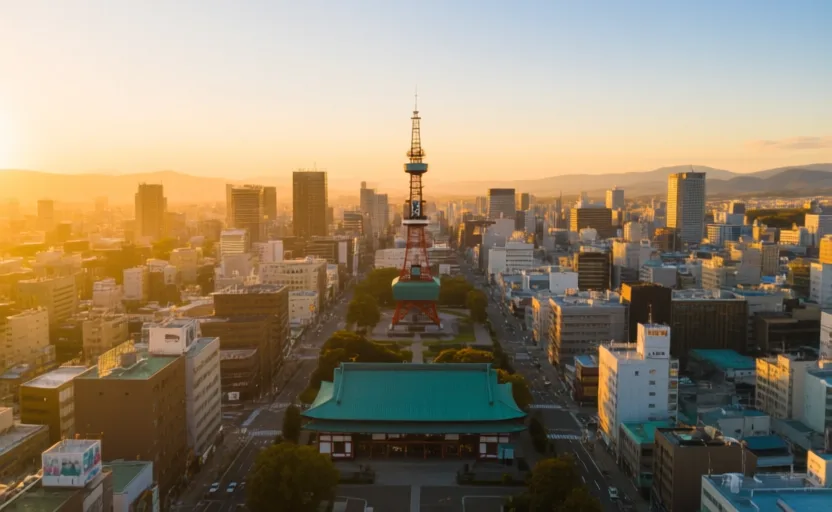 Sapporo · AI city illustration · Artistic impression
City · East Asia
Sapporo
Saved in this browser — no account needed. Sign in later and it comes with you.
Where it is
Sapporo spreads across the south-western corner of the Ishikari Plain, on the alluvial fan of the Toyohira River, which feeds the larger Ishikari River. Hokkaido is mostly mountainous, so this broad, flat and well-drained lowland is unusual, and mountains such as Teine, Maruyama and Moiwa close the city in on the west and south. The climate is humid continental. Summers are warm without oppressive heat, and winters bring about 4.8 metres of snow a year, the result of cold air from the Siberian High crossing the sea. Few cities of this size in the world get so much snow.
The land and water around it
The Ishikari Plainplain
An unusually large stretch of flat, well-drained land in a mountainous island, which is why the Meiji planners sited their capital here.
The Toyohira River fanriver
The city grew on the alluvial fan of the Toyohira, a tributary of the Ishikari River. A canal built through the area from 1866 attracted the first settlers.
Snow climateclimate
Cold air from the Siberian High meets moist flow over the Tsushima Current, producing heavy snowfall on western Hokkaido. The Siberian High and the Aleutian Low together set up the pattern.
Its history, in short
The plain was home to Ainu settlements, with a few trade posts of the Matsumae domain in the Edo period. The city itself was a deliberate creation. In 1868 the new Meiji government decided that the existing capital of Hokkaido, the port of Hakodate, was badly placed for defence and expansion, and chose the Ishikari Plain for a new administrative centre. The Hokkaido Development Commission started building in 1869, with American advisers: Horace Capron, a former US Secretary of Agriculture, guided it, Edwin Dun set up ranches, and William S. Clark helped found the agricultural college that became Hokkaido University. The streets were laid out on a grid, as Kyoto’s were, around the green strip of Odori Park. After the war Sapporo displaced Otaru as the commercial hub of the island and passed a million people by 1970. It then hosted the 1972 Winter Olympics, the first held in Asia, and became a designated city the same year.
Timeline
Dates are shown on a timeline rather than as changing shapes on the map. The globe draws modern boundaries only, and tinting a modern outline to stand for a historical one would state something we cannot source.
Industrial & imperial
1868
A new capital for Hokkaido
The Meiji government decides to build a new administrative centre on the Ishikari Plain instead of using Hakodate. The year is the officially recognised “birth” of the city.
Well attestedWikipedia1869
The Development Commission
Construction begins around Odori Park under the Hokkaido Development Commission, with the American government’s help from 1870–71.
Well attestedWikipedia1876
Agricultural college and brewery
William S. Clark spends eight months at the new Sapporo Agricultural College, forerunner of Hokkaido University. The Sapporo Breweries are founded the same year, and Edwin Dun starts ranching.
Well attestedWikipedia1922
Sapporo City
Under a new national city system, Sapporo-ku is renamed Sapporo City.
Well attestedWikipedia
Contemporary
1950
First Snow Festival
The first Sapporo Snow Festival is held. It now draws more than two million visitors each February, with many snow statues built by Ground Self-Defense Force members.
Well attestedWikipedia1971
Subway
The municipal subway opens, making Sapporo the fourth Japanese city to have one.
Well attestedWikipediaFebruary 1972
Winter Olympics
The first Winter Olympics in Asia take place from 3 to 13 February. The 1940 Games, awarded to Sapporo, had been cancelled because of war. Seven wards are created the same year.
Well attestedWikipedia
Places that carry meaning
Odori Park1869 onward
The green ribbon that divides the central grid. It hosts the Snow Festival and the Sapporo TV Tower.
Hokkaido University1876
Grew from Sapporo Agricultural College, where Clark’s course introduced Christian ethics to the first class. It sits just north of Sapporo Station.
The old Hokkaido government building1888
A red-brick American neo-baroque building completed in 1888, one of the city’s surviving pieces of colonial-era design.
Languages here
Places are usually multilingual. This lists what is actually spoken, not one language per border.
JapaneseJaponic family
The language of nearly everyone in the city.
The city was settled by people from the rest of Japan after 1868, including migrants and former soldier-farmers, which is why its speech and street plan resemble the standard national norm more than a long-rooted local dialect.
EnglishGermanic family
The language of the American advisers who helped plan the city.
American advisers such as Capron, Dun and Clark shaped the farms, college and street plan in the 1870s, and an American educator brought lilacs, now the subject of a May festival, in 1889.
Learn the language here
- 1Understand which languages are spoken hereSapporo is multilingual. Start with which languages are used, by whom, and for what — the phrase list only covers one of them.Written by Globe Quest
- 2Learn 11 phrasesCurated everyday phrases for Sapporo, with audio and a written form.Written by Globe Quest
- 3Say them out loudSpeaking practice with pronunciation feedback, one phrase at a time.Globe Quest material, your own additions
- 4Come back to themSpaced review, so what you learned this week is still there next month.Written by Globe Quest
Check yourself
Why was Sapporo built on the Ishikari Plain?
The Meiji government wanted a better-placed capital than Hakodate on a large flat plain
Hakodate was judged hard to defend and to develop, while the Ishikari Plain was a rare expanse of flat, well-drained land on a mountainous island.
What was special about the 1972 Winter Olympics in Sapporo?
They were the first Winter Games held in Asia
Sapporo had been chosen for 1940, but war cancelled that Games, and it finally hosted in 1972, the first Winter Olympics in Asia.
Worth arguing about
- Sapporo was planned on a grid by foreign advisers on land with an existing Ainu presence. How should such founding stories be told today?
- Heavy snow is both a cost and the city’s best-known attraction. How does a place turn a climate burden into an identity?
What we have not established
These are open questions, listed rather than filled in. We would rather show a gap than a plausible guess.
How did the Ainu experience the founding of Sapporo?
The record available describes the plain as home to Ainu settlements before the Meiji project but says little about how they were affected, so that side of the founding story stays open.
Sources
- Wikipedia · SapporoWikipedia · encyclopedia · checked 2026-11-24
Reviewed by Globe Quest editorial on 2026-11-24. Drafted with AI assistance and checked against the sources above before publication.