 Globe Quest
 Human Quest · LearningSign in
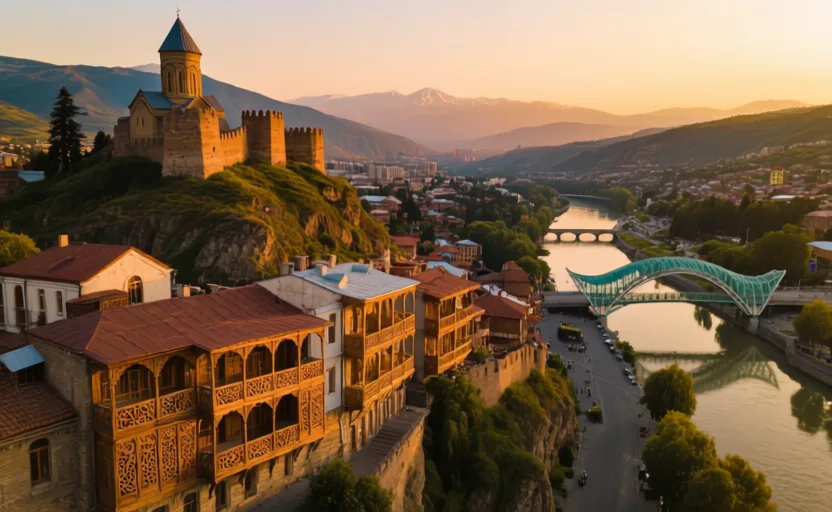 Tbilisi · AI city illustration · Artistic impression
City · Europe
Tbilisi
Also known as Tiflis, თბილისი
Saved in this browser — no account needed. Sign in later and it comes with you.
Where it is
The Kura, called the Mtkvari in Georgian, runs through a basin where the city lies between roughly 380 and 770 metres above sea level. Ridges close the basin on three sides: the Saguramo Range to the north, the Trialeti Range to the south and west, and the open Iori Plain to the east and south-east. On the right bank the slopes drop almost to the water, so building there is squeezed into dense pockets, while the left bank stretches out for more than 30 kilometres. The mountains put Tbilisi in a partial rain shadow, with about 630 to 670 millimetres of rain a year, a drier and more continental climate than Georgia’s Black Sea side.
The land and water around it
The Kura (Mtkvari)river
The river divides the city into a left bank, long and relatively open, and a right bank pushed up against the Trialeti foothills. The two sides have developed very differently as a result.
The sulphur springsclimate
Hot sulphur springs gave the city its name, which comes from an old Georgian word for warm. They are still used for public baths in the Abanotubani district.
The surrounding rangesmountains
The Saguramo and Trialeti ranges trap cloud in spring and autumn, and the Greater Caucasus to the north blocks cold air from Russia. The result is a milder winter than the latitude would suggest, with snow on only 15 to 25 days a year.
Its history, in short
Medieval chronicles credit King Vakhtang Gorgasali with founding the city in the 5th century, after his hunting bird fell into a hot spring. Archaeology shows people were here far earlier, and Vakhtang is better seen as someone who rebuilt it. Its position between Europe and Asia, near the Silk Road, made it a prize for Persians, Byzantines, Arabs and Seljuks. David IV took it in 1122 and made it the capital of a united kingdom, and under Queen Tamar it was a centre of literature, with a population that reached about 100,000. Khwarezmian, Mongol and later Safavid and Ottoman-era conquests followed, and very little survived the destruction of 1795, which is why most old buildings date from Russian rule. Annexation in 1801 brought a European-style grid and railways, and Tiflis became the seat of the viceroy of the Caucasus. The city was the capital of the independent republic of 1918 to 1921, then of Soviet Georgia, growing around new districts and a metro opened from 1966. Mass protests in 1956, 1978 and 1989 were part of its Soviet-era politics.
Timeline
Dates are shown on a timeline rather than as changing shapes on the map. The globe draws modern boundaries only, and tinting a modern outline to stand for a historical one would state something we cannot source.
Classical world
458, by tradition
Vakhtang’s city
Medieval Georgian chronicles date the founding of the city to the reign of King Vakhtang I Gorgasali. Archaeologists have found settlement from the 4th millennium BCE and a fortress built around 364, so Vakhtang is understood to have revived or rebuilt parts of an existing place.
DisputedWikipediaMedieval Georgian chronicles, set against modern archaeological findings
Post-classical world
1122
David IV makes it the capital
After the victory over the Seljuks at Didgori in 1121, David IV besieged and took the city, then moved his residence there from Kutaisi. This marks the start of Georgia’s Golden Age.
Well attestedWikipedia1226
Khwarezmian sack
Jalal al-Din’s Khwarezmian forces take the city and massacre tens of thousands of Christians, leaving its defences ruined. Georgia submits to Mongol domination in 1236.
Well attestedWikipedia
Early modern & oceanic
1795
The city is destroyed
Very few buildings survive the destruction of this year. Most historic buildings in the city today date from the Russian imperial period, 1801 to 1917.
Well attestedWikipedia
Industrial & imperial
1801
Russian rule and the Tiflis Governorate
After the annexation of Kartli-Kakheti, the city is known as Tiflis. Russian administrators lay out districts on a Western plan and build roads and railways to Batumi and Poti, and from 1846 it is the capital of the Tiflis Governorate.
Well attestedWikipedia26–28 May 1918
Three independence declarations
In the former palace of the viceroy, the national councils of Georgia, Armenia and Azerbaijan declare independence. Tbilisi is then capital of the Democratic Republic of Georgia until the Red Army enters on 25 February 1921.
17 August 1936
Tiflis becomes Tbilisi
The Soviet leadership changes the official Russian name to match the local form, and Georgian linguists modernise the old form Ṭpilisi to Tbilisi. Most languages then adopt the new name, though Turkish, Persian, Greek, Spanish and German keep forms of Tiflis.
Well attestedWikipedia
Places that carry meaning
AbanotubaniMedieval origins; rebuilt in the Russian period
The bathhouse district beside the springs that gave the city its name. It is one of the oldest quarters, along with Kala and Avlabari, and was largely rebuilt on its medieval street plan.
Metekhi5th century onward
A palace site where Vakhtang is said to have worked on the city, now marked with his statue. It is one of the places that archaeology suggests he rebuilt rather than founded.
Sololaki and Rustaveli Avenue19th century
Districts laid out under the Russian authorities on a European plan, with Beaux-Arts, Orientalist and revival styles. They give the centre a Western appearance, in contrast to the older neighbourhoods near the river.
Mtskheta3rd century BCE to the 5th century CE as capital
The ancient capital of the eastern kingdom, about 20 kilometres north-west of Tbilisi, where the Aragvi and Mtkvari meet. It stayed the country’s spiritual centre after the capital moved to Tbilisi, and the Georgian Orthodox Church is still headquartered there.
Languages here
Places are usually multilingual. This lists what is actually spoken, not one language per border.
GeorgianKartvelian family
The official language and the main language of the city.
About 85 per cent of the residents are ethnic Georgians. In 1978 the city saw mass demonstrations in defence of the Georgian language during Soviet rule.
ArmenianIndo-European family
The language of the city’s largest historic minority.
In 1918 Tbilisi had roughly as many Armenians as Georgians. Armenians remain one of the larger ethnic groups, and the Armenian Apostolic Church has a significant following.
RussianSlavic family
A language of the imperial and Soviet administration, still present among the city’s Russian community.
Russians were the third largest group in 1918. Nationally only about 1.4 per cent give it as their first language.
AzerbaijaniTurkic family
The language of the city’s Azerbaijani community.
Azerbaijanis are among the larger minority groups in a city of more than 100 ethnic groups. They are also the largest language minority in Georgia as a whole, at about 6.8 per cent.
Learn the language here
- 1Understand which languages are spoken hereTbilisi is multilingual. Start with which languages are used, by whom, and for what — the phrase list only covers one of them.Written by Globe Quest
- 2Learn 12 phrasesCurated everyday phrases for Tbilisi, with audio and a written form.Written by Globe Quest
- 3Say them out loudSpeaking practice with pronunciation feedback, one phrase at a time.Globe Quest material, your own additions
- 4Come back to themSpaced review, so what you learned this week is still there next month.Written by Globe Quest
Check yourself
What does the name Tbilisi come from?
An old Georgian word for warm, after the hot springs
Tpili meant warm, and the name marks the sulphur springs that are still used for public baths. The older form Tiflis was the Persian-influenced pronunciation used abroad until 1936.
Why are most historic buildings in Tbilisi from the 19th century?
The city was destroyed in 1795 and rebuilt under Russian rule
Very little survived 1795, so most surviving buildings date from 1801 to 1917, although the oldest quarters were rebuilt on their medieval street plans.
Worth arguing about
- The city has been captured, burnt and rebuilt many times, yet kept the same name and site. What makes a city outlast so many conquerors?
- Tbilisi’s centre has a European plan from the Russian period grafted onto a medieval river-town. Which tells you more about the city’s identity?
What we have not established
These are open questions, listed rather than filled in. We would rather show a gap than a plausible guess.
When was Tbilisi really founded?
Chronicles give the 5th century and Vakhtang Gorgasali, while excavations show earlier habitation, including a fortress around 364. The exact beginnings of a continuous urban settlement stay uncertain.
Sources
- Wikipedia · TbilisiWikipedia · encyclopedia · checked 2026-11-24
- Wikipedia · History of TbilisiWikipedia · encyclopedia · checked 2026-11-24
- Wikipedia · Georgia (country)Wikipedia · encyclopedia · checked 2026-11-24
- UNESCO · Historical Monuments of MtskhetaUNESCO World Heritage Centre · intergovernmental · checked 2026-11-24
Reviewed by Globe Quest editorial on 2026-11-24. Drafted with AI assistance and checked against the sources above before publication.