 Globe Quest
 Human Quest · LearningSign in
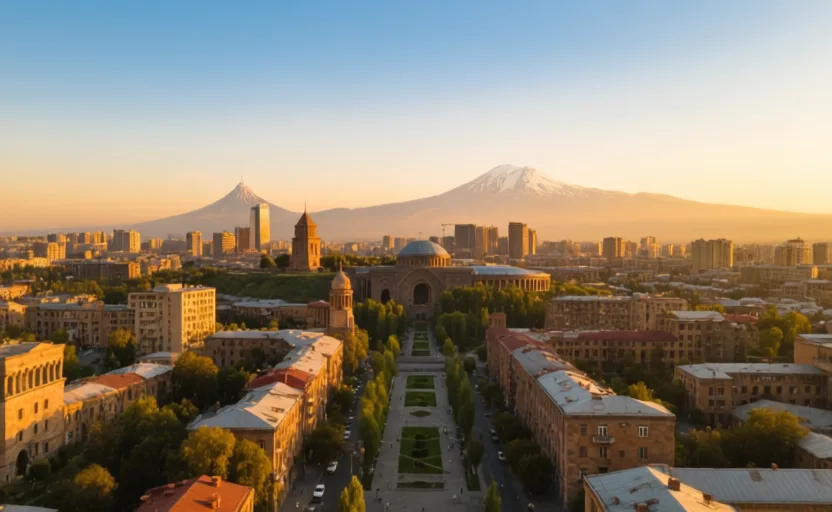 Yerevan · AI city illustration · Artistic impression
City · Europe
Yerevan
Saved in this browser — no account needed. Sign in later and it comes with you.
Where it is
Yerevan climbs from the bank of the Hrazdan River at about 865 metres to nearly 1,400 metres in the north-east, with an average height of 990 metres, which places it in the small group of the world’s fifty highest cities that exceed a million residents. The river cuts a canyon through the city, and mountains close the upper districts in on three sides. The Ararat Plain opens to the south-west. Because the city sits on a plain ringed by mountains, far from any sea, the climate is cold semi-arid: summers reach 40 °C, January can drop to −15 °C, and only about 318 mm of rain falls in a year.
The land and water around it
The Hrazdan canyoncanyon
The Hrazdan flows out of Lake Sevan and splits Yerevan in two through a gorge, with the upper city standing on the heights above it.
The Ararat Plainplain
The lowland that holds Yerevan at its north-eastern edge and several earlier Armenian capitals. Mount Ararat, now in Turkey, rises above it and is plainly visible from the country’s side.
A highland basinclimate
Yerevan’s steppe climate is a product of altitude and enclosure: mountains cut it off from moderating air from the seas, so summers are long and dry and winters cold and snowy.
Its history, in short
The city grew from a fortress, Erebuni, founded by the Urartian king Argishti I in 782 BCE at the western end of the Ararat Plain to guard against attacks from the north Caucasus. When later Armenian kings founded new capitals, Erebuni lost importance, and little is known of the town under Sasanian rule. Safavid Iran took the area in 1501–02 and made Yerevan the centre of a province, and for three centuries it stayed mostly under Iranian rule. The Safavid deportation of 1603–05 emptied it of most of its Armenians, and an earthquake in 1679 wrecked much of what remained. Russia took the city in 1827 and received it by treaty in 1828, and it was given the status of a city in 1879. It was still small, with about 30,000 people, at the start of the twentieth century. It became the capital in 1918, when survivors of the Armenian genocide arrived in the area, and then the capital of Soviet Armenia in 1920. Soviet planning, from Alexander Tamanian’s design, made it a modern industrial and cultural centre, and the city has been the capital of independent Armenia since 1991.
Timeline
Dates are shown on a timeline rather than as changing shapes on the map. The globe draws modern boundaries only, and tinting a modern outline to stand for a historical one would state something we cannot source.
First cities & states
c. 3200 BCE
Shengavit
The southern part of today’s city is settled during the Kura–Araxes culture of the early Bronze Age. Excavations at the site began in 1936.
Approximate dateWikipedia
Classical world
782 BCE
Erebuni founded
King Argishti I of Urartu orders a military fortress built on the site, to serve as a citadel against attacks from the north Caucasus. The city’s name is thought to descend from it.
Post-classical world
658 CE
Arab conquest
Yerevan is conquered in the Muslim conquest of Persia and falls within the Emirate of Armenia, whose centre is Dvin.
Well attestedWikipedia
Early modern & oceanic
Industrial & imperial
1827–1828
Russian rule
Russian troops under General Paskevich capture Yerevan on 1 October 1827, and Iran cedes it in 1828 after the Treaty of Turkmenchay. Armenians whose ancestors had been moved in the seventeenth century are repatriated.
Well attestedWikipedia1918
Capital of the First Republic
Yerevan becomes the capital of the First Republic as thousands of genocide survivors from the Ottoman lands reach the area. On 2 December 1920 it becomes the capital of Soviet Armenia.
Contemporary
21 September 1991
Capital of independent Armenia
The city becomes the capital of the independent Republic of Armenia after the dissolution of the Soviet Union. The monument to Lenin had been removed from Republic Square in April.
Well attestedWikipedia
Places that carry meaning
Erebuni Fortress782 BCE
The Urartian citadel on the hill of Arin Berd, regarded as the birthplace of the city. A cuneiform inscription records its founding.
Republic Square and the Cascade20th century
The centre of the modern city was developed mainly from Alexander Tamanian’s original design, later revised by Jim Torosyan. The Opera Theatre, opened in 1933, is among its landmarks.
Matenadaranopened 1959
A manuscript library that holds one of the largest collections of ancient books anywhere.
The Blue Mosque18th century
Once one of eight mosques in the city in the mid-nineteenth century, it was restored with money from Iran and reopened in the 1990s, and it is now the sole working mosque in the country.
Languages here
Places are usually multilingual. This lists what is actually spoken, not one language per border.
ArmenianIndo-European family
The only official language.
Armenian has its own alphabet, devised by Mesrop Mashtots, of 39 letters. The population of Yerevan is overwhelmingly Armenian.
RussianSlavic family
The main foreign language, a Soviet inheritance.
A 2013 survey found 95 per cent of Armenians had some knowledge of Russian, with older people generally speaking it well. A large part of the Russian minority left in the 1990s.
EnglishGermanic family
The second foreign language, widely wanted in schools.
About 40 per cent of Armenians said they knew some English in 2013, and half of adults thought it should be taught in public secondary schools.
Kurdish and Yezidi communities
A small minority presence.
Yerevan’s minorities have included Kurds, Russians and Iranians, with Yezidi and other small communities, though the Azerbaijani population left during the conflict over Nagorno-Karabakh.
Learn the language here
- 1Understand which languages are spoken hereYerevan is multilingual. Start with which languages are used, by whom, and for what — the phrase list only covers one of them.Written by Globe Quest
- 2Learn 11 phrasesCurated everyday phrases for Yerevan, with audio and a written form.Written by Globe Quest
- 3Say them out loudSpeaking practice with pronunciation feedback, one phrase at a time.Globe Quest material, your own additions
- 4Come back to themSpaced review, so what you learned this week is still there next month.Written by Globe Quest
Check yourself
Which Urartian king founded the fortress of Erebuni, from which Yerevan grew?
Argishti I
Argishti I founded Erebuni in 782 BCE as a citadel against attacks from the north Caucasus, and the name Yerevan is generally traced back to it.
What was the Great Surgun of 1603–05?
A Safavid forced deportation of hundreds of thousands of Armenians to Iran
The deportation depopulated Yerevan. The earthquake that wrecked it came later, in 1679.
Worth arguing about
- Yerevan was redesigned in the Soviet period around one master plan, and since 2000 older buildings have been replaced by high-rises. What should a capital keep, and who decides?
- In the 1990s Yerevan’s Azerbaijani and much of its Russian population left. How does a city remember communities that are no longer there?
Sources
- Wikipedia · YerevanWikipedia · encyclopedia · checked 2026-11-24
- Wikipedia · History of YerevanWikipedia · encyclopedia · checked 2026-11-24
- Wikipedia · ArmeniaWikipedia · encyclopedia · checked 2026-11-24
Reviewed by Globe Quest editorial on 2026-11-24. Drafted with AI assistance and checked against the sources above before publication.