 Globe Quest
 Human Quest · LearningSign in
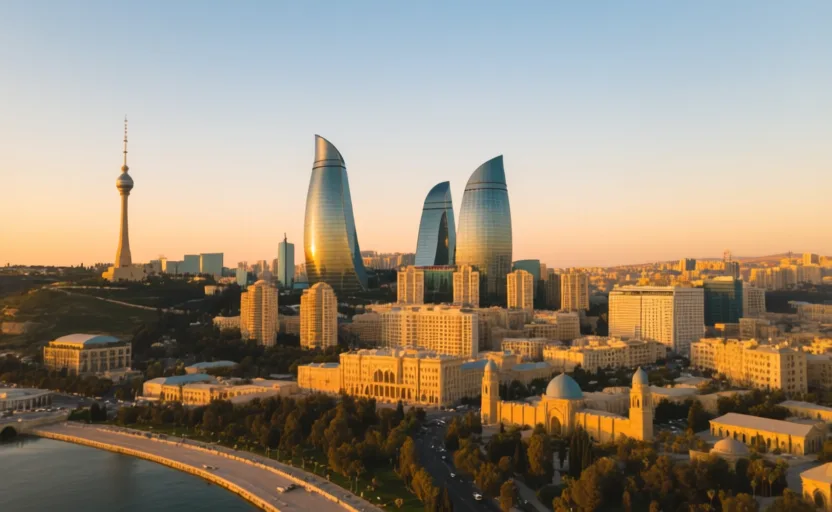 Baku · AI city illustration · Artistic impression
City · Europe
Baku
Also known as Bakı
Saved in this browser — no account needed. Sign in later and it comes with you.
Where it is
Baku curves round a bay on the southern shore of the Absheron Peninsula, a dry finger of land pushing into the western Caspian. The ground is about 28 metres below sea level, which makes it the lowest national capital on Earth. The Greater Caucasus throws a rain shadow over the peninsula, so annual rainfall is around 200 millimetres or less, while the wind never really stops: the cold northerly khazri and the warm southerly gilavar give the city its nickname. Mud volcanoes and salt lakes lie in the country just outside, and oil seeps from the same rocks.
The land and water around it
Absheron Peninsulapeninsula
A low, arid spit running east into the Caspian, with the Bay of Baku on its southern side. It is the driest part of Azerbaijan, shut off from Black Sea moisture by the Caucasus. The shelter of the bay is why a port stands here, and the oil that lies under the peninsula is why the port grew into a metropolis.
The Caspian shorelinesea
The Caspian has no tide, but its level has moved enough to matter. In the medieval period rising water repeatedly flooded part of the city, and the castle built on an island in the bay went under in the 14th century, a loss that fed local legends of drowned cities. Land reclaimed from the bay later became the modern waterfront.
Mud volcanoes and salt lakesvolcano
Around the city are mud volcanoes such as Lokbatan and salt lakes such as Boyukshor. They are surface signs of the gas and oil held in the rock below, the same resource that lit the fires worshipped in antiquity and that drove the 19th-century boom.
Its history, in short
Baku was a modest walled port for most of its life. Its earliest layers are prehistoric rock carvings, and later Zoroastrian fire-worship was linked to the flames that burned from the ground. In 1191 the Shirvanshahs moved their court here after an earthquake wrecked their capital at Shamakhi, and the fortifications and palace that define the old town date from the following centuries. Safavid, Russian, Ottoman and Persian rulers took the city in turn, and the Baku Khanate that emerged after 1747 was small and poor. Everything changed with oil. Russian authorities opened the oil-rich land to private bidders in 1872, investors such as the Nobel brothers arrived the next year, and by 1913 the population had reached 215,000, making Baku the largest city of the Caucasus. The twentieth century brought brief independence in 1918, Soviet rule from 1920, an oil field the Germans failed to reach in 1942, and, after 1991, a rebuilding of the waterfront on a scale the city had never seen.
Timeline
Dates are shown on a timeline rather than as changing shapes on the map. The globe draws modern boundaries only, and tinting a modern outline to stand for a historical one would state something we cannot source.
Post-classical world
1191
The Shirvanshah court moves to Baku
After a devastating earthquake at Shamakhi, capital of Shirvan, the court relocates to Baku, and a mint is set up. The following centuries see heavy fortification of the city and its surroundings.
Early modern & oceanic
1501–1540
Safavid conquest
Shah Ismail I besieges Baku in 1501 and breaches the walls; in 1538 Shah Tahmasp I ends the Shirvanshah dynasty, and Safavid troops recapture the city in 1540.
Well attestedWikipedia1723
Surrender to Peter the Great
After a long siege Baku surrenders to Russia. A treaty signed in 1735 returns the city to Iran, and in 1747 the semi-independent Baku Khanate forms after Nader Shah’s death.
Industrial & imperial
1872–1873
The oil boom begins
Russian imperial authorities auction parcels of oil-bearing land to private investors in 1872, and the Nobel brothers arrive in 1873. A belt of refineries known as Black Town grows beside the city within a decade. The first well had been drilled at Bibi-Heybat in 1846.
Well attestedWikipediaMarch 1918
The March Days
In the chaos after the Russian Revolution, fighting in Baku between the Bolshevik-led Baku Soviet with Dashnak forces and Azerbaijani armed groups leaves many Azerbaijani civilians dead. Estimates range from 3,000 to 12,000.
DisputedWikipediaAzerbaijani historiography, as summarised in the English-language encyclopedia article; the death toll and the roles of the parties are described differently by other accounts
28 April 1920
Red Army takes Baku
The 11th Red Army enters the city and ends the short-lived independent republic. Baku becomes capital of the Azerbaijan Soviet Socialist Republic and the main oil city of the Soviet Union.
Well attestedWikipedia1942
Operation Edelweiss
Capturing the Baku oil fields is a primary aim of the German offensive. The army stops some 530 kilometres to the north-west and is driven back by December.
Well attestedWikipedia
Places that carry meaning
Icherisheher, the walled Old City12th century onward
The inner city keeps much of its 12th-century defensive wall, and its lanes hold caravanserais, bath-houses and mosques from the medieval period alongside houses of the 18th to 20th centuries. It remains a residential quarter rather than a museum and was inscribed by UNESCO in 2000.
Maiden Tower12th century, possibly earlier
The oldest monument in the Old City and the symbol of Baku. UNESCO notes that some evidence points to construction as early as the 7th to 6th centuries BCE, while the surrounding wall is 12th century; the tower’s date is not settled.
UNESCO’s property description, which notes evidence for a much earlier origin than the medieval walls
Palace of the Shirvanshahs12th to 15th century
A court complex at the highest point of the Old City, including a reception hall, the ruler’s residential building, the family tomb, a mosque and a bath-house.
Ateshgah of Baku17th–18th century
A temple built by Indian traders who settled in the region while Baku was a commercial focal point; it served Hindu, Sikh and Parsi worshippers.
Languages here
Places are usually multilingual. This lists what is actually spoken, not one language per border.
AzerbaijaniTurkic family
The official language and the everyday speech of the city.
Around 96 per cent of Azerbaijan’s people speak it as a mother tongue. The vast majority of Baku’s residents are ethnic Azerbaijanis, a majority only since the 1970s.
RussianSlavic family
A legacy of imperial and Soviet rule, still spoken in the city.
Baku had large Russian, Armenian and Jewish communities until 1988. Russian remains the mother tongue of a small share of Azerbaijan’s population, and a Russian drama theatre still operates in the city.
Talysh and Lezgian
Minority languages of communities living in and around the capital.
Talysh and Lezgian speakers are named among Baku’s residents beside Russians, and both languages are among a dozen minority languages spoken natively in Azerbaijan.
Learn the language here
- 1Understand which languages are spoken hereBaku is multilingual. Start with which languages are used, by whom, and for what — the phrase list only covers one of them.Written by Globe Quest
- 2Learn 11 phrasesCurated everyday phrases for Baku, with audio and a written form.Written by Globe Quest
- 3Say them out loudSpeaking practice with pronunciation feedback, one phrase at a time.Globe Quest material, your own additions
- 4Come back to themSpaced review, so what you learned this week is still there next month.Written by Globe Quest
Check yourself
What is unusual about Baku’s elevation?
It is the lowest-lying national capital, about 28 metres below sea level
The Caspian is a closed sea whose surface is below the world ocean, so its shoreline cities sit below sea level. Baku is the largest city in the world at that level.
What turned Baku from a small walled port into the largest city of the Caucasus?
The auction of oil-bearing land in 1872 and the investment that followed
Oil had been known for centuries, but commercial exploitation after 1872 took the population from a few thousand to 215,000 by 1913.
Worth arguing about
- Baku’s identity has been rebuilt more than once, from Shirvanshah capital to oil boom town to Soviet industrial city to a glass-and-fountain waterfront. Which layers does a city choose to keep?
- The Maiden Tower’s age is still argued over. How should a heritage listing handle a monument whose date is unsettled?
What we have not established
These are open questions, listed rather than filled in. We would rather show a gap than a plausible guess.
How many people died in Baku in March 1918?
Accounts of the March Days differ on who fought whom and on the toll; the figures found range from 3,000 to 12,000, so no single total is given.
Sources
- Wikipedia · BakuWikipedia · encyclopedia · checked 2026-11-24
- Wikipedia · History of BakuWikipedia · encyclopedia · checked 2026-11-24
- Wikipedia · AzerbaijanWikipedia · encyclopedia · checked 2026-11-24
- UNESCO · Walled City of Baku with the Shirvanshah's Palace and Maiden TowerUNESCO World Heritage Centre · intergovernmental · checked 2026-11-24
Reviewed by Globe Quest editorial on 2026-11-24. Drafted with AI assistance and checked against the sources above before publication.