 Globe Quest
 Human Quest · LearningSign in
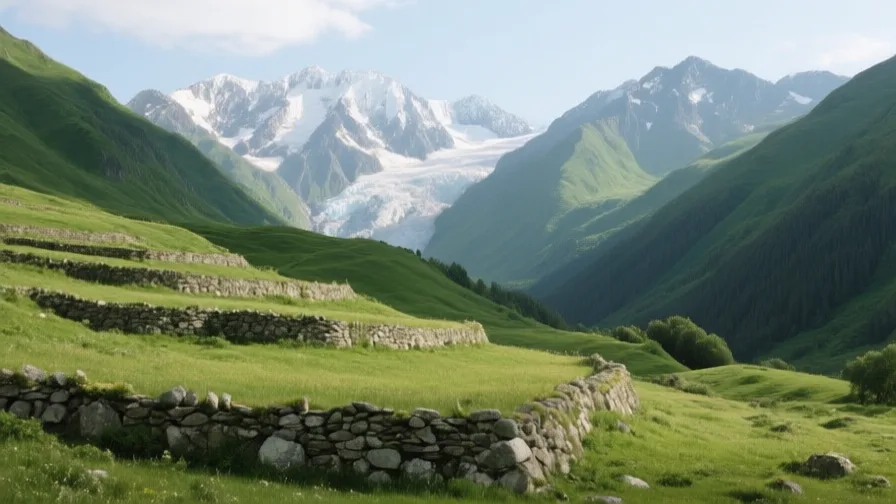 Georgia · AI landscape illustration · Artistic impression
Country · Europe
Georgia
Saved in this browser — no account needed. Sign in later and it comes with you.
Where it is
Georgia is a small mountain country on the eastern shore of the Black Sea, walled in by the Greater Caucasus along its northern border and the Lesser Caucasus to the south. The Likhi Range cuts across the middle and separates a wet western half, historically Colchis, from a drier eastern plateau, historically Iberia. The ranges do real climatic work: the Greater Caucasus holds back cold air from the north, and the Lesser Caucasus softens hot, dry air from the south. Within a short journey the land runs from humid subtropical lowlands and marsh forest to permanent snow and glaciers.
The land and water around it
The Greater Caucasusmountains
The range forms the northern frontier and shields the country from cold northern air. Only a few routes cross it into Russia, notably the Darial Gorge in Khevi and the Roki Tunnel linking Shida Kartli with North Ossetia, which is why control of these passes has mattered so much.
The Likhi Rangemountains
A lower ridge running across the centre of the country. It splits Georgia into a western half that drops toward the Black Sea and an eastern half of plateau and dry plain, and the two halves long carried different names and histories, Colchis and Iberia.
The Colchis lowlandplain
Low ground on the Black Sea side, once marsh forest and temperate rainforest. Most of that forest has gone to farming and urban growth over the past century, and what remains is mostly inside national parks and reserves such as the area around Lake Paliastomi.
Its history, in short
People have lived here for a very long time. The Dmanisi fossils, about 1.8 million years old, are the oldest hominin remains found in Eurasia, and the region is known for some of the earliest winemaking. In antiquity the west was the kingdom of Colchis, trading with Greek colonies on the Black Sea, while the east was Iberia. Iberia took up Christianity in the first half of the 4th century, and the Church became a lasting pillar of national identity. Persia, Byzantium and the Arabs all fought over the territory, and a unified kingdom peaked under David IV and his great-granddaughter Tamar. After 1466 it broke into three kingdoms and several principalities, and Ottoman and Iranian forces took the west and the east in turn. Looking for protection, the eastern rulers turned to Russia, which absorbed Kartli-Kakheti from 1801. Independence in May 1918 lasted until the Red Army arrived in February 1921. Georgia left the Soviet Union in April 1991, then lived through civil conflict and wars over Abkhazia and South Ossetia. After the Rose Revolution of 2003 it turned toward the EU and NATO, and the war with Russia in 2008 left parts of both regions in the hands of Russian-backed separatists.
Timeline
Dates are shown on a timeline rather than as changing shapes on the map. The globe draws modern boundaries only, and tinting a modern outline to stand for a historical one would state something we cannot source.
First cities & states
14th century BCE
A wealthy Colchis
Archaeology points to a prosperous kingdom in the west by this time, with an extensive trade network reaching Greek colonies such as Dioscurias and Phasis on the Black Sea shore.
Approximate dateWikipedia
Classical world
First half of the 4th century
Iberia adopts Christianity
After the missionary work of Saint Nino of Cappadocia, Christianity becomes the state religion of Iberia, the eastern part of today’s Georgia. The Church later gained autocephaly and became central to how Georgians define themselves.
Approximate dateWikipedia
Early modern & oceanic
1466
The kingdom falls apart
The medieval kingdom collapses into anarchy and splits into three separate kingdoms plus five principalities that were only partly independent. Larger neighbours exploit the weakness, and from the 16th century Ottoman and Iranian forces subdue the west and the east respectively.
Well attestedWikipedia
Industrial & imperial
1801
Absorbed by the Russian Empire
A proclamation of December 1800 and a decree of 8 January 1801 incorporate the eastern kingdom of Kartli-Kakheti into the Russian Empire, and the Bagrationi royal family is deported. Russia annexes the rest of Georgia gradually.
Well attestedWikipedia26 May 1918
Independence declared
After a short-lived Transcaucasian federation with Armenia and Azerbaijan, Georgia declares itself independent, under German protection.
Well attestedWikipediaFebruary 1921
The Red Army enters Tbilisi
The Georgian army is defeated, the Social Democratic government flees, and Georgia becomes a republic of what soon becomes the Soviet Union.
Well attestedWikipedia
Contemporary
April 1991
Secession from the USSR
A mass independence movement, which grew sharply after Soviet forces suppressed a peaceful demonstration in Tbilisi on 4–9 April 1989, ends in Georgia’s secession. The 1990s bring economic crisis, political instability and wars in Abkhazia and South Ossetia.
Well attestedWikipedia2008
The Russo-Georgian War
Fighting with Russia leaves parts of Abkhazia and South Ossetia under Russian-backed separatist control, and Russian military bases are set up there. Georgia describes the continuing Russian presence as occupation; the authorities in those regions and Russia take a different view of their status.
DisputedWikipediaGeorgian government; Russia and the separatist authorities in Abkhazia and South Ossetia
Places that carry meaning
DmanisiAbout 1.8 million years ago
The site of the oldest known hominin fossils in Eurasia, assigned to a subspecies of Homo erectus. It supports the picture of the Caucasus as a refuge through the Pleistocene, buffered by the mountains and the Black Sea.
Darial Gorge and the Roki TunnelHistoric routes; tunnel in modern times
The two main roads over the Greater Caucasus into Russian territory. They are the physical links between Georgia and the North Caucasus.
Pankisi GorgePresent day
Home to the Kists, a Sunni Muslim group described as a Chechen sub-ethnic group, in a country whose Muslims are otherwise Azerbaijani Shia in the south-east, Georgian Sunnis in Adjara, and Laz-speaking Sunnis and Meskhetian Turks near the Turkish border.
Languages here
Places are usually multilingual. This lists what is actually spoken, not one language per border.
GeorgianKartvelian family
The official language and mother tongue of about 85 per cent of people.
Georgian is not related to Indo-European, Turkic or Semitic languages, and belongs to the small Kartvelian family with no known relatives outside it. Its classical literature, associated with the poet Shota Rustaveli, had a revival in the 1800s. Abkhaz is co-official within the autonomous region of Abkhazia.
Mingrelian and SvanKartvelian family
Kartvelian relatives of Georgian, spoken in the west and the high mountains.
With Laz, they make up the rest of the Kartvelian family. The Kartvelian family is the most widespread language group in the country.
AzerbaijaniTurkic family
The largest minority language, at about 6.8 per cent.
Linked to the Azerbaijani Shia Muslims of the south-east, near the border with Azerbaijan.
ArmenianIndo-European family
Spoken by about 3.5 per cent of the population.
The Armenian Apostolic Church counts about 2.6 per cent of the country’s believers. Russian is the first language of a further 1.4 per cent.
Learn the language here
Check yourself
What does the Likhi Range do in Georgia’s geography?
It divides the country into western and eastern halves
The ridge separates the wetter west, historically Colchis, from the drier east plateau, historically Iberia, which is why the two parts developed different identities for so long.
Which language family does Georgian belong to?
Kartvelian
Georgian is the most widely spoken member of the Kartvelian family, alongside Svan, Mingrelian and Laz, and it is unrelated to any language family outside the Caucasus.
Worth arguing about
- Georgia was held by the Mongols, Ottomans, Iran and Russia in turn, yet kept its language, script and Church. What made those things so durable?
- Two of the country’s main road links to Russia run through mountain passes. How does a border you can only cross in a few places shape a country’s foreign policy?
What we have not established
These are open questions, listed rather than filled in. We would rather show a gap than a plausible guess.
How many people live in Georgia?
A census count of about 3.9 million exists for 2024, but the 2014 census found roughly 700,000 fewer people than estimates built on the earlier 2002 census had assumed, so population series before and after it do not line up.
Sources
- Wikipedia · Georgia (country)Wikipedia · encyclopedia · checked 2026-11-24
Reviewed by Globe Quest editorial on 2026-11-24. Drafted with AI assistance and checked against the sources above before publication.